
[1] And it came to pass, that in those days there went out a decree from Caesar Augustus, that the whole world should be enrolled. [2] This enrolling was first made by Cyrinus, the governor of Syria. [3] And all went to be enrolled, every one into his own city. [4] And Joseph also went up from Galilee, out of the city of Nazareth into Judea, to the city of David, which is called Bethlehem: because he was of the house and family of David, [5] To be enrolled with Mary his espoused wife, who was with child.
[6] And it came to pass, that when they were there, her days were accomplished, that she should be delivered. [7] And she brought forth her firstborn son, and wrapped him up in swaddling clothes, and laid him in a manger; because there was no room for them in the inn. [8] And there were in the same country shepherds watching, and keeping the night watches over their flock. [9] And behold an angel of the Lord stood by them, and the brightness of God shone round about them; and they feared with a great fear. [10] And the angel said to them: Fear not; for, behold, I bring you good tidings of great joy, that shall be to all the people:
[11] For, this day, is born to you a Saviour, who is Christ the Lord, in the city of David. [12] And this shall be a sign unto you. You shall find the infant wrapped in swaddling clothes, and laid in a manger. [13] And suddenly there was with the angel a multitude of the heavenly army, praising God, and saying: [14] Glory to God in the highest; and on earth peace to men of good will. [15] And it came to pass, after the angels departed from them into heaven, the shepherds said one to another: Let us go over to Bethlehem, and let us see this word that is come to pass, which the Lord hath shewed to us.
Luke: 2: 1-15
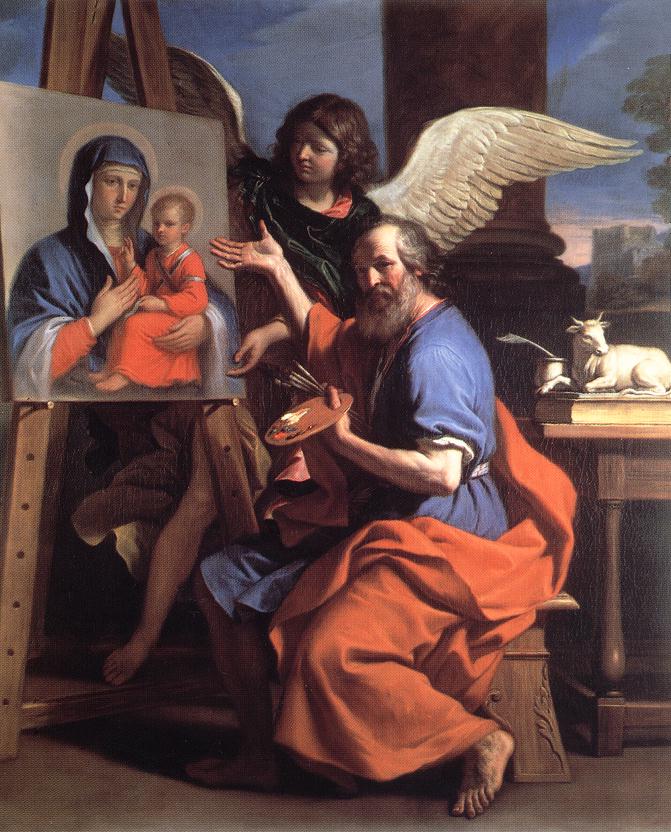
Continuing on with our look at Christmas saints this Advent, go here for the post on Saint Matthew, we turn to Saint Luke.
Probably a Greek, or a strongly Hellenized Jew, with Luke we have a well written Gospel and the following Acts, that bear many similarities to the techniques and styles of secular Greek historians. Twenty-seven percent of the New Testament is written by Luke. Saint Luke is good on geography and the titles of local officials. He was a man of his world, the Hellenic East of the Roman Empire, bringing news of Christ to the Greek speaking portion of the Mediterranean World. A physician, Saint Luke was obviously well educated and by his role of a companion of Saint Paul, he would have mixed with those who knew and spoke with Christ. Some writers have theorized that Saint Luke was one of the 70 disciples, which only his Gospel mentions. If so, Luke would have had first hand knowledge of Christ.
The nativity as depicted by Saint Luke was framed for Gentile audiences. Saint Luke is careful to give details as to when it occurred so that his readers would know that this was a historical event and not a Jewish version of the type of myths about gods that all Greeks were familiar with. All of his readers would have known who Caesar Augustus was and when he ruled. Luke skips the wise men, the Holy Innocents, the sojourn in Egypt, perhaps wishing to give a stream lined account to new Gentile converts, or perhaps not wishing to repeat what was contained in Saint Matthew’s account, if that Gospel was written first, and Luke had access to it. Some modern scholars assign a late date to the composition of Luke/Acts to 80-100. I find this unconvincing particularly since Acts ends prior to the execution of Saint Paul which would indicate a likely date of composition for Acts between 64-67.
The Gospel of Saint Luke’s Nativity, in its conciseness, works well in our sound bite age. (That is your cue Linus.)

