
https://www.youtube.com/watch?v=F7cNHz3z6zY
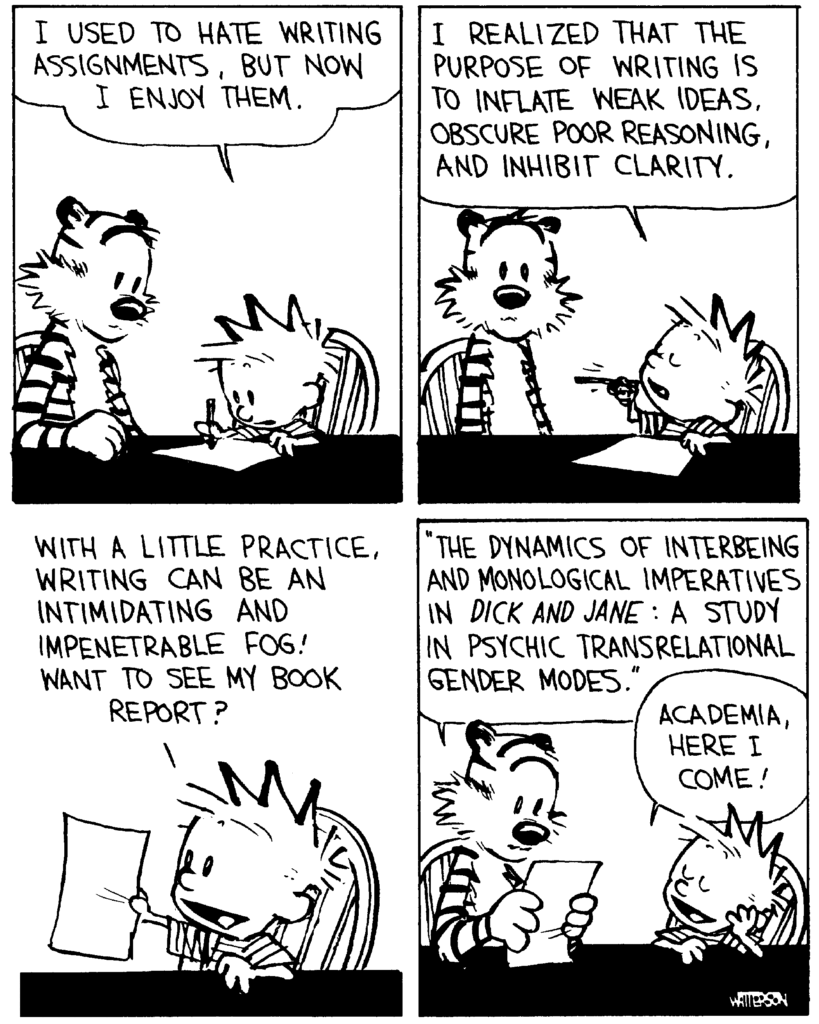
Outside of a few technical fields, a college degree is useful only as a certificate to an employer that a future employee can think, write and speak clearly, can comprehend complicated information and can deal with intelligent people as a peer. The degree is losing its value based on employers more and more learning that a college degree no longer guarantees any of this, as colleges concentrate on their core goals: satisfying their customers with easy classes and high grades without much work to interfere with partying, and indoctrinating customers in the latest of wokeness. In short, colleges have turned their backs on the job of education. (To be fair, most writing by academics these days is turgid politicized crap, so they may be simply incapable of passing on what they lack: the ability to think, write and speak clearly.)
Are some new grads hardworking and very bright? Of course, but they would likely have had those same characteristics if they had never been to college. Likewise, some people were dopes when they entered and are dopes with degrees when they leave. Who lack of a traditional college education hurts are those people in the middle, who would benefit from a good education and are greatly harmed by a poor one.
https://www.youtube.com/watch?v=S1s3C__3YIA
College used to be the pursuit of the rich and a few brilliant students with scholarships, with the hardworking men and women not going to college having alternative ways to enter professions as Abraham Lincoln did. We may be returning to that dispensation. I heartily recommend that we do so.


Agree completely, Don. My niece just graduated from high school in May and is now undergoing apprenticeship training as a carpenter. She will, in all likelihood, make more money and be much happier than her sister who is pursuing a degree and wants to become a probation officer. Good on her, we need P.O’s who are not just poorly paid SJW’s, but I question whether a degree in anything is necessary to be one.
Back in the days when the phone company was the phone company, they trained non-management employees from the ground up. While military or other applicable experience was always welcomed, it was never required. Unfortunately, like nearly all large employers, they also bought into the fiction that an undergraduate degree is necessary to succeed in the white collar ranks. They would have done much better simply to hire people who seemed capable and then train them for the job they would be assigned to do.
My youngest just chose to get an electrical degree. Because of his high scores on standardized tests, was hoping for an engineering degree but after these past 2 years I do not blame him one bit.
Outside of a few technical fields, a college degree is useful only as a certificate to an employer that a future employee can think, write and speak clearly, can comprehend complicated information and can deal with intelligent people as a peer.
People studying academics or the arts amount to about 1/3 of all undergraduates; about 40% of these are studying biology, computer science, economics, mathematics, chemistry, physics, geology, or statistics. One large problem is the padding of undergraduate education with distribution requirements. Allan Bloom thought two years of study in a discrete subject should be enough except for ‘the hardest of hard sciences’.
Most people obtain occupational degrees – business, teacher training, nursing, physical education and its variants, “criminal justice” &c. Occupational schools of a certain sort – teacher-training, social work, library administration – are properly shuttered for various reasons. The baccalaureate degree as preparatory for certain professional schools could be replaced with briefer certificate programs not exceeding (say) 70 credits.
Actually, the purpose of higher education is to provide employment for a certain sort of person. Labor-market signalling is a secondary purpose. Occupational training is a tertiary function. Actual liberal education is something you seldom see. Maybe St. John’s College, in a twee sort of way.
Engineering schools are comparatively over-subscribed at this time, in case anyone tells you we ‘need’ H1-Bs imported from China.
On the same vein, our local community college teaches a lot of remedial courses now. So, what they are teaching to more than half are basically their jr/sr year again. That fed money for college is spent teaching what they didn’t learn in HS. Let me give you an example; for those normal average intelligent kids they offer to enroll them in the community college for jr/sr year. When they graduate, they get a HS and 2year degree diploma- which that diploma means nothing now a days. Most of courses don’t transfer to 4 year college.
Well, as a former philosophy major with master’s degrees in history and theology, I must admit the job market is not a welcoming place, but I’ve managed to make a living the past forty-five years as a percher in a dyehouse, as a security guard, as quality control in a sports equipment factory, and eventually as an archivist and a translator. I’m debt-free, own my own home and am reasonably sure of a comfortable retirement. And even though my fields of study contributed almost nothing to my working life, my education was worth every penny because, as a philosophy professor once told me, the point of education is not a career or wealth, but a human life.
As for the prediction that print media will be dead in twenty years, that may seem believable to anyone who reads the New York Times, and who likely hasn’t cracked a book himself since junior high. The claim that “everything” will be available in digital format is just the sort of lie that makes books like 1984 seem like prophecy.
“And even though my fields of study contributed almost nothing to my working life, my education was worth every penny because, as a philosophy professor once told me, the point of education is not a career or wealth, but a human life.”
Completely agree R, with the caveat that independent reading can now do most of the job that colleges used to do. Our access to the best that Man has written is remarkably easy today, and it is melancholy to think of how few of us take advantage of this contemporary miracle.
I’ll see your “completely agree” and raise you an “indubitably”, Donald. Apart from the chapel, the only truly valuable buildings on a campus are the library and the dining halls, cafeterias or lounges, because the whole value of the place lies in access to otherwise inaccessible works and, if you’re lucky, the opportunity to meet people with similar intellectual interests