
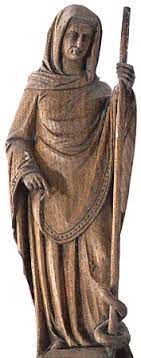
She was the daughter of Brychan Brycheiniog, King of Brycheiniog in South Wales, a man of many saintly children: by some accounts, twenty-four daughters besides sons. Keyne was his most distinguished child. Many noble lords sought her hand in marriage but, wishing to remain a virgin, she crossed the Severn to find a wooded solitary abode. She travelled south (possibly via Kentchurch in Herefordshire, although this may be named after her sister, St. Ceingar), and settled in a place where now stands the town of Keynsham on the Avon in Somerset. It is said, however, that she was warned by the local King that the area was swarming with serpents and neither man nor beast could inhabit it. St. Keyne, addressing herself to her heavenly spouse, obtained of him by the fervour of her prayer, that all this poisonous brood should be changed into stones perfectly resembling the winding of serpents. Today, these are considered to be the fossilized remains of ammonites. A similar miracle is sometimes recorded of St. Hilda.
After living an austere and saintly life in Keynsham for some years, St. Keyne made a pilgrimage to Dinsol which is traditionally said to be St. Michael’s Mount, but was probably St. Keyne, near St. Neots. She gave to the Cornish people here, a well which has the wonderful property of conferring the chief domestic authority on husband or wife, whichever first, after marriage, drinks of its waters.
Go here to read the rest.

