
Yonder are the Hessians! They were bought for seven pounds and ten pence a man. Are you worth more? Prove it!
General John Stark to his men prior to the Battle of Bennington
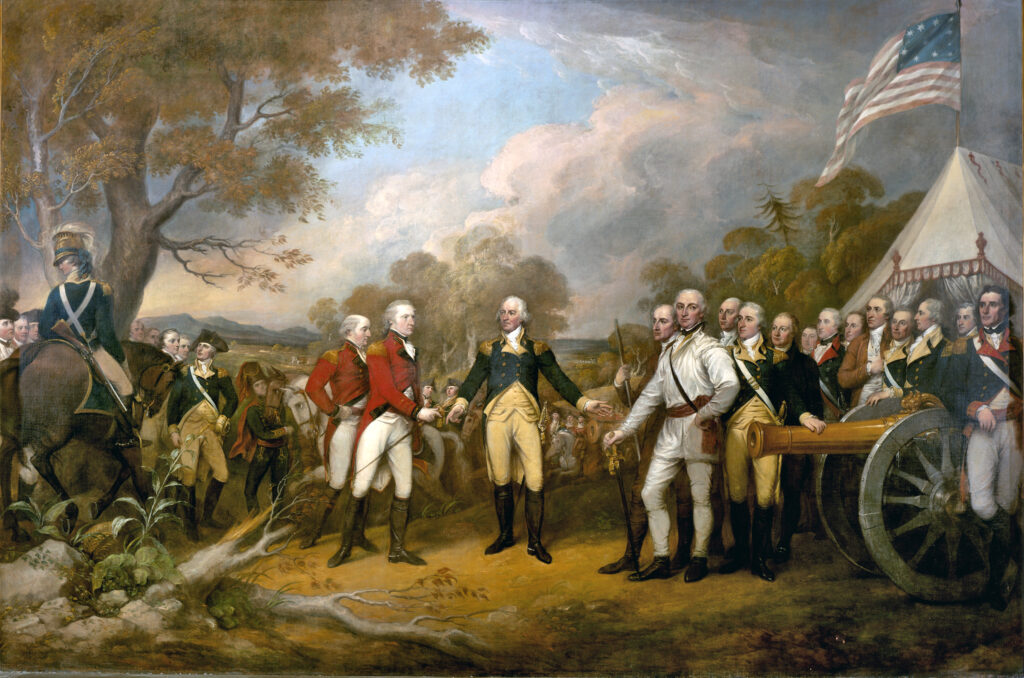
The Fate of John Burgoyne sung by Bobby Horton, turning his attention to the music of the Revolution rather than his usual stomping grounds, the Civil War. Two hundred and forty-four years ago the turning point of the American Revolution occurred with the surrender of his British army by Major General John “Gentleman Johnny” Burgoyne. A playwright and sometime member of Parliament, Burgoyne has gone down in history as something of a fop and an amateur incompetent soldier. This is unjust to him. Burgoyne was a career officer who took his duties seriously and his overall military record indicates above average ability combined with a streak of ruthlessness. However, his invasion of northern New York in 1777 with 7,000 troops from Canada was doomed by events largely out of his control.

Supposedly his invasion was to be coordinated with the efforts of General Howe commanding the main British army in New York. However, no orders were issued to Howe requiring such coordination and he embarked on a campaign against the American de facto capital of Philadelphia, leaving Burgoyne to fend for himself among the wilds of frontier northern New York.
His was a polyglot force, much of it ill-suited for frontier fighting. That was certainly the case with his Hessian mercenaries and British regulars. The Loyalists and Indians under his command were more suited for the area but brought their own problems including lack of discipline and a desire for loot and sometimes murder.
The campaign started well for Burgoyne and by July 6 he had taken the strategic fort of Ticonderoga, the gateway to northern New York. Then the campaign went south for him as Burgoyne’s army proceeded south. The first blow was that a column led by Lieutenant Colonel Barry St. Leger that was to cooperate with Burgoyne, became bogged down besieging Fort Stanwix in western New York. Patriot Tryon County militia under General Nicholas Herkimer fought a bloody battle against St. Leger’s Indian auxiliaries at Oriskany. Losses on both sides were devastating with General Herkimer being mortally wounded. Indian morale plummeted due to their losses. Patriot General Benedict Arnold caused St. Leger to break the siege and retreat by using loyalist Hans Yost to spread among the Indians the news that Arnold, actually leading a small force, was on his way to relieve Fort Stanwix with an army as numerous as the leaves of a forest. Without the support of his Indian allies, St. Leger had no choice but to retreat.
Burgoyne’s campaign suffered its worst single blow when Indians from Burgoyne’s army on July 27, 1777 murdered Jane McCrea, a young woman on her way to visit her sweetheart, ironically a Loyalist officer with Burgoyne’s army. News of her murder spread like wildfire and converted hordes of Loyalists to being Patriots overnight. Thousands of militia poured into the American army of the North, and across northern New York a common sign on cabins, farms and businesses read: “Gone to fight Burgoyne.”
On August 16, 1777, General John Stark, a veteran of Roger’s Rangers during the French and Indian War, New Hampshire militia, fought and won the battle of Bennington. His force, consisting of 1500 New Hampshire militia, more than 10 percent of the male population of New Hampshire over the age of 16, about 500 Massachusetts militia and 350 Green Mountain Boys from Vermont under Colonel Seth Warner, defeated a force of approximately 800 dismounted dragoons of the Brunswick Prinz Ludwig regiment, Canadians, Tories and Indians under Colonel Friedrich Baum, which had been sent out on a foraging expedition by General Burgoyne. The battle was hotly contested, and at the end the Americans had killed or captured all of Baum’s force, Baum being among the slain. At the end of the battle, the Americans fought a second fight against a reinforcing column of around 650 members of the Breymann Grenadiers, an elite force under the command of Lieutenant Colonel Heinrich Breymann, driving them off with casualties of about one-quarter of their force.
General Washington, while desperately needing every man against Howe’s force, did not neglect the North, and sent some of his elite units, including Colonel Daniel Morgan’s corps of riflemen, to bolster the northern army, now commanded in a lackluster fashion by Major General Horatio Gates.
Moving towards Albany, Burgoyne’s army and the American northern Army collided ten miles south of Saratoga. The American army was protected by field works, cunningly laid out by Polish patriot Colonel Kościuszko, the hero of two nations. Burgoyne attacked the left of the American army at the Battle of Freeman’s Farm on September 19, 1777, taking the farm but suffering a loss of 600 casualties, almost ten percent of his force.
Burgoyne now made the fatal mistake of holding his position in the completely mistaken hope that Howe and his army was on its way to his relief. Troops were on their way, American militia and continentals, who increased the size of the force confronting Burgoyne each day. By the time the battle of Bemis Heights on October 7, 1777 was initiated, Burgoyne, once again attacking the American left, was outnumbered three to one. Burgoyne was defeated, with Dan Morgan and Benedict Arnold being the heroes of the day, losing 900 men to 150 for the Americans. Ten days later Burgoyne surrendered his army, following his retreat to Saratoga, his troops marching out to lay down their arms while the American bands played “Yankee Doodle“. As earlier noted, Burgoyne enjoyed success as a playwright, but nothing his pen put to paper ever matched the drama now ending in which he had played a leading role.


‘In memory of
the “most brilliant soldier” of the
Continental Army
who was desperately wounded
on this spot the sally port of
BURGOYNES GREAT WESTERN REDOUBT
7th October, 1777
winning for his countrymen
the decisive battle of the
American Revolution
and for himself the rank of
Major General.’
– Inscription on the Boot Monument in Saratoga National Historical Park
https://en.wikipedia.org/wiki/Boot_Monument