
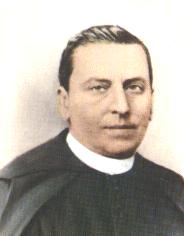
Blessed Giacomo Cusmano (15 March 1834 – 14 March 1888) was an Italian Roman Catholic priest and the founder of the “Congregatio Missionariorum Servorum Pauperum” which is also known as the “Boccone del Povero” (Morsel of the Poor). Cusmano also established the Sisters Servants of the Poor. He was beatified by Pope John Paul II on 30 October 1983.
His older sister was Vincenzina Cusmano, who joined his female religious order and was declared Venerable in May 2017, putting her on the path to beatification.
Giacomo Cusmano was born on 15 March 1834 in Palermo. He was the fourth of five children and his eldest sister was the Venerable Vincenzina Cusmano (6 January 1826 – 2 February 1894).
As a child and adolescent he attended the Jesuit “Collegio Massimo” in Palermo in the midst of anti-clerical civil strife in the 1848 Sicilian revolution. He undertook medical studies at the Collegio and in 1851 transferred to the school of medicine at the Royal University of Palermo. In 1852 his father died and he had familial responsibilities at the farms and estates in San Giuseppe Jato that the household ran. During this time he became aware of the plight of the poor peasants who worked under him during the time of the harvest. Most of those peasants were amazed that he “showed us courtesy, kindness, and even gratitude”. The peasants would further remark that “rather than commanding he would softly ask”. Often when coming from the countryside to the town he would surrender his horse to some poor farmer suffering the long trek on foot.
Despite these commitments he graduated in medicine with honors on 11 June 1855 at the age of 21.
After graduating he spent most of his time in the continuous care of the poor, not in Palermo, but in San Giuseppe Jato, where commitments multiplied. In 1859, at the outbreak of the second war of independence, the Resorgimento, the revolutionary Enrico Albanese, a friend of Garibaldi and his family doctor, approached Cusmano, with whom he had woven an excellent relationship throughout the years of study, and asked him to join them to fight in the revolution. Saddened by the plight of the poor of his town, whose misery was not diminished but rather increased dramatically after the riots of 1848, he declined and continued to minister to the poor of San Giuseppe Jato.
Go here to read the rest.

