
https://www.youtube.com/watch?v=bQUAo7mjs3Q
The Pilgrims and the Puritan
Were English to the bone
But didn’t like the English Church
And wished to have their own
And so, at last, they sailed away
To settle Massachusetts Bay.
And there they found New England rocks
And Indians with bows on
But didn’t mind them half as much
(Though they were nearly frozen)
As being harried, mocked and spurned in
Old England for the faith they burned in.
The stony fields, the cruel sea
They met with resolution
And so developed, finally,
An iron constitution
And, as a punishment for sinners,
Invented boiled New England dinners.
They worked and traded, fished and farmed
And made New England mighty
On codfish, conscience, self-respect
And smuggled aqua-vitae.
They hated fun. They hated fools.
They liked plain manners and good schools.
They fought and suffered, starved and died
For their own way of thinking
But people who had different views
They popped, as quick as winking,
Within the roomy local jail
Or whipped through town at the cart’s rail.
They didn’t care for Quakers but
They loathed gay cavaliers
And what they thought of clowns and plays
Would simply burn your ears
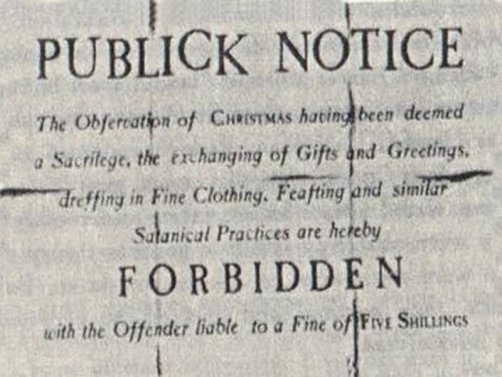
While merry tunes and Christmas revels
They deemed contraptions of the Devil’s.
But Sunday was a gala day
When, in their best attire,
They’d listen, with rejoicing hearts,
To sermons on Hell Fire,
Demons I’ve Met, Grim Satan’s Prey,
And other topics just as gay.
And so they lived and so they died,
A stern but hardy people,
And so their memory goes on
In school house, green and steeple,
In elms and turkeys and Thanksgiving
And much that still is very living.
For, every time we think, “Aha!”
I’m better than Bill Jinks,
So he must do just as I say
No matter what he thinks
Or else I’m going to whack him hard!”
The Puritan’s in our backyard.
But when we face a bitter task
With resolute defiance,
And cope with it, and never ask
To fight with less than giants
And win or lose, but seldom yell
– – Why, that’s the Puritan, as well.
Stephen Vincent Benet
The products of Calvinism, both the Pilgrims and the Puritans were revolutionary forces four centuries ago. Calvinism was one of the strongest challenges ever posed to the Church. In the Eighteenth Century the descendants of the Pilgrims and the Puritans remained revolutionaries, many of them, in the secular world, enough to help trigger the American Revolution, but their gloomy conception of God would tend to lead to Unitarianism in the Nineteenth Century and to Political Liberalism and Leftism as substitute religions in the 20th and 21rst centuries. John Calvin would be appalled. It is interesting that the most successful opponents to Calvinism, the Jesuits, now also embrace, most of them, Leftism as a substitute religion. Saint Ignatius Loyola would be appalled.


Good subject for more analysis and commentary. Vatican II is the Catholic version of Unitarianism it could be argued.
Don
A long time ago, I read an observation that the Enlightenment vision was the Reformation without a faith in Jesus, whatever else can be said about it faith in Jesus was the best part of the Reformation. In a broad sense this observation seems very reliable.
The current trends seem to be the Enlightenment without reason, a faith in reason being the best part of the Enlightenment being a faith in reason.
God have mercy!
King Charles is considered a saint in Anglican churches.
My father was born in MA in1913; could trace his descendance back to 1620 Mayflower. His family were Congregationalist church goers. A Sunday visit to one set of grandparents meant no radio, no games and no sports. Dad used to hide his hockey skates under a bush next to the frozen pond. His cousin outed him and that was the end of Sunday skating. Dad said that Christmas celebration was low key if at all. Even though he went to Mass and had us in Catholic school my father waited to convert to Catholicism until after his mother died. He was 55.
I saw the Puritanism in one cousin with her subtle remarks. However she softened when her eldest son married a Catholic. I was surprised when she showed me her granddaughter’s First Communion picture. People can change.
A long time ago, I read an observation that the Enlightenment vision was the Reformation without a faith in Jesus, whatever else can be said about it faith in Jesus was the best part of the Reformation. In a broad sense this observation seems very reliable.
The Reformation was a retrograde revolt against reason, the Catholic Church of course holding that there is no contradiction between Faith and Reason.
Today we see the dawning of the age of materialist magicians predicted by CS Lewis:
“I have great hopes that we shall learn in due time how to emotionalise and mythologise [human] science to such an extent that what is, in effect, belief in us, (though not under that name) will creep in while the human mind remains closed to belief in the Enemy. The ‘Life Force’, the worship of sex, and some aspects of Psychoanalysis, may here prove useful. If once we can produce our perfect work—the Materialist Magician, the man, not using, but veritably worshipping, what he vaguely calls ‘Forces’ while denying the existence of ‘spirits’—then the end of the war will be in sight.”
The Enlightenment was as filled with superstitions as any period in the history of mankind, with the superstitions often concealed beneath a thin wrapper of science talk. The current age reminds me of Hellenism in decline with science fading into obscurantism, religion descending into superstition and divine rulers taking the place of republics and democracies. If we are not stouthearted and successful in this century mankind could be entering a very dark period indeed.
The Reformation was a retrograde revolt against reason, the Catholic Church of course holding that there is no contradiction between Faith and Reason.
It was Catholic nominalists like William of Occam, and other proponents of the Via Moderna who, I think, paved the way for Luther and the other reformers. So the retrogression was already well underway before Luther made his fateful vow.