
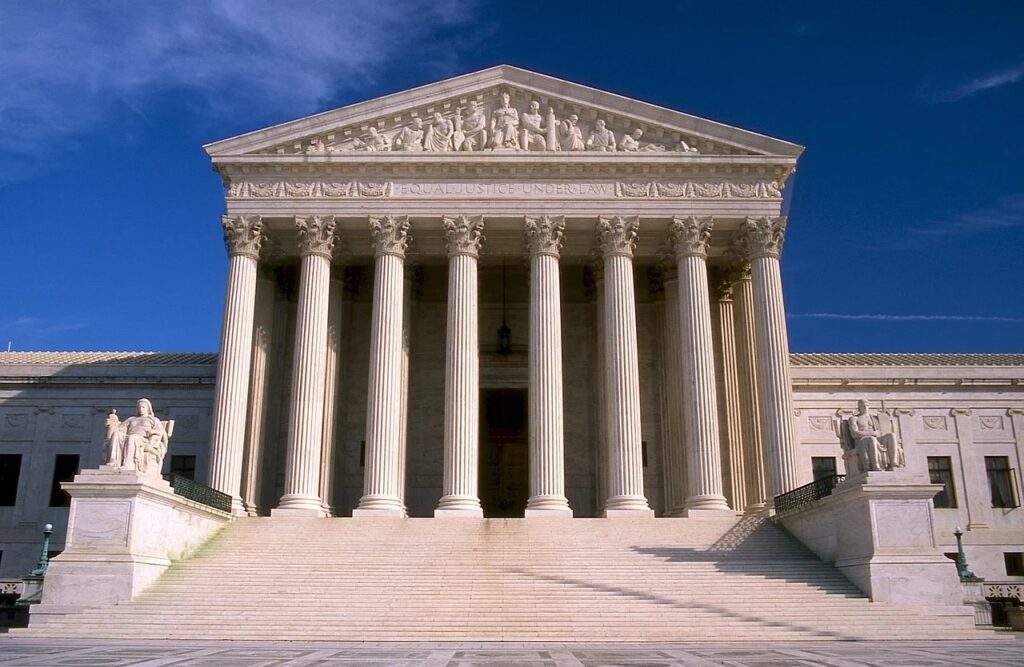
Our Founding Fathers were well aware of a government in which power was concentrated in one ruler or one small group. This is the type of government against which they had rebelled. To avoid this, they divided the power of the federal government into three branches – executive, legislative, and judicial. No branch had the power of the other two, nor could any branch legitimately exercise power it did not have. For example, the judicial branch cannot legislate. They also did not give the federal government all power – each state remained sovereign and powers not accorded to the federal government remained with the states, or the people.
The Founders also made it very clear and explicit in the text of the Constitution itself what powers were granted, what rights the people had, and what rights were to be constitutionally protected. They realized that changes to the Constitution would be far reaching and would affect every American citizen. So they explicitly required in the Constitution itself that three-fourths of the people agreed to any change – “constitutional amendment” – either directly or through their legally elected representatives.
It is clear that any right not listed explicitly in the Constitution was either not recognized by it, or that any such right was reserved to the people or to the states. The Founding Fathers did not say that they had hidden any rights in the words they wrote, rights to be discovered by judges in later generations.
The Constitution gives the judicial branch of government no power to create a new right. Such ultra vires (“beyond power”) assumption of power, for example by a court, was and is unconstitutional. No judge and no court has the power to create a new right. That would amount to amending the Constitution without meeting the required three-fourths majorities.
Dred Scott v. Sandford – Unconstitutional Amendment
Before the Civil War (1861-1865 A.D.) pro-slavers and enslavers trumpeted what they called ‘the law of the land,’ which was a ‘law’ to be accepted and followed by all good Americans. This ‘law,’ that was never passed by any legislature nor by the federal government, was based on the despicable United States Supreme Court decision, Dred Scott v. Sandford, (1857) which said, in essence, African-American human beings were property, not U.S. citizens. The court ruling applied to Mr. and Mrs. Scott as “property,” and also included the Scotts’ child who was unborn at the time of the initial filing of the first lawsuit.
The Supreme Court, acting as an illegal judicial legislature, ruled that the US Constitution did not include American citizenship for black people – wording that is not in the text of the Constitution. The Court enlarged on this judicial “amendment,” asserting that, regardless of whether the black people were enslaved or free, that the rights and privileges that the Constitution conferred upon American citizens (specifically referring, at page 60, to the right to keep and bear arms, the right to trial by jury, and the right to not be compelled to being a witness against themself) could not apply to black people.
Roe – Worse Than Scott
As bad as the Scott decision was, it is not the worst Supreme Court decision. The Roe v. Wade Supreme Court decision (1973 A.D.) is the most flawed, incorrect, questioned, criticized, rejected, dishonest, wicked, and condemned decision of the Court in all our history. Seven men said they had discovered a right, hidden in the words of the Constitution for almost two centuries, a right that went against the will of the majority of the people in America.
These flaws, errors, and the outright dishonesty of the seven men who rendered the Roe decision, each ironically with the status of ‘Justice,’ are discussed at length in numerous books and articles which have been published by constitutional law scholars, researchers, and writers since the decision was made and published. The books include, inter alia, Abuse of Discretion – The Inside Story of Roe v. Wade, by Clarke D. Forsythe, 2013.
Some of the articles which expose Roe as the fraud and chicanery it was are listed below. An internet search with terms like “Roe,” “overreach,” “unconstitutional,” “judicial legislating,” “errors,” and “supreme legislature” will reveal many further discussions of this subject.
The sheer baselessness of Roe makes it crystal clear why the abortionarians and the democrats fight any nomination to the Supreme Court not made by a democrat Party-Of-Death-And-Abortion president. They are fully aware that another Court, invoking their new and unconstitutional concept of court power, can overrule Roe; or worse.
Rights Here, Rights There & Everywhere
The democrats fear their own creation. They see that invoking the court’s unconstitutional right-creating power as validated by the democrats, nondemocrats could take over the Court and ‘find’ new rights that suit other political agendas.
For example, a ‘right’ hidden by the Founding Fathers could be discovered, e.g. in the shadows and penumbras of the Commerce Clause, and the asserted as “clear yet unstated implications” of the 1st, 4th, and 5th Amendments to the Constitution. A previously-hidden “right to safety” could be discovered, with only five “Justices” required for the visionary revelation, which constitutionally validates and empowers a new law that requires the federal government to buy a pistol, shotgun, and rifle for every U.S. citizen, with a monthly allotment from tax dollars for ammunition and gun safety classes, with government funded shooting training at government-owned gun ranges, along with government supplied liability insurance. “Gun History Month” could be proclaimed. Government supplied “Guns Matter” t-shirts could be given to all middle scho0olers. This ‘right to safety’ could be revealed to be so basic, so fundamental that there would be no ‘conscience’ exceptions that would allow any citizen to ‘opt out’ of gun ownership and marksmanship training.
In our time, since the Roe decision, democrats, marxists, and other totalitarians who would make abortion another judicially legislated ‘law of the land’ have realized that the truth undercuts their efforts to weave abortion into a bloody and bleeding part of our social fabric. They have also realized that in fostering and using a court like the Roe court, they have created a judiciary that can gut their godless, deadly, totalitarian plans.
They realize too well that their “law-of-the-land-legislating” court can overrule Roe. It is no wonder they want to halt efforts now to follow the Constitution in filling the seat of the justice who recently died. They shredded the Constitution long ago.
It seems they consider pointing out their consummate hypocrisy as a compliment.
[An earlier version of this article appears as an Appendix in the author’s book, A Key To Aunt Thommie’s Cabin Abortion Is Slavery.]
Further Sources
“The Wages of Cryng Wolf: A Comment on Roe V. Wade,” John Hart Ely, Yale Law Journal, 1973; https://digitalcommons.law.yale.edu/fss_papers/4112/.
“Roe v. Wade at 25: Still Illegitimate,” Michael W. McConnell, Updated Sept. 18, 2002 , Wall Street Journal, Sept. 18, 2002; https://www.wsj.com/articles/SB122704335139038479.
“Honest pro-choicers admit Roe v. Wade was a horrible decision,” Timothy P. Carney, Washington Examiner,| January 22, 2011; https://www.washingtonexaminer.com/honest-pro-choicers-admit-roe-v-wade-was-a-horrible-decision.
“Why Roe v. Wade is a travesty of constitutional law,” Rich Lowry, The New York Post, July 6, 2018; https://nypost.com/2018/07/06/why-roe-v-wade-is-a-travesty-of-constitutional-law/.
“Roe v. Wade a horrific overreach,” Rich Lowry, The Post and Courier, July 3, 2018; https://www.postandcourier.com/opinion/commentary/roe-v-wade-a-horrific-overreach/article_14cca854-7ef5-11e8-a8db-139bbef8db60.html.
“Understanding the Slavery-Abortion Analogy,” Justin Dyer, Dec. 13, 2013; https://www.thepublicdiscourse.com/2013/12/11683/.


People say if the Roe decision is overturned then the “question” of abortion would revert to the States. (Imagine if that same standard was applied to the question of slavery to this day?)
I don’t agree. All the Supreme Court or Congress need do is to “recognize” that human life begins at conception and is recognized as a person with all of the rights and protections as guaranteed by the Constitution. This recognition at the Federal level would supersede any state decreeing some people could be killed by other people.
Yes. The baby is a person. I remember asking a canon lawyer years ago if Catholic Canon law has anything to say about what is meant by “person” thinking that would help in life discussions. He didn’t seem to know.
Why can’t it be argued that Roe vs Wade is invalid because of improper jurisdiction? Roe vs Wade is properly a subject for government legislation not for decision by the Supreme Court.
Michael, I agree. It was a legislation from the bench decision. That Court attempted to define what is and isn’t a person. That is the legislatures job. That’s why I say Congress should define it. I also think, the Court could also just say that the previous decision was wrong, medically, scientifically and that the unborn should be recognized as having the same protections as anyone else.
And now, amazingly and unfortunately, we must have “person” include the newly born, who survive an abortion. God help us. Guy McClung
Lino Graglia pointed out about a generation ago that the three clauses of the 14th amendment – privileges and immunities, due process, and equal protection – can be understood as admonishments to the legislature, judiciary, and executive respectively. Which is to say that ‘equal protection’ is not a warrant to test a statutory law.
Actually, the conduct of the courts since 1937 should discredit the practice of judicial review tout court. Robert Bork was of the opinion that the culture of the bar was such that judicial review could no longer be reconciled with popular government.
Note how awful our law professoriate is. Three of the four professors who testified at the recent shampeachment hearings contended a banal conversation between the President and a foreign head of state was grounds to impeach the president. We have reason to believe the whole business was instigated by Alexander Vindman using Eric Ciaramella as a cut out, and that the DNI altered the rules to allow a complaint to be lodged by a non-witness. And Vindman’s essential complaint was that his commander-in-chief had policy ideas in conflict with ‘the Inter-Agency’. (Keep that in mind when a list of ‘national security officials’ – whose names the media won’t publish – tells you the president is a threat and that therefur we must have in office a man who will not appear before more than a few dozen people in events which are not publicized)
Michael Dowd –
That is exactly the argument the defending states made in Roe. Basically police powers rest exclusively with are to be exercised by state legislatures absent a constitutional warrant for federal legislation or a constitutional prohibition. The Supreme Court simply invented such a constitutional prohibition by discovering certain “penumbra” surrounding several of our Bill of Rights amendments.
I have engaged in online debates with people who really believe that judicial review (JR) is in the Constitution. When I copy and paste Article III into my reply and challenge them to find it, most simply disappear or resort to arguing that is “should” be there. Some try to equate JR with “the judicial power” which Article III does vest in the Supreme Court in the first instance. But that doesn’t work. It took John Marshall’s imagination to create it because he thought the country needed it. As Art points out, events have shown the contrary.
“it” should be there. Apology for poor proofreading.
Edited for clarity:
Michael Dowd –
That is exactly the argument the defending states made in Roe — that police powers rest exclusively with and are to be exercised by state legislatures absent a constitutional warrant for federal legislation or a constitutional prohibition. The Supreme Court simply invented such a constitutional prohibition by discovering certain “penumbra” surrounding several of our Bill of Rights amendments.
As Federalist No. 78 explicitly acknowledges judicial review is a necessary implication of our constitutional architecture. If there is a constitutional defect it is in the Framers’ belief that the judicial branch would be the least powerful of the three branches — also noted in Federalist No, 78 — and it is presumably for this reason that the constitutional checks against its misbehavior are so feeble and clumsy, at least as a practical matter. The Framers’ simply did not foresee the size and scope of contemporary American government and the consequential temptation of a politically-charged judicial activism. That said, politically-charged decisions from the federal bench are not new. Dred Scott is a classic example.