
Tristram Griffin: I was thinking about going with you.
Walter of Gurnie: To Cathay?
Tristram Griffin: Well, where’s that?
Walter of Gurnie: Well, it’s a long way from your forest.
Tristram Griffin: Well, maybe Sarah (his long bow) would like it there.
Walter of Gurnie: Now, don’t talk too lightly about it, Tris,. If we should go to such a place, the chances are all you’ll get out of it is that, in the end, you’ll be hung by a Mongol instead of a Norman.
Tristram Griffin: Well, if it comes to that, I’d sooner give the pleasure to somebody I don’t know than a Norman I hate.
Walter of Gurnie: A far land it is then. I guess this is the beginning.
From the screenplay The Black Rose (1950)
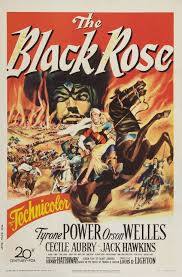
My bride and I came across the film The Black Rose (1950) on YouTube last night. It is a vast sprawling tale set at the beginning of the reign of Edward I, and stretching from England to far Cathy. It had been decades since I last saw it. A great entertainment from the tail end of the Golden Age of Hollywood, Tyrone Power; Jack Hawkins, Orson Welles and Michael Rennie give superb performances. Base upon the novel The Black Rose by Thomas B. Costain, the film has sadly relevant things to say about the persistence of love of country, even when your country is divided.
Norman and Saxon
A.D. 1100
"My son," said the Norman Baron, "I am dying, and you will
    be heir
To all the broad acres in England that William gave me for
    share
When he conquered the Saxon at Hastings, and a nice little
    handful it is.
But before you go over to rule it I want you to understand this:--

"The Saxon is not like us Normans. His manners are not so polite.
But he never means anything serious till he talks about justice
      right.
When he stands like an ox in the furrow--with his sullen set eyes
     on your own,
And grumbles, 'This isn't fair dealing,' my son, leave the Saxon
     alone.

"You can horsewhip your Gascony archers, or torture your
      Picardy spears;
But don't try that game on the Saxon; you'll have the whole
     brood round your ears.
From the richest old Thane in the county to the poorest chained
              serf in the field,
They'll be at you and on you like hornets, and, if you are wise,
                  you  will  yield.

"But first you must master their language, their dialect, proverbs
              and songs.
Don't trust any clerk to interpret when they come with the tale
              of their own wrongs.
Let them know that you know what they are saying; let them feel
               that you know what to say.
Yes, even when you want to go hunting, hear 'em out if it takes
                you all day.

They'll drink every hour of the daylight and poach every hour
     of the dark.
It's the sport not the rabbits they're after (we've plenty of game
     in the park).
Don't hang them or cut off their fingers. That's wasteful as well
     as unkind,
For a hard-bitten, South-country poacher makes the best man-
     at-arms you can find.

"Appear with your wife and the children at their weddings and
     funerals and feasts.
Be polite but not friendly to Bishops; be good to all poor parish
   priests.
Say 'we,' 'us' and 'ours' when you're talking, instead of 'you
    fellows'  and  'I.'
Don't ride over seeds; keep your temper; and never you tell 'em
     a lie!"


Big fan of Thomas Costain as a teen and young adult. He was a very prolific historical fiction writer. This post prompted me to pull out Cavalcade of the North, 1958 copyright. The volume is “An Entertaining Collection of Distinguished Writing By Canadian Authors with an Introduction by Thomas B. Costain Selected by George E. Nelson”. I probably bought it in some dusty used book store because I enjoy short story collections and this particular one featured six Vignettes of French Canada by Thomas B. Costain.
Hollywood’s adaption of the Black Rose is an entertaining film while the adaptation of Costain’s The Silver Chalice was very poor or as a critic put it, “not an imposing offering”.