


After teaching Religious Education to eighth grade confirmation students for nine years at our local parish, I’ve made a transition to teaching adults in our RCIA program. I found a notable difference between teaching teens that would mostly rather not be there, as compared to adults who really do!
In one session, some Marian doctrines not familiar to some candidates, and not explicitly found in the Bible, resulted in a wide-ranging discussion on what I like to call “the mother of all questions”…How can we know what’s true?
So we briefly covered the topics below and asked “How can we know what’s true about…
Science
The Scientific Method helps us to find truth about the physical world, but falls short when trying to answer the most important questions in life like: What does it mean to be human? What’s the best way to live? How can I have lasting happiness? Questions that science cannot answer need not be so broad. The next time you hear someone claim that women have a universal right to an abortion, ask “Can you tell me the name of the scientist that discovered that?”
Even science that is settled may no longer be settled in the light of new data. For example, suppose you and I see a cat running across the street. We agree that it was a cat and go forward with that premise. There is no doubt that we saw a cat; it’s an unquestioned fact. We later receive more data that informs us that it was actually a funny looking raccoon. This is not so different from replicable observations used in science. Once something is “proven” is the science settled forever? No; not if more data is found to question the previous thinking. Consider that Isaac Newton and centuries of Aristotelian logic held to the assertion that our universe and past time were infinite. Today many accept the premise that time/space had a starting point or Big Bang.1
History
How can we know what’s true about the past? Did the 30 Years War really happen? How do you know? Were you there? Or is this just what other people told?
In the scientific method a theory can be tested with experiments. The historical method can’t recreate the past, but one can still gather relevant data, such as a historian’s record of events, other public records and archaeological findings. From here the evidence is critiqued in light of the question being asked or subject being examined in terms of authenticity and integrity. A formal statement of the findings is then made based on the relevant data, and a key thing to understand is that the historian is not working toward an absolute statement about what definitely happened in the past, except for inconsequential points like the exact birthdate of George Washington. A historian, instead, works to present a theory that will explain the most data.
Justice
Consider our criminal justice system. Have you ever been a juror for a criminal trial? I have; it was quite a rigorous exercise in reason with a bunch of perfect strangers. Like history, no one can go back in time to see what really happened. The prosecution says one thing; the defense says another. Proving someone guilty beyond a reasonable doubt gets rather contentious when the jurors cannot agree on when the threshold for “reasonable doubt” has been achieved. It seems to me that when people try hard enough, they can always find a doubt that is reasonable…at least to them.
Morality
I’ve heard it said that children should be taught the difference between right and wrong. How can we know what that is? On one occasion a confirmation student of mine told a classmate “You gotta live your truth!” I respond that Osama bin Laden may have well said the same thing. In fact, could we not write “He Lived His Truth!” over the grave of every famous tyrant in history?
Without objective morality, ethics just boils down to the opinion of an individual or a group based on certain premises; and those premises may just as well be called opinions also. In such a situation, if a person, group or society were to say “murder is wrong”, all they are really saying is “I/we don’t like murder”. It could not be objectively wrong; nothing could be.
In Christianity (and other religions) we have things called moral law, natural law and divine law which are universal and unchangeable, much like physical laws (i.e. The Law of Gravity). And they exist outside the human mind as an outside system…moral laws from a moral law giver.
Religion(s)
Speaking of religion, there are so many! Surly there cannot be just one that is right. I think this is analogous to saying there is a horserace with 12 horses and each horse owner is completely convinced his horse will win, therefore, we must conclude that no single horse can win.
A lot of ink has spilled over the centuries on this topic, but consider the historical basis for any given religion and how it compares to Christianity growing out the Jewish tradition. Beyond this, there was no religious founder like Jesus. Jesus claimed to not only know the way the back to God, but to actually be “The Way” by making himself equal to God. Other religious figures like Buddha or Mohammad were not anticipated ahead of their birth and certainly did not make the radical claims or do the radical things that Jesus did. God went public in the person of Jesus through many public miracles and a public resurrection with many witnesses.
“Always remember that Jesus Christ, a descendant of King David, was raised from the dead. This is the Good News I preach.” (2 Tim 2:8)
Christianity
The whole point of this discussion was building-up to this…How can we know what’s true within Christianity? Where do we go? Where do we look? What should we do?
Many Christians will answer, “The Bible” meaning that all matters of Christian doctrine and practice should be based on the Bible alone. So we first discussed the idea of “contradiction”. Using the Bible alone is not found in the Bible, so we might say it’s “unbiblical”. Sort of like saying, “all statements are false”. If true, the statement must be false.
Next we talked about “interpretation”. All Christians will do or teach things not found in the Bible, so who do we listen to? Take the Trinity for example. Here is one Bible verse that seems to suggest that Jesus is not God. “If you loved me, you would rejoice that I am going to the Father; for the Father is greater than I.” (Jn 14:28) And could we not say the Holy Spirit is just an allegory for the power of God, and not a 3rd person?
How about the cannon of Scripture? The Bible does not attest to its own canon. Why not include the Gospel of Thomas, the Gospel of Mary, the Didache and the epistles of Barnabas as part of scripture. Who is to say and by what authority?
It’s different in Catholicism. There are three pillars to guide the Church to Truth: Sacred Scripture, Sacred Tradition and the Magisterium. Skeptics can disagree all they want, but at least Catholics avoid certain logic conundrums found in other denominations.
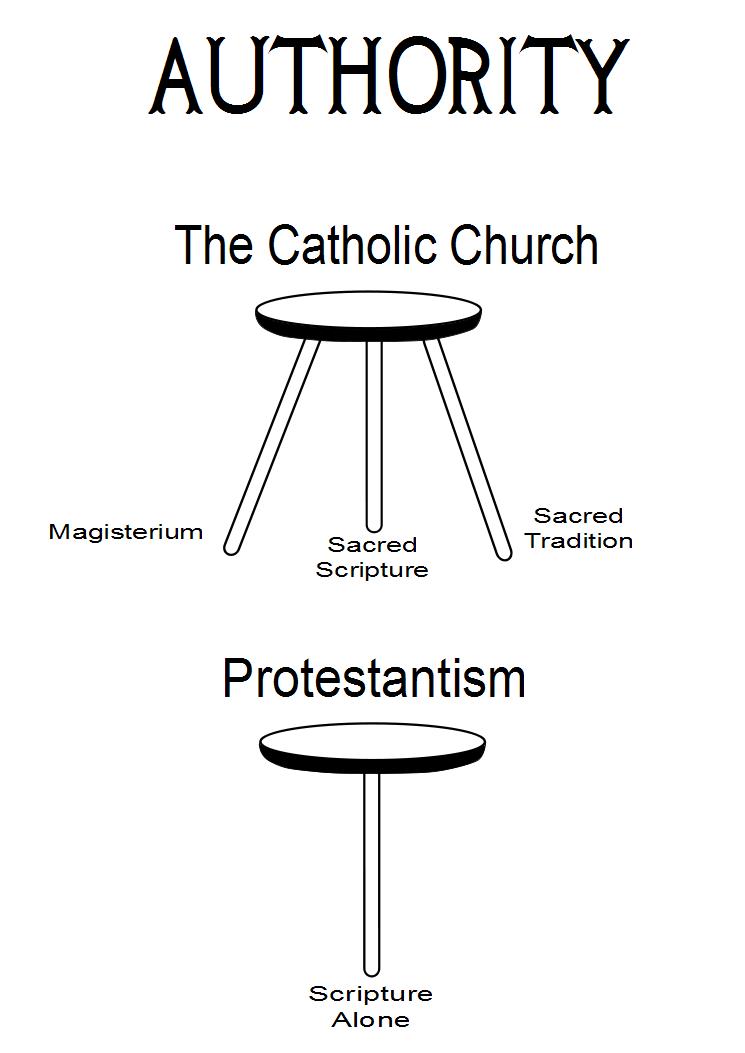
Sacred Scripture – The Bible is the inerrant word of God inspired by the Holy Spirit, but what good is an infallible book if no one can infallibly interpret it? Even the Bible tells us of the need for interpretation.
- “Philip ran up and heard him reading Isaiah the prophet and said, ‘Do you understand what you are reading?’ He replied, ‘How can I, unless someone instructs me?’” (Acts 8:30-31)
- “Ezra read clearly from the book of the law of God, interpreting it so that all could understand what was read.” (Ne 8:8)
Sacred Tradition – This is the teaching that the apostles & their successors passed on orally through their preaching. How can that be a bad thing? Some will point to this verse:
- You nullify the word of God in favor of your tradition that you have handed on. And you do many such things.” (Mk 7:13)
Catholics should respond with these two verses:
- “Therefore, brothers, stand firm and hold fast to the traditions that you were taught, either by an oral statement or by a letter of ours.” (2 Thes 2:15)
- “I praise you because you remember me in everything and hold fast to the traditions, just as I handed them on to you.” (1 Cor 11:2)
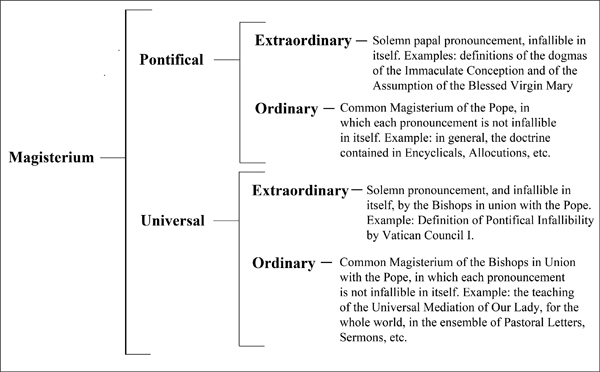
Magisterium – This is the teaching authority of the Church to give authentic interpretation of the Word of God, whether in its written form or in the form of Tradition. There is a bit of detail one could get into in terms of Pontifical Magisterium vs. Universal and Ordinary Magisterium vs. Extraordinary, but for the sake of brevity let’s just say that Christians need a “decision point” when they are so bold to ask the mother of all questions…How can we know what’s true?
“But if I should be delayed, you should know how to behave in the household of God, which is the church of the living God, the pillar and foundation of truth.” (1 Tim 3:15)
- Thomas E. Woods, How Catholic Church Built Western Civilization (Washington D.C: Regnery Publishing, Inc., 2005), p. 91


I too taught eighth grade for confirmation. I’ve come to realize that:
1. Parochial school (inadvertently) removed parents from being teachers. That is an essential piece of what is missing now. Bus loads of nuns are not on the horizon. There are people who by virtue of the Sacrament of marriage are teachers of children, they’re called Parents.
2. To be good teachers, parents must be educated. There is no chapter in the acts of the apostles that speaks of only teaching children.
3. An eighth grade education today is not enough. Catholic high schools were originally formed to get some Catholic children into college. Today, too often, they’ve become white upper middle class prep schools. This at a time when most Catholic children actually do go to college. The goal should be to keep high school children Catholic, Not get them into Ivy League schools.
4. With the loss of parochial schools there has been a loss of community. This needs to be replaced. And it can’t just be for children who can afford, or who receive, money to attend parochial school.
5. Humanae Vitae must be preached. You can’t on one hand say that the church is the voice of God and on the other say that you don’t really have to follow It.
6. Bureaucracies in Diocese’ (in my experience) impede all these steps. How can we work around these?
Wyatt Earp said his grandfather told him that one more reason for believing in God is the unfairness of life, that all will be evened up in His own good time. ‘The Equalizer’ episode from 1957 had encouragement from the Marshall and Deacon. “There’s some things the Good Lord will explain in due time. The Lord and T. Jefferson said all men are created equal, but it sure ain’t equal the way this world looks at them.” Then, he spoke about being big inside.
I have always believed Patricia that the balancing of the scales of justice is of great concern to God, as the story of Lazarus and the rich man indicates.
Yes, the stories in both the New Testament and Old Testament tell about that Concern, which brings the joy into the sorrow of Faith, Hope, and Charity.
“And for the support of this Declaration with a firm reliance on the protection of divine Providence, we mutually pledge to each other our Lives, our Fortunes and our sacred Honor” Ratified by every state and every constituent of every state: “We, the people…”.
As Captain Barbossa in the Curse of the Black Pearl said: “For too long we have not been able to eat, to enjoy a woman’s touch…”
Jesus Said: “I AM THE TRUTH, THE LIFE AND THE WAY.” If Jesus lied, Jesus would not be God, nor would mankind be saved.
Mary said: “I AM THE IMMACULATE CONCEPTION”. If Mary lied, Mary would not be the IMMACULATE CONCEPTION, nor would mankind be saved. Mankind is offered salvation. Let us partake of the goodness of God for His creatures.
One teacher once said: “There is my opinion, your opinion and the TRUTH.”
Atheists must ask God for the gift of Faith. To fail to do so does not empower the atheist to remove any sovereign person’s relationship with God in public and in private…being that all men are created equal by “their Creator” (Declaration) Thanks for reading
…because God “their Creator” (Declaration) creates all human souls. all rational, immortal human souls in original innocence. At the instance of procreation, the innocent soul is afflicted with the sins of the fathers, Adam and Eve’s original sin.
The Blessed Mother having full consent of her free will asked God to preserve her original innocence. God granted Mary’s petition. Mary was conceived in the IMMACULATE CONCEPTION.
The Sacraments of Baptism and Penance return a person, a sovereign person, to his original innocence. With a petition to God for the grace of remaining in innocence, mankind may be saved.