
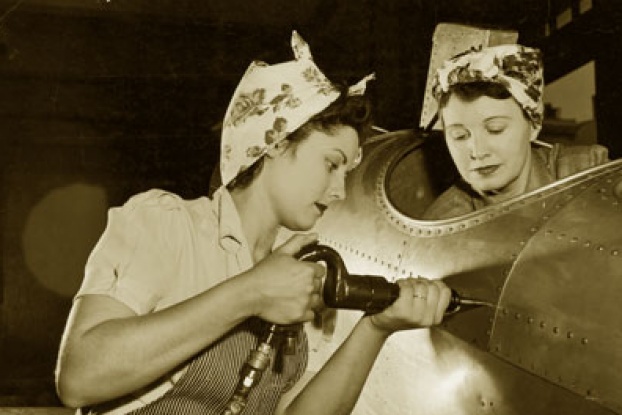
Something for a Labor Day weekend. Rosie the Riveteer. Written in 1942 the song celebrated the fact that with some sixteen million American men being called into military service, American women were going to have to pick up the slack if America was to win the battle of production, the decisive battle of World War II. Women, especially young women, were absolutely critical in this task. In 1944 1.7 million unmarried men were involved in war production, compared to 4.1 million women. The war of the factories was won for the US by middle aged married men, many of them World War I veterans, and young women, many of them daughters of the older men they labored beside. Below is a film, Women on the Warpath, made in 1943 by Ford honoring the women involved in assembling B-24 bombers at the Willow Run bomber plant in Ypsilanti, Michigan.


In Britain, women between 18 and 60 were made liable to “directed labour” under the National Service Act (No 2) 1941. In practice, only single women between 20 and 30 were called up.
It was only on 23 June 1941, as part of the war against fascism, that the Trades Union Congress withdrew its opposition to women in traditional male occupations and in firms with closed shops (compulsory union membership), even as volunteers. By mid-1943, 80% of married women and 90% of single women were engaged in the labour force.
Here’s a gov’t training film, “Supervising Women Workers”
http://www.theatlantic.com/national/archive/2011/02/supervising-women-workers-management-techniques-from-1944/71127/
My Nana operated a drop hammer at Convair.
Favorite factoid about Rosie the Riveter was that Norman Rockwell’s painting of the subject was modeled after Michelangelo’s Isaiah in the Sistine Chapel.
WWGD?
I’d imagine that she would go with the brownshirts if she was alive in Rosie’s day.
Now the Greta goes to Gaza.
Love this. If she is physically capable then why not? Dad used to take us kids to help him on job site in school holidays. Girl or boy, didn’t matter. As the young ones say today “It was a valuable core memory of my childhood”.
Rosie not only made the planes, Rosie also flew them.
Rosie, the Riveter, met a particular need at a particular time. Fine.
I would be much more impressed with women now if they focused more on either being mothers ..or being nuns. On being holy.
The whole idea of working mothers has induced “need” for several changes, some of them pretty lamentable. …However well-intended, daycare for children has not been the benefit it was portrayed to be.
Our republic will not last very long if our mothers and fathers do not spend energy on personally instilling values into our future citizens.
About a 1/4 of the formal sector workforce was female in 1930. In 1958, about 1/3 was female. Please note that in 1930 about 1/4 of the heads of households were earning some part of their living from agriculture, fishing, or forestry. Farm wives are diversely skilled and quite busy with productive activity.
==
Please note that the ratio of women to men in the working population has changed little since 1995.
==
In our own time, hardly any women work in heavy manufacturing, building trades, or extractive industries. Women are well-represented in service occupations which are an extension of domestic life e.g. dietary services, janitorial work, and junior grade nursing. As a rule, service occupations where you get your hands dirty are occupied by men. Women account for 4.5% of those in ‘Installation, Maintenance, and Repair Occupations”, 4,3% of those in “Construction and extractive occupations”, 6% of those in “Natural resources, construction, and maintenance occupations”
==
It has been public policy to expand the number of women working in public sector protective service occupations. This requires relaxing performance standards, which means weaker organizational effectiveness.
==
You see proportionately more women in formal sector employment because (1) farming is now the occupation of an odd minority, (2) the architecture of the family is more fragile than it once was and women hedge their bets, (3) the technology of domestic life allows tasks to be completed with less time and effort, and (4) being a working mother is not status lowering for women or their husbands, which it could be in 1955. Housekeeping standards have also declined (not necessarily a bad thing).
Oh my goodness Philip! Greta looks like she’s auditioning for the job of spokesmodel for Dutch Boy Paint!! 🤣
“(2) the architecture of the family is more fragile than it once was and women hedge their bets”
That’s a very optimistic way of stating it. For my experience, women have less interest in hedging their bets, more interest in being successful in careers, while still being mothers. Such intent has distinctly impacted everything from playground equipment to expectations about workplace benefits. ..Not for the better.