
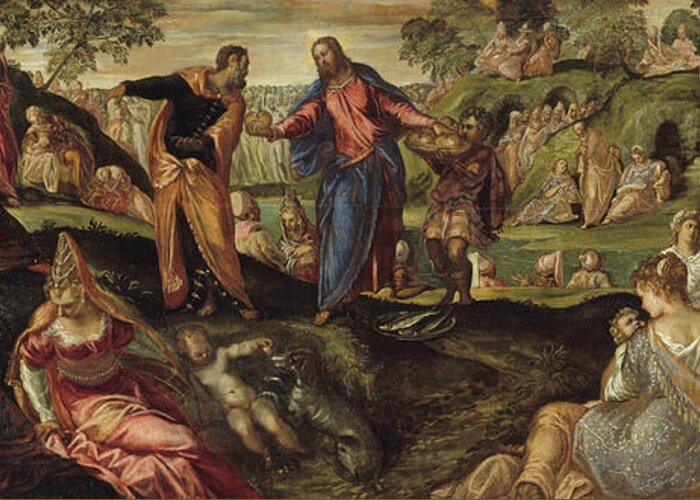
1 After these things Jesus went over the sea of Galilee, which is that of Tiberias. 2 And a great multitude followed him, because they saw the miracles which he did on them that were diseased. 3 Jesus therefore went up into a mountain, and there he sat with his disciples. 4 Now the pasch, the festival day of the Jews, was near at hand. 5 When Jesus therefore had lifted up his eyes, and seen that a very great multitude cometh to him, he said to Philip: Whence shall we buy bread, that these may eat?
6 And this he said to try him; for he himself knew what he would do. 7 Philip answered him: Two hundred pennyworth of bread is not sufficient for them, that every one may take a little. 8 One of his disciples, Andrew, the brother of Simon Peter, saith to him: 9 There is a boy here that hath five barley loaves, and two fishes; but what are these among so many? 10 Then Jesus said: Make the men sit down. Now there was much grass in the place. The men therefore sat down, in number about five thousand.
11 And Jesus took the loaves: and when he had given thanks, he distributed to them that were set down. In like manner also of the fishes, as much as they would. 12 And when they were filled, he said to his disciples: Gather up the fragments that remain, lest they be lost. 13 They gathered up therefore, and filled twelve baskets with the fragments of the five barley loaves, which remained over and above to them that had eaten. 14 Now those men, when they had seen what a miracle Jesus had done, said: This is of a truth the prophet, that is to come into the world. 15 Jesus therefore, when he knew that they would come to take him by force, and make him king, fled again into the mountain himself alone.
John 6: 1-15
Likely the best known of Christ’s miracles prior to the Crucifixion, due to the multitude who witnessed it and were fed. Other than the Resurrection, it is the only one Christ’s miracles to appear in all four Gospels.


“they had seen what a miracle Jesus had done, ” yet both Francis and Leo have both denied it was a “real” miracle, but was instead just a “miracle of sharing” for Jews to share.
Tertullian in his Against Marcion, Book 4, Chapter 21, makes an interesting connection between this miracle of Jesus and what he calls several precedents from the OT, namely, the manna in wilderness for 40 years, the multiplying of the oil by Elijah for the widow, and the multiplying of loaves by Elisha. He concludes that Peter would have known these accounts well and connected them readily to the Christ, which, in Luke’s account, prompts his confession of Christ following this miracle:
I was so encouraged by The Chosen’s depiction of the Feeding of the 5,000. Some revisionist theology depicts the miracle as Jesus encouraging everyone to share, that the food already existed. The Chosen doesn’t cop out.
A bit off-topic, but I hope next Good Friday Don will be able to use The Chosen’s Christ Before Pilate in his annual post.
I’ve always found the “sharing” angle of this miracle to be, IMO, mostly unserious, at least as far as the literal reading of the text, and seems to not take the text in its various accounts in the Gospels seriously. I don’t presume to judge anyone’s motivation for doing so, but I think there are some major problems embedded within the texts themselves which foreclose such an interpretation, unless it is perhaps meant as a latent moral principle to be derived from the actuality of the miracle of multiplication itself or a spiritual interpretation drawn from the literal meaning.
An example of this might be (off the top of my head) that Jesus wishes to share Himself with us in the Eucharist by means of the hands of His disciples (i.e., bishops and priests), and in the miraculous multiplication of the loaves we see a foreshadowing of how Christ is present in the Eucharist on the altars throughout all the world, etc. Such a theoretical application takes the miracle seriously but also can draw out a profound truth of God’s bounty and generosity towards us.
At any rate, here are some of the biggest problems with reading sharing as the literal meaning of the text.
(1. The Jews of Jesus’ time were not unaccustomed to their environment or to travelling. As the account in Luke indicates, the disciples, being of the same people, expected that the people had money to go and buy food, which indicates that (A. most hadn’t brought food (B. They had the means to procure it. The reason for A seems to be the fervor with which they wanted to hear His words; Mark says they ran on foot to get ahead of Him. So there was a mixture of excitement and lack of preparation, the latter of which actually dovetails into Jesus’ words to the disciples before He sends them out immediately prior to this miracle in Luke. The could have presumably gone and gotten food, but Jesus wanted them to stay so that the disciples could give them something to eat, which the disciples deemed impossible up until the moment of the miracle.
(2. The text just doesn’t give any indication that the means of distribution was sharing. The Synoptics says Jesus gave thanks, broke the loaves, gave them to the disciples and the disciples distributed them; John speaks of Jesus distributing them without mentioning the disciples, but it seems to be implied. Aside from the clear Eucharistic foreshadowing, in these accounts the miracle is accomplished in the act of blessing and distribution by Jesus through the disciples. That is, there is something about Jesus and His disciples specifically that accomplishes this miracle.
(3. It’s not all together clear to me that a theoretical “sharing” would need either an example or a miraculous prompting. The people hearing Jesus speak would very likely have had many family and extended family about. We can see this in Joseph and Mary not being concerned about the young Jesus’ whereabouts until after a good amount of time, since they assumed he would have been among the extended family whom they were travelling with, and thus expected that these same people could be trusted to care for Him if something occurred. Thus, if enough of the people all had food to share with everyone, it’s not clear to me that sharing would have been some extraordinary gesture; rather, this seems to be more of a projection of one’s own modern social and familial expectations (which I think says more about the modern presuppositions than anything…) After all, in Jesus’ teaching he speaks of doing good to those who hate you, for if you do good only to those who love you, you are no better than a pagan or a tex collector, who does the same thing that is being predicated of this miracle in terms of “sharing.”
(4. The psychology is all wrong. John specifically says that after this the crowd wanted to make Him king by force. But if the miracle was “sharing,” it’s not at all clear that this would prompt them to spontaneously make Him king. For what? Giving them an example of something they already do on a regular basis?
(5. The sign is all wrong. In John’s Gospel he says that when He performed this “sign” (signorum) they concluded that he was the Prophet to come. There are many instances of this prefigured in the OT, such as the manna in the wilderness, Elijah multiplying oil and Elisha multiplying bread. It was the multiplication itself that they seem to have seen as the sign, which is why they confused Jesus for Elijah or another prophet. Is there a “sharing” sign from the OT that would create this connection for them?
(6. The kind of power is wrong. In Mark’s Gospel immediately following this account the disciples are in the boat in the storm and see Jesus walking to them. He calms the storm and the waves subside and they are “amazed,” which is written as a rebuke, for Mark goes on to say that they didn’t understand about the loaves, for they were hard of heart. Now, if the miracle had been “sharing,” it is understandable that they would perhaps not recognize Jesus’ power over nature, since it’s not clear that the “sharing” is even miraculous. However, Mark links the storm’s subsiding with the “loaves,” which, it seems to me, means that they saw Jesus’ power over nature in multiplying the loaves but didn’t transfer that same power to Him in being able to calm a storm. That is, they didn’t yet fully understand Who He was, because their hearts were hard. It’s not clear to me, however, that this lack of understanding would justly incur a rebuke if the sign had been people sharing with each other; there’s no meaningful connection in “sharing” to the storm by means of power and dominion over nature, and thus Mark’s commentary about them not understanding about the loaves seems out of place.
(7. John says that the entire reason the crowd had followed Jesus to this place was because of Him healing diseases. This may partially explain also why many of them didn’t bring bread, in that they were in a frenzied hurry but probably also expected Him to do something like this. After all, the retort that the Jesus’ enemies make to Him later in John 6 is that Moses fed the the Israelites in the desert. If, as John says at the end of this account, they acclaimed Him as “the Prophet,” it’s not unrealistic to think that they may gave expected a miraculous feeding like Moses did in the desert. If so, Him doing so confirms to them that He is indeed the Prophet.
(8. Jesus’ “testing” of His disciples in asking them to give the people something to eat would be completely obliterated if the miracle was the people sharing with each other. His challenge to the disciples was for them to feed the people, and in the Synoptics they are the distributors of the bread which was blessed by Jesus, Who gives it to the people through them. It seems to me that the disciples, being men of the world and generally pretty practical in their thinking, would have suggested the people share with each other if they thought the crowds had enough food to share. Their problem isn’t with selfishness or an unwillingness to share, but rather with what they see as an utterly inadequate supply. For if the miracle was accomplished by the generosity of the crowds towards each other, what kind of test of faith is that?
As to JFK’s point, I’m not aware of either Pope Francis or Pope Leo denying the reality of a true miracle in the multiplication of the loaves.
It is true that the “sharing”aspect has been stressed by many commentators, and maybe sometimes it seems to the exclusion of the miraculous nature of the event. But I’d be very surprised to learn that our Popes have expressly denied the reality of the miraculous event.
Regarding Francis, I spent less than one minute finding these quotes. There are probably others.
“During his June 2, 2013 Angelus, he made the statement, “This is the miracle: rather than a multiplication it is a sharing, inspired by faith and prayer.” ”
“On August 3, 2014, he was once again accused of denying the miracle when he said, “It isn’t magic, it’s a ‘sign’: a sign that calls for faith in God, provident Father, who does not let us go without ‘our daily bread,’ if we know how to share it as brothers.””
Stating that it was a “miracle” for these people to share is telling.
Jason, your post is excellent— so much sensible, thoughtful explication on that miracle. I think too many of us have had to sit through homilies such as what JFK describes, wherein the supernatural dimension is shelved in favor of a more anodyne “gosh sharing is nice, Jesus wants us to be nice” explication. Again, thank you for that post.
@ John F Kennedy: Excellent illustration of an example of P Francis’ faithless rationalist/horizontalist interpretation of the Gospel miracle.
Sadly, having listened to many Jesuit sermons and read many Jesuit scriptural reflections, the denial of Jesus’ Sonship of God and of His infinite capacity for miraculous works and signs is a trademark of the New Jesuit Order.