
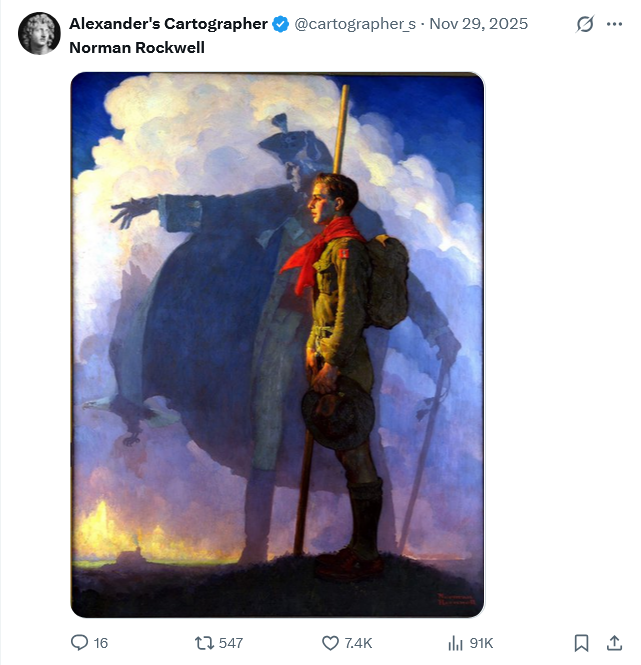
We at last have a film worthy of the Father of our country. The film follows Washington from young boyhood, under the mentorship of his half brother Lawrence Washington, to Commander of the Virginia regiment in the French and Indian War. His role in that war made him famous around the globe long before the American Revolution. The film centers on Washington’s activities in the Ohio country in a time when American settlement beyond the Appalachians was in its infancy.
Lord Thomas Fairfax, played with verve by Kelsey Grammer, employed Washington to survey his extensive holdings in the Ohio Country. The only British peer to reside in the 13 colonies, this was the beginning of a life long friendship between Fairfax and Washington which survived the American Revolution, despite the quiet loyalism of Fairfax. Washington extended his protection and Fairfax lived quietly on his estates in Virginia, dying at age 88 in December 1781, a few months after Washington’s crushing victory at Yorktown.
In his early experiences in what was then the West we see Washington and his frontier companion Christopher Gist coming into contact with the vastness of the West, the Indian tribes who inhabited it, and the French soldiers who sought to claim the Ohio country for New France. The cinematography is magnificent as we see an untamed wilderness through the eyes of Washington.
Washington is commissioned in 1753 by Lieutenant Governor Robert Dinwiddie, who in effect was the Governor of the colony of Virginia, to carry a message to the French at Fort Leboeuf advising them that this was British land and to leave. The French commander politely rejects this demand.
Dinwiddie responds by sending a force of Virginia militia out in the Spring of 1754 to blaze a road to the Monongahela River in what is now West Virginia and which flows into the Ohio River. Washington takes command when the original commander dies from his horse falling upon him. Washington leads his men in a victorious skirmish against the French. He then builds a fort in what is now southwestern Pennsylvania, just west of Laurel Pass through the Appalachians, and christens it Fort Necessity. The film points out that the site of the fort was poorly chosen by Washington, being susceptible to flooding and surrounded by thick forests that would provide cover to enemy snipers. Washington and his men were besieged by the French, Washington negotiating a surrender on July 4, 1754. Thus started the French and Indian War, known in Europe as the Seven Years War, with Washington having his first run in with fame as the militia officer who stated the vast global war.
The film continues on with the Braddock Expedition of 1755. General Edward Braddock, commander in chief of the British Army in America, led a 2100 man force of British regulars and colonial militia to take the French Fort Fort Duquesne, north of the Monongahela. Washington, now a Lieutenant Colonel of Virginia militia, served as a volunteer aid de camp to the General. Braddock’s force was ambushed on July 9, 1754 just after they had crossed the Monongahela. The British were decisively defeated with 900 casualties, half of them fatalities. Braddock was fatally shot off his horse. Washington was the hero the day, leading a rear guard which allowed the British force to retreat. The British would eventually take the ruins of Fort Duquesne in 1758, the French having destroyed it, assuming they could not defend against the 6000 man British force, a campaign in which Colonel Washington commanded the Virginia militia.
The film does an excellent job conveying the history, romanticizing it a bit along the way for dramatic purposes, but never mangling it.
Washington, ironically enough is portrayed by English actor William Franklyn-Miller, who at 22 does a superb job at bringing to life an ambitious, likeable George Washington, who chaffs at the fact that all colonials are thought of as less than British officers and officials. The supporting cast is superb, especially Mia Rodgers as the charming Sally Fairfax, Ben Kingsley as Lieutenant Governor Robert Dinwiddie and Andy Serkis as General Edward Braddock. All the actors and actresses involved in the film seemed to be bringing their A game for this film.
The musical score is good without being overwhelming.
The intent of the film is noble, in bringing to Americans, especially young Americans, a stirring account of the events that helped Washington have the experience to win a lop-sided war for independence. That it is also a very good film is icing on the cake. Highest recommendation.


His treatment of Lord Fairfax reflects an age when the enemy was an opponent to be fought, not always an unredeemable villain to be destroyed (as opposed to our opponents in WWII and the Cold War, who were commanded by genuine villains, as Russia now). Even George III respected Washington. He once asked the US ambassador what Washington intended to do after serving as president; and when told he intended to go back to his farm, the astonished king replied: “If he does that, he will be among the greatest men who ever lived.”
Agree totally with the review. It was excellent. Recommended.