
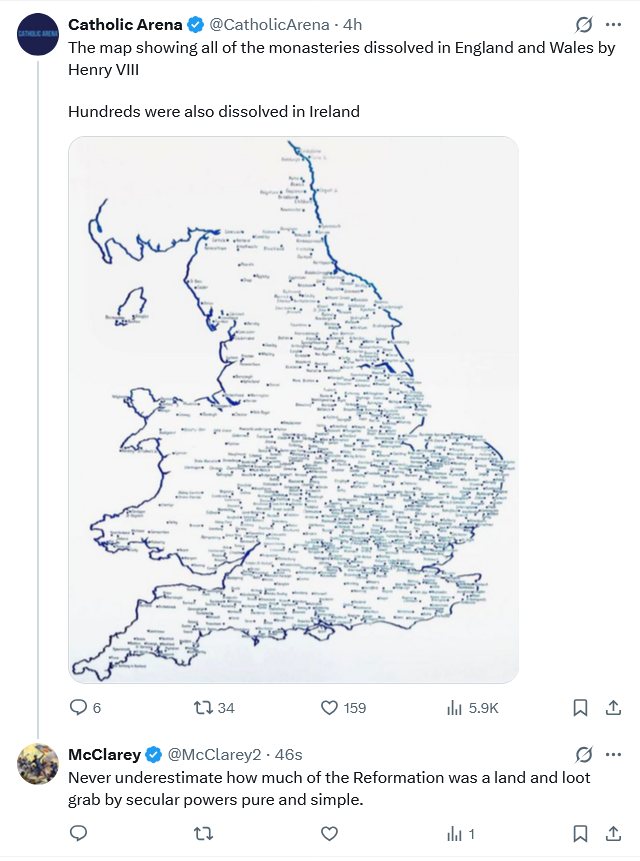
“Since the realm of England was first a realm was there never in it so great a robber and pillager of the Commonwealth read of nor heard of as is our king” (Thomas Hale, Priest executed in the reign of Henry VIII)
The Reformation greatly enhanced the power of the Caesars of the day, turning them into mini-popes in the areas they ruled. It set the example for the bloody tyrants who followed them in the lamentable annals of human crime and folly.


I have long been convinced that most of the “reformation” was driven by political ambition and pure envy of the properties held by religious orders. The alleged theology of Luther, Calvin, etc. was, IMO, largely if not entirely a cover story for their self-aggrandizement. Pride is always the sin that underlies most of the others.
Frank:
Not quite. No doubt that envy had existed for centuries, but it only erupted after 1500. Why? Even Belloc (who sometime defends even the indefensible in Catholic history) admitted that the reforms issued after Trent were two centuries too late. In many cases local folks were genuinely riled by the corruption of Rome and elsewhere. This varied by locality. In Scandinavia, the kings were clearly behind the Reformation to consolidate their power. My reading suggests that there was no support for the reformers in Norway or Iceland, for example. But in Scotland (where the crown remained Catholic and many monasteries had “lay abbots” for a century or more) the burghers and townsmen led the revolt, and that is manifest in their declarations and the structures of the Church of Scotland, in which an elected assembly and moderator (and not the king) ran things. Unlike their English counterparts, the Scottish Calvinists were “legitimists” and wanted a king (provided he was Protestant). They were also somewhat more tolerant of “local options”, so that if a distant laird or clan chief want to worship “the old way”, they were more likely to leave him alone than Henry, Elizabeth, or Oliver.
So greed was not the only issue.
Luther was financially supported by the aristocracy to a great extent. When they grew impatient, he dredged up the old stand-by of iconoclasm to rile up the illiterate mob. Many monks and nuns were murdered for the acquisition of land.