
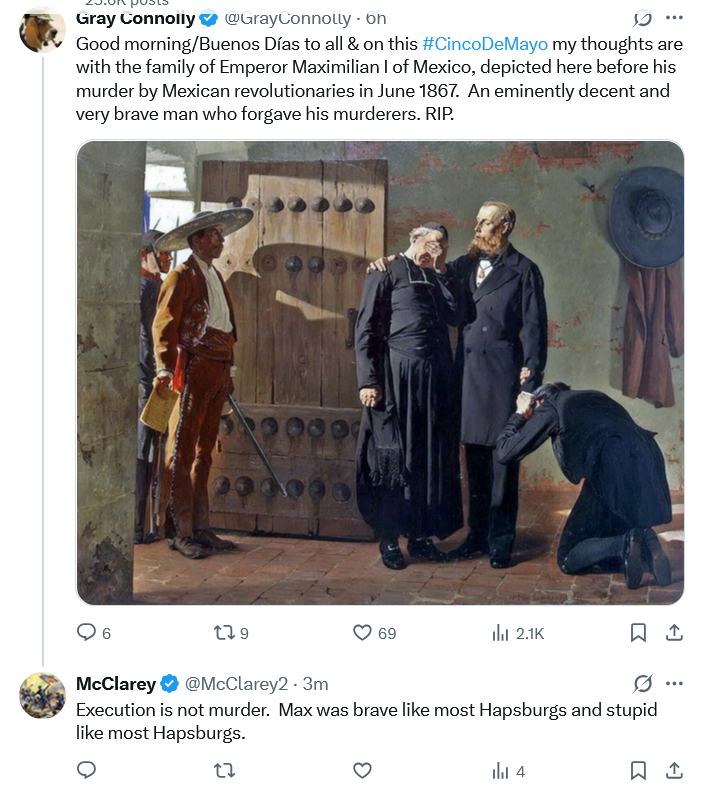
A Hapsburg should never trust a Bonaparte. Max was gulled into believing that the Mexican people wanted him by a popular plebiscite, rigged by the French. Once the French decided to give up their Mexican adventure, that was the time for Max to get out. Instead, he thought he had a duty to stay on his throne, ruling a people who, at best, were completely indifferent to him or, at worst, actively opposed to him. He had made laudable attempts to be a good ruler of Mexico, but without French military support his Potemkin empire collapsed in 1867, three months after the French troops left. Put on trial by the Mexican government under President Juarez, he was condemned to death. Max had offered to make Juarez his prime minister to bring peace to Mexico. Juarez respected Max, but resisted all calls for a commutation, reasoning that a stern lesson had to be taught that Mexico was no longer a subject for foreign conquest. Max was executed by firing squad on June 19, 1867. His last words, in Spanish, were: “I forgive everyone, and I ask everyone to forgive me. May my blood which is about to be spilled end the bloodshed which has been experienced in my new motherland. Long live Mexico! Long live its independence!” Most Mexican historians depict him as a well-meaning but tragic figure, the dupe of Napoleon III.


An execution can most certainly be murder. Especially in places like Mexico (or Jerusalem)
Murder is unlawful. Executions by a lawful authority cannot be murder in that sense. They may be unjust or quite a few other pejoratives, but not unlawful.
Fr. Miguel Agustin Pro was executed by the legitimate government of Mexico … A lawful authority.
However …
He was not given a fair trial. The government knew he was innocent (Luis Segura had already confessed and was in custody), but the President of Mexico wanted the spectacle of the public execution of a priest complete with a photographer and audience of cheering leftist elites.
I think few would shy away from calling his politically motivated execution murder.
Regardless of what one thinks of Mexican executions, they set the attitudes and actions of the governments for over a century. When the PRI came into power it solidified the nature of government in Mexico. When the people finally and enough and PAN started modern reforms, there was hope for a less authoritarian approach. Unfortunately it became an opportunity for the cartels who hold power in a number of areas. Note: Benito Juarez was quite the anti-Catholic church politico with confiscations of Church property and various restrictions on its activities. His treatment of Maximilian was essentially judicial murder even acknowledging traditional Hapsburg problems.
Fr. Miguel Agustin Pro was executed by the legitimate government of Mexico … A lawful authority.
True, but he was not given a trial as required by Mexican law at the time, as you noted. A government must obey its own laws in order for an action by it to be lawful. Emperor Maximilian was given a trial by military tribunal as was required under Mexican law. He had legal counsel and the trial was conducted in accord with Mexican legal procedure of the time.
A knowingly unjust execution is murder, morally speaking, regardless of legality.
“ Mexican lagers often incorporate corn as an adjunct, resulting in a lighter, crisper taste, while German lagers typically use barley and have a more robust flavor profile.”
– but, they’re both German.
David WS:
But they’re NOT both made in accordance with the Reinheitsgebot!
Whisky made in Scotland is made from Barley, water and yeast. Whisky made in New Scotland adds corn, making it sweeter. Not as sweet as Maple Syrup (Canada’s national beverage) but too close for comfort.
-These two whiskies are not both Scottish. Canadian whisky is only good for brining salmon.
CAG, we agree on Whiskey not being a real thing (with the exception of bourbon).
Only WhiSKY is real -and only Islay!
With Beer exceptions can be made, it’s about variety. Germans in Mexico had no six row barely only two row with harshness that needed to be softened with an adjunct like corn. Forgive able..
After all Hefeweizen (wheat beer) is allowed under the Reinheitsgebot (German Purity Law).
Seems odd using purity and German in the same sentence…
Ha!! 😀 I agree, the allowance of nonsense like wheat to be used in the modern purity law demonstrates how little use Germany has for tradition. I know correlation does not necessarily imply causation, but the original beer purity law was written in 1516 … Luther rebelled in 1517 … And today we have nonsense like the Synodal way and hefeweizen!
As an American of German descent, I can say that original standards were maintained in various places in the US by immigrant communities. In my family home of Warsaw Illinois, the community had an authentic brewery for over 5o years until the large breweries started shipping their product in. So much for original quality..