Vatican II was never popular among faithful Catholics who received the backhand of too many clergy for their loyalty to traditional Catholicism.
Donald R. McClarey
Cradle Catholic. Active in the pro-life movement since 1973. Father of three, one in Heaven, and happily married for 43 years. Small town lawyer and amateur historian. Former president of the board of directors of the local crisis pregnancy center for a decade.
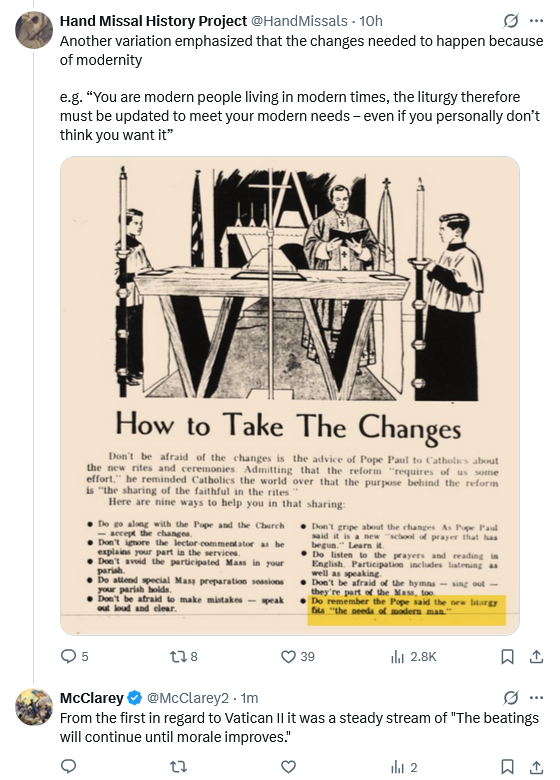
#9: Don’t be afraid of the hymns-sing out–they’re part of the Mass, too.
I almost always attend the TLM, but during the times I attend a NO mass, this is one of the more trying aspects of it. And I’ll admit, most of the hymns I do not sing. Not because I’m afraid, but rather because most of them within the OCP fare are so bad.
It seems like such an unforced error to me, because even people who are otherwise musically talented end up sounding awful when performing these songs, because most of the songs themselves are schmaltzy and banal, not to mention all the tied notes and syncopation make congregational participation nearly impossible. And it’s not like there isn’t an embarrassment of riches of really good vernacular hymns that are solid musically and theologically and written for congregational singing. I don’t understand why the dreck from the 70’s and 80’s persists.
The Bruised Optimist
Thursday, April 9, AD 2026 8:11am
Jason-
In my experience the drek from the 70s & 80s persists because the musical directors from the 70s & 80s persist.
No mandatory retirement or 6 year rotation for *them*
Art Deco
Thursday, April 9, AD 2026 9:29am
The thing which prevents the pastor / administrator from instructing the music director to modify the program is that he’s reflexively deferential to a certain demographic in the parish. The pastors own the messes over which they preside.
Clinton
Thursday, April 9, AD 2026 9:53am
Another reason why the dreck persists is that it’s under copyright, and represents a significant revenue stream. Parishes pay good money for the privilege of using that dreck. Older hymns and chant aren’t under copyright, and can be used without the need of paying fees— hence, they’re useless to certain parties.
It’s much the same with the scripture translations used. Douay-Rhiems is copyright-free, but the more recent translations used are not. And every parish pays for the privilege of using that copyrighted material.
Josh
Thursday, April 9, AD 2026 10:57am
In my little country parish, the Boomer demographic (and no disrespect to any of the wonderful people here of that generation) has an ironclad grip on *everything* – the worship, the music, who “gets” to do what, and so forth.
When I volunteered to do the narration for the Passion on Palm Sunday a couple of years ago, there was a huge uproar about the “younger folk not knowing their place and paying their dues.” The territoriality is astonishing to behold, and it is one of those unintended consequences of Vatican II.
Or maybe it *was* intended?
Greg Mockeridge
Thursday, April 9, AD 2026 1:28pm
Josh,
TLM parishes that I’ve been exposed to are no less cliquish than what you describe.
Jason
Thursday, April 9, AD 2026 5:19pm
At the time of publication, was that illustration aspirational of what was to come or more indicative of things at the time of the introduction of the NO? I’ve heard there was quite a bit of experimentation in the 50s and 60s, but I’m curious how widespread it was.
Penguins Fan
Thursday, April 9, AD 2026 9:34pm
Greg, my own TLM is cliquish. Some are deeply bothered by that. I am not.
Art Deco
Friday, April 10, AD 2026 8:01am
Not sure who the ‘boomer demographic’ is supposed to be. Size of annual birth cohorts increased from 1936 to 1957 and declined from 1957 to 1976. The youngest ‘boomers’ are now 68 years old (the median age of Stephen Colbert’s audience per published reports). Your parish is run by a geezer clique?
==
I was referring to the ‘Hallmark Channel” demographic, not the boomer demographic.
==
I knew a music director whose programs consisted of Oregon Catholic Press material played on an upright piano (with no one singing). Her enabler was the administrator of the parish. Both were born in 1932. Her obituary made her sound like quite the dynamo and she did produce six children in addition to two stints as a teacher and operating a small business. She wasn’t putting much effort into her position as music director. Important things in her life did not go well. She and her husband divorced, she had fewer grandchildren than children, and her obituary concluded with “there will be no services”. (Her estranged husband had died 16 years previous and hadn’t had any services either). The past
==
or enabler had died five years earlier; his family put in his obituary a menu of complaints he had about the Church refusing to end priestly celibacy, ordain women, and allow contraception. I’d once asked him what he thought of the wild variation in the number of seminarians per capita from one diocese to another; he hadn’t heard of it and could not have been more indifferent.
Pinky
Friday, April 10, AD 2026 1:45pm
The term “baby boom” typically refers to those born from 1946-1964. It was a big cohort, and they largely came of age during / immediately after Vatican II. They’ve been the largest earners and the majority of adults for decades. I don’t know if they’re overly influential in the Church, but they have a reputation for self-righteousness without self-reflection, which makes them stand out and not in a good way.
I don’t know who the “Hallmark demographic” is supposed to be.
Art Deco
Friday, April 10, AD 2026 4:17pm
The term “baby boom” typically refers to those born from 1946-1964. == That’s an arbitrary convention. == It was a big cohort,
==
Live births from 1926-45 were about 52 million; from 1946-64 about 76 million; from 1965-83, about 65 million; from 1984-2002 about 76 million; and from 2003-21 about 76 million.
== and they largely came of age during / immediately after Vatican II. == If by ‘immediately after’ you mean a decade later. == They’ve been the largest earners and the majority of adults for decades.
==
They’ve never been the majority of adults. Their earnings vis a vis the rest of the population might have peaked around about 2010.
== I don’t know if they’re overly influential in the Church, but they have a reputation for self-righteousness without self-reflection, which makes them stand out and not in a good way. == I think you’re talking about a modest segment of the bourgeois youth population ca. 1970. Most of them grew up. What distinguishes the cohorts in question (in comparison to those who came before) was a higher propensity to make use of divorce courts, a higher propensity toward street crime, and a higher propensity toward the use of street drugs, a higher propensity toward out-of-wedlock child bearing, a higher propensity to hire abortionists, a higher propensity to enroll in tertiary schooling, and a lower propensity for military service. You compare them to those who came after, and the picture is more mixed.
Art Deco
Friday, April 10, AD 2026 4:36pm
I don’t know who the “Hallmark demographic” is supposed to be. ==
Watch a selection of the made-for-television movies on the Hallmark Channel and ask yourself what sort of person would find the fare entertaining.
==
I’d never tuned in and saw one of their offerings about ten years ago. It starred the quondam juvie actress Kellie Martin. She, then 40, played a middle-aged widow who runs a catering business and has a pair of adolescent children. To be crass, her primary asset is that she’s kept her weight down. She has a minor car accident which disrupts the fulfillment of a service contract. The other driver is a 46 year old bachelor whose occupation is unknown to her. She’s abrasive and unappealing to him. She’s abrasive and unappealing the next time she crosses paths with him too. He’s unaccountably smitten with her and her children. It turns out he’s a superlatively wealthy businessman who could just never find the right girl. Now he’s found her in the form of an irritable middle-aged woman with a pair of adolescent children. They marry and he finances her dream, opening a small bakery. All through this, she keeps getting funny messages of one sort or another on her cell phone; it appears, at the end, that they are from her deceased husband telling her to ‘follow her heart’. (The filler is the conversation she has with her gal pals).
==
Another fine example: a Netflix offering called Happiness for Beginners. I looked up the available biographical data on the scriptwriters. Big f***ing surprise.



I almost always attend the TLM, but during the times I attend a NO mass, this is one of the more trying aspects of it. And I’ll admit, most of the hymns I do not sing. Not because I’m afraid, but rather because most of them within the OCP fare are so bad.
It seems like such an unforced error to me, because even people who are otherwise musically talented end up sounding awful when performing these songs, because most of the songs themselves are schmaltzy and banal, not to mention all the tied notes and syncopation make congregational participation nearly impossible. And it’s not like there isn’t an embarrassment of riches of really good vernacular hymns that are solid musically and theologically and written for congregational singing. I don’t understand why the dreck from the 70’s and 80’s persists.
Jason-
In my experience the drek from the 70s & 80s persists because the musical directors from the 70s & 80s persist.
No mandatory retirement or 6 year rotation for *them*
The thing which prevents the pastor / administrator from instructing the music director to modify the program is that he’s reflexively deferential to a certain demographic in the parish. The pastors own the messes over which they preside.
Another reason why the dreck persists is that it’s under copyright, and represents a significant revenue stream. Parishes pay good money for the privilege of using that dreck. Older hymns and chant aren’t under copyright, and can be used without the need of paying fees— hence, they’re useless to certain parties.
It’s much the same with the scripture translations used. Douay-Rhiems is copyright-free, but the more recent translations used are not. And every parish pays for the privilege of using that copyrighted material.
In my little country parish, the Boomer demographic (and no disrespect to any of the wonderful people here of that generation) has an ironclad grip on *everything* – the worship, the music, who “gets” to do what, and so forth.
When I volunteered to do the narration for the Passion on Palm Sunday a couple of years ago, there was a huge uproar about the “younger folk not knowing their place and paying their dues.” The territoriality is astonishing to behold, and it is one of those unintended consequences of Vatican II.
Or maybe it *was* intended?
Josh,
TLM parishes that I’ve been exposed to are no less cliquish than what you describe.
At the time of publication, was that illustration aspirational of what was to come or more indicative of things at the time of the introduction of the NO? I’ve heard there was quite a bit of experimentation in the 50s and 60s, but I’m curious how widespread it was.
Greg, my own TLM is cliquish. Some are deeply bothered by that. I am not.
Not sure who the ‘boomer demographic’ is supposed to be. Size of annual birth cohorts increased from 1936 to 1957 and declined from 1957 to 1976. The youngest ‘boomers’ are now 68 years old (the median age of Stephen Colbert’s audience per published reports). Your parish is run by a geezer clique?
==
I was referring to the ‘Hallmark Channel” demographic, not the boomer demographic.
==
I knew a music director whose programs consisted of Oregon Catholic Press material played on an upright piano (with no one singing). Her enabler was the administrator of the parish. Both were born in 1932. Her obituary made her sound like quite the dynamo and she did produce six children in addition to two stints as a teacher and operating a small business. She wasn’t putting much effort into her position as music director. Important things in her life did not go well. She and her husband divorced, she had fewer grandchildren than children, and her obituary concluded with “there will be no services”. (Her estranged husband had died 16 years previous and hadn’t had any services either). The past
==
or enabler had died five years earlier; his family put in his obituary a menu of complaints he had about the Church refusing to end priestly celibacy, ordain women, and allow contraception. I’d once asked him what he thought of the wild variation in the number of seminarians per capita from one diocese to another; he hadn’t heard of it and could not have been more indifferent.
The term “baby boom” typically refers to those born from 1946-1964. It was a big cohort, and they largely came of age during / immediately after Vatican II. They’ve been the largest earners and the majority of adults for decades. I don’t know if they’re overly influential in the Church, but they have a reputation for self-righteousness without self-reflection, which makes them stand out and not in a good way.
I don’t know who the “Hallmark demographic” is supposed to be.
The term “baby boom” typically refers to those born from 1946-1964.
==
That’s an arbitrary convention.
==
It was a big cohort,
==
Live births from 1926-45 were about 52 million; from 1946-64 about 76 million; from 1965-83, about 65 million; from 1984-2002 about 76 million; and from 2003-21 about 76 million.
==
and they largely came of age during / immediately after Vatican II.
==
If by ‘immediately after’ you mean a decade later.
==
They’ve been the largest earners and the majority of adults for decades.
==
They’ve never been the majority of adults. Their earnings vis a vis the rest of the population might have peaked around about 2010.
==
I don’t know if they’re overly influential in the Church, but they have a reputation for self-righteousness without self-reflection, which makes them stand out and not in a good way.
==
I think you’re talking about a modest segment of the bourgeois youth population ca. 1970. Most of them grew up. What distinguishes the cohorts in question (in comparison to those who came before) was a higher propensity to make use of divorce courts, a higher propensity toward street crime, and a higher propensity toward the use of street drugs, a higher propensity toward out-of-wedlock child bearing, a higher propensity to hire abortionists, a higher propensity to enroll in tertiary schooling, and a lower propensity for military service. You compare them to those who came after, and the picture is more mixed.
I don’t know who the “Hallmark demographic” is supposed to be.
==
Watch a selection of the made-for-television movies on the Hallmark Channel and ask yourself what sort of person would find the fare entertaining.
==
I’d never tuned in and saw one of their offerings about ten years ago. It starred the quondam juvie actress Kellie Martin. She, then 40, played a middle-aged widow who runs a catering business and has a pair of adolescent children. To be crass, her primary asset is that she’s kept her weight down. She has a minor car accident which disrupts the fulfillment of a service contract. The other driver is a 46 year old bachelor whose occupation is unknown to her. She’s abrasive and unappealing to him. She’s abrasive and unappealing the next time she crosses paths with him too. He’s unaccountably smitten with her and her children. It turns out he’s a superlatively wealthy businessman who could just never find the right girl. Now he’s found her in the form of an irritable middle-aged woman with a pair of adolescent children. They marry and he finances her dream, opening a small bakery. All through this, she keeps getting funny messages of one sort or another on her cell phone; it appears, at the end, that they are from her deceased husband telling her to ‘follow her heart’. (The filler is the conversation she has with her gal pals).
==
Another fine example: a Netflix offering called Happiness for Beginners. I looked up the available biographical data on the scriptwriters. Big f***ing surprise.