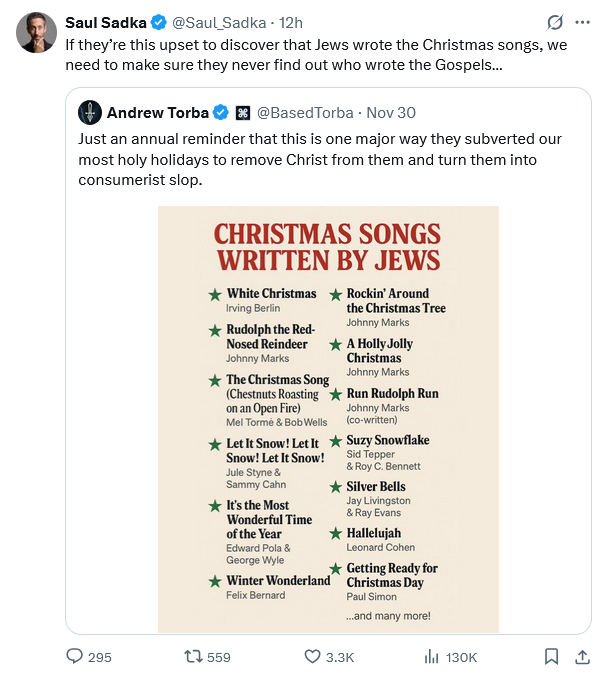
Brings to mind how Saint Ignatius Loyola reacted when informed that one of his early Jesuits had Jewish ancestry. “How wonderful to have a blood tie to Jesus and Our Lady!’
Jew hatred is not only immensely stupid, it is fundamentally anti-Christian.
Donald R. McClarey
Cradle Catholic. Active in the pro-life movement since 1973. Father of three, one in Heaven, and happily married for 43 years. Small town lawyer and amateur historian. Former president of the board of directors of the local crisis pregnancy center for a decade.
Anthony Esolen defines popular culture in music as that people play on their own instruments and sing with their own voices. The music you hear over the radio -or on your phonograph or via latter-day technologies – whether it be pleasant or brutal – is mass entertainment, seldom popular culture. Christmas carols are popular culture. People sing them in their homes, they tramp around neighborhoods singing them to others (though this is a practice that seems to be dying out) and sing them in church choirs and volunteer chorales. The five songs you’re most likely to hear out of your neighbors mouths are references to features of mundane life in late December (outside the South, whose experience of Christmas is not depicted in mass entertainment). They’d only be ‘consumerist slop’ if they were peculiarly amenable to being deployed as background music in sales. That might be true in regard to department store displays, not television advertisements. (BTW, can people who kvetch about ‘consumerism’ define the term for the rest of us?)
Dave G.
Tuesday, December 2, AD 2025 5:44am
Technically it isn’t Jew hatred. PBS had a special a few years ago about the very thing, in which the Jewish songwriters themselves said it was on purpose. They saw a cash cow with the Christmas holiday, but didn’t have any intention of writing Christian songs to capitalize on it. Per them, they deliberately encouraged the secularizing of the holiday, pushing the Christian elements into the closet so to speak, while promoting a generic holiday celebration so that they could then unleash an endless stream of music to cash in. Which fits in with some of my Jewish friends and acquaintances over the years and their attitudes about the subject.
Art Deco
Tuesday, December 2, AD 2025 7:04am
[eyeroll] Tin Pan Alley hacks Jedi-mind tricking everyone in to enjoying their work product?
==
“A few years ago”? Most of the people on this list have been dead for 30 years or more.
Dale Price
Tuesday, December 2, AD 2025 8:35am
“Hallelujah” is NOT a Christmas song of any kind.
Though the late Mr. Cohen was fascinated by Catholic saints…
The Bruised Optimist
Tuesday, December 2, AD 2025 8:53am
Christmas, as expressed in the US, is the sort of thing you get when you soften the message.
Secular carols are part of that softening. It wouldn’t matter if they had been written by a rabbi or an archbishop. They still move the needle toward a Christmas season where the arrival of and importance of Our Savior is nearly lost in well intentioned additions.
Dave G.
Tuesday, December 2, AD 2025 9:20am
Art, the ‘few years ago’ referenced the PBS special, not the subject or the song writers.
Art Deco
Tuesday, December 2, AD 2025 10:14am
Did they use archival footage, Dave? Diary entries? Please tell me how Mel Torme, who was forced into retirement by a stroke in 1996, gives an interview about “The Christmas Song” ‘a few years ago’? This was an ‘American Masters’ documentary, no? Which episode?
== Secular carols are part of that softening. == It’s not about ‘the message’. The songs make reference to things people do at Christmas time. They’re not, implicitly or explicitly, making a theological point. The song “Sleigh Ride” does the same thing (and is sung by local chorales), there just aren’t any Christmas references in it. ==
Dave G.
Tuesday, December 2, AD 2025 10:42am
Art, I’d have to go back and look for it. I think it was in 2022 IIRC. Or round about then. My guess is it combined several types, including people interviewed nowadays and people from back then. As such documentaries often do. I didn’t see the whole thing. But I remember the promotions for it, how Jewish songwriters were able to help secularize the holiday. And that’s not anything new. I remember when Neil Diamond released a Christmas album back when I was younger, and it was a big story since it did include Christian songs. He said he was OK with it since they had a beauty all their own. On the other hand, I also recall the nationwide backlash against Gibson’s Passion of the Christ and what various Jewish leaders and activists said at the time (even some of my more liberal colleagues in mainline Protestant denominations admitted it was a bit much). But that’s not some newsflash that Jewish songwriters purposefully avoided Christian themed songs. If the special overplayed the idea that it was some vast conspiracy, I don’t know. I didn’t see the whole thing. I just remember the promos and the part I saw in which it was made clear that the desire was to make Christmas a more generic, secular holiday for all Americans, rather than one moored to the Christian religion.
Fr J
Tuesday, December 2, AD 2025 12:13pm
This post is a good example of the fallacy of an undistributed middle (term). “Jew” is doing a lot of work here to condone the secularization of a Catholic holy day (Christ’s Mass).
Or, are we to believe that the Apostle St. Matthew was a Jew in the same sense that Mel Torme was a Jew? Are the Holy Gospels Jewish literature? They were written by “Jews” after all. Did St. Ignatius rejoice, in the first instance, that a Jesuit had Jewish blood, or that a Jew had converted to the true Faith? (Apparently, he fell away some time later.)
Finally, is pointing out, or merely noticing, the secularizing intent of Jewish songwriters in regard to Catholic holy days equivalent to “hating” them? By the same token, wouldn’t Jewish noticing of the religious content of Christmas constitute hatred?
Torba’s Jew hate is self evident. Too many Catholics have bugs up their butts about Jews. For the Christians in the decades following Christ there were two types of converts, Jews and Gentiles. Both could become Christians, with the Council of Jerusalem determining that Gentile converts were not subject to the Jewish ritual purity laws of the Old Testament.
Jesus of course is the Messiah, the anointed one, the fulfillment of many Old Testament prophesies, God manifest among us. The hatred of Jews is a heresy as well as idiocy.
Mary De Voe
Tuesday, December 2, AD 2025 1:38pm
Jesus Christ died for all men. If you do not believe this then you are no Christian,
Art Deco
Tuesday, December 2, AD 2025 1:50pm
I don’t think it’s all that challenging to tell the difference between Mel Torme and Leon Wieseltier.
== https://www.imdb.com/title/tt6877088/fullcredits/?ref_=tt_cst_sm
==
It was a one-off broadcast eight years ago. No, none of the composers were interviewed. They have some archival footage of one and interviewed Mel Torme’s son. It’s the documentarian pushing his own thesis.
Dave G.
Tuesday, December 2, AD 2025 3:02pm
Art, again I only saw a part of it back a few years ago. And I only watched it for that amount because I had seen the promos for it, and that was the gist – how the Jewish songwriters helped secularize Christmas. I doubt that it’s some fabricated hit piece on the part of Public Broadcasting. And it makes sense. It’s not the first time that sort of thing has been discussed. After all, if I’m a Christian songwriter in Communist China I’d like to think I’d avoid writing songs praising the Communist Party. And if I could move China farther away from Communism, all the better. And those friends and acquaintances I’ve had over the years who are Jewish have never said anything to suggest that’s too far off the mark in general. Just remember Gibson’s The Passion. It’s just keeping it real, as they say.
Pinky
Tuesday, December 2, AD 2025 3:17pm
Public broadcasting isn’t biased? Seriously? I mean, I doubt it was “the Jews are behind everything” biased, but they’re all about creating a narrative.
lepanto
Tuesday, December 2, AD 2025 4:12pm
Hatred?
I am all too familiar with certain secular groups hurling the word “hatred” at anyone who has a different set of moral or religious beliefs. (Et tu?).
If you believe that marriage can only exist between one man and one woman, the homosexual lobby groups immediately accuse you of “hatred.” If you disagree with the latest statement of the NAACP, or Black Lives Matter, you are denounced as a “racist.” Abortion advocates routinely accuse the Pro-Life movement of “hatred” of women.
Groups like “Antifa” have a loose to nonexistent definition of what is meant by the word “fascist.” It seems to cover most of history, and most of the human race outside of their own organization. It is not necessary to be connected to Mussolini anymore to be identified as a “Fascist.” “You are a Fascist,” seems, now, to mean simply, “You disagree with us.”
Is it really wise to accuse people of “hatred” without genuine evidence of hatred?
Isn’t it normal for practicing Catholics to lament the secularization of our Holy Days by the non-Christian and non-religious culture around us, most notably perhaps in the popular music industry and in Hollywood?
For example, there are many songs that are marketed as “Christmas carols” that have little or nothing to do with the birth of Christ. These songs are often very popular in shopping malls and “Winter Holiday” concerts in public schools, precisely because they are not religious, and carry no trace of religious belief. They do not “offend” the non-Christian and agnostic mentality. None of the songs in the list in the article above were written by Christian believers. You wouldn’t want to sing them in Church. They might be “fun” songs, but they are not about the birth of Jesus.
As for Jesus, Mary, and the Apostles being “Jews,” there are distinctions to be made. In the New Testament, people of both Jewish and Gentile ethnic descent are identified equally as Christians and followers of Christ. But the term, “the Jews,” (hoi Iudaioi, in Greek) is used, most often, to refer specifically to those Jews who rejected and opposed Jesus and his Church.
Does the modern nation of Israel recognize a Jewish convert to Catholicism as a “Jew?”
Tom Byrne
Tuesday, December 2, AD 2025 4:39pm
There are secular winter songs associated with the Christmas season as far back as the Middle Ages, mostly about eating and drinking (for I doubt many took sleigh rides for fun in the 1300s). Folks in cold northern climates (and even temperate Roman Italy) always had harvest/solstice celebrations. Christians have no reason to lament the mere presence of these elements (like cranky old Tertullian attacking laurel wreaths), but should lament the fading or absence of the specifically Christian elements. However, those only faded in the public square after they first faded in our own hearts and family (and church) celebrations). Put them back “inside”, then they’ll return “outside”, and Santa, holly and ivy and eggnog will reassume their secondary importance.
Dave G.
Tuesday, December 2, AD 2025 6:09pm
Pinky, I never said it wasn’t biased either. I said I doubt it would make up some yarn about a vast conspiracy of Jewish people just because. Though it should be noted, the special, and certainly the promos, were not treating it as some dark and sinister plot. Rather, when I watched the ads for it, the gist seemed to be a high five and a celebration for those songwriters who so helped with getting the Jesus out of Christmas. Which wasn’t some random development. I remember well the discussions about why, for sensitivities sake, we needed to default to Holiday Tree and Holiday Break. And that was when I was in college. So it’s also not something new.
CAG
Tuesday, December 2, AD 2025 6:25pm
“The songs make reference to things people do at Christmas time.”
Exactly! These are things people do in Europe. In Russia, in Canada … And in America! Forget the obviously deliberate secularization of Christmas for profit, these songs are Nothern-Hemisphero-centric, and therefore racist and colonialist! Clearly someone was dreaming of a privaledged White-only Christmas here!
Hey! Can we segue into Hollywood’s overwhelming profanation of our Lord’s name in movies in the last few decades? I mean, did they really need to toss out a “JayCee” in The Princess Bride? Sometimes life imitates art. (Not you, Art Deco)
Steven Cass
Tuesday, December 2, AD 2025 6:31pm
Dale- exactly right on Leonard Cohen. It’s not even a Christian song.
A couple of years ago I was celebrating Christmas with my parents and sister. We decided to call the families of my brothers and do some caroling over the phone. When we called my brother Mike, Dad gave me a wrong number, and the guy who answered said we sounded great but why did we call him? Turns out, not only was it a wrong number, but he was Jewish. We all laughed, he thanked us for sharing our gift of singing, and wished us a Merry Christmas. We wished him a belated Happy Hanukkah.
Ooo. Another good story. I worked with kids in an intake facility for about ten years. One year when we were decorating the unit for Christmas, some of the kids realized one of them was Jewish, so they secretly made a menorah and paper flames that she could use to “light” the candles. The young lady, and her family when they visited, were touched by the gesture.
Anyway. Just a couple of stories to show how easy it is to be a decent person this time of year.
“Folks in cold northern climates (and even temperate Roman Italy) always had harvest/solstice celebrations.”
One of C.S. Lewis’ essays concerns how “three things go by the name of Christmas” — the religious celebration of Jesus’ birth; a “popular holiday” marked by “merrymaking”; and the “commercial racket” of buying gifts. He didn’t see anything wrong with the first or second iterations of Christmas, nor did he see anything wrong with people “making merry” with their families and friends any way they wished, or with giving gifts voluntarily to people close to them or dependent on them (he cites Scrooge sending a fresh turkey to Bob Cratchit’s house as one example).
Lewis’ main complaint was with the expectation, stoked by mass media advertising (in 1950s Britain) that people should buy gifts, send treats, or at least send cards to everyone they know, including casual acquaintances. Families who tried to “keep Christmas” in that sense, he observed, tended to mentally and physically exhausted long before Dec. 25.
Note, however, that Lewis didn’t object to Christmas being a “popular holiday” celebrated for other reasons in addition to celebrating the birth of Christ. So why treat Christmas songs about Santa, Rudolph, chestnuts roasting on an open fire, etc. as being part of some vast conspiracy to secularize Christmas.
Pinky
Wednesday, December 3, AD 2025 9:25am
Dave, you’re saying that the documentary was supportive, but that reflects a bias. You may have taken it to be supportive of a bad thing, but that doesn’t make it neutral. They presented it to tell a story, not to convey the truth, so it doesn’t matter if later viewers interpreted the moral of the story differently.
More broadly, what you’re describing is textbook confirmation bias. You saw part of a special years ago, from a source you wouldn’t necessarily trust, and don’t seem to remember much detail. But it confirmed your priors so you’re citing it years later as evidence. This is how a possible error can travel around the world. I mean, you flat-out said that you don’t remember the details but it fit your expectations. Those are the things we should triple-check, not assume to be correct.
Pinky
Wednesday, December 3, AD 2025 9:32am
Lepanto – Yes, some things are mislabeled as hatred. It doesn’t mean that everything that’s labeled hatred is mislabeled.
If you’re saying I’m holding anti-Semitism to a different standard, though, I’m fine with that. There are two consistent themes throughout history, anti-Semitism and anti-natalism, that can’t readily be explained without reference to an eternal unseen malevolent force. They always merit scrutiny.
Dave G.
Wednesday, December 3, AD 2025 10:27am
Pinky, you’ve told me too much about what I’m really thinking here. I merely pointed to a special on PBS I saw promoted, that I watched a part of. That special appeared to discuss how, shocking no one, Jewish song writers were keen on doing what song writers do, and that’s write songs to be hits and make money. Being Jewish, they weren’t crazy about writing songs about saviors in mangers and angels from on high. So just like anyone in pop culture, they set about trying to change the fads and the flavors of the day. Which makes total common sense. Just like I wouldn’t want to write a song praising something I don’t agree with, but might be inclined to find other ways to make a hit. That fits in with other analysis of the influence of Jewish individuals in various areas of media and broader society I’ve seen over the years. Because it’s just people being people. And again, based on friends I’ve had who are Jewish, who never shied from being proud of the strong foundation that Jewish movers and shakers laid regarding the rise and development of Hollywood and entertainment as a whole, it’s hardly outside the realm of the obvious. The problem here seems to be suggesting that Jewish people might be just like people, and be inclined to act like people do in such circumstances.



Anthony Esolen defines popular culture in music as that people play on their own instruments and sing with their own voices. The music you hear over the radio -or on your phonograph or via latter-day technologies – whether it be pleasant or brutal – is mass entertainment, seldom popular culture. Christmas carols are popular culture. People sing them in their homes, they tramp around neighborhoods singing them to others (though this is a practice that seems to be dying out) and sing them in church choirs and volunteer chorales. The five songs you’re most likely to hear out of your neighbors mouths are references to features of mundane life in late December (outside the South, whose experience of Christmas is not depicted in mass entertainment). They’d only be ‘consumerist slop’ if they were peculiarly amenable to being deployed as background music in sales. That might be true in regard to department store displays, not television advertisements. (BTW, can people who kvetch about ‘consumerism’ define the term for the rest of us?)
Technically it isn’t Jew hatred. PBS had a special a few years ago about the very thing, in which the Jewish songwriters themselves said it was on purpose. They saw a cash cow with the Christmas holiday, but didn’t have any intention of writing Christian songs to capitalize on it. Per them, they deliberately encouraged the secularizing of the holiday, pushing the Christian elements into the closet so to speak, while promoting a generic holiday celebration so that they could then unleash an endless stream of music to cash in. Which fits in with some of my Jewish friends and acquaintances over the years and their attitudes about the subject.
[eyeroll] Tin Pan Alley hacks Jedi-mind tricking everyone in to enjoying their work product?
==
“A few years ago”? Most of the people on this list have been dead for 30 years or more.
“Hallelujah” is NOT a Christmas song of any kind.
Though the late Mr. Cohen was fascinated by Catholic saints…
Christmas, as expressed in the US, is the sort of thing you get when you soften the message.
Secular carols are part of that softening. It wouldn’t matter if they had been written by a rabbi or an archbishop. They still move the needle toward a Christmas season where the arrival of and importance of Our Savior is nearly lost in well intentioned additions.
Art, the ‘few years ago’ referenced the PBS special, not the subject or the song writers.
Did they use archival footage, Dave? Diary entries? Please tell me how Mel Torme, who was forced into retirement by a stroke in 1996, gives an interview about “The Christmas Song” ‘a few years ago’? This was an ‘American Masters’ documentary, no? Which episode?
==
Secular carols are part of that softening.
==
It’s not about ‘the message’. The songs make reference to things people do at Christmas time. They’re not, implicitly or explicitly, making a theological point. The song “Sleigh Ride” does the same thing (and is sung by local chorales), there just aren’t any Christmas references in it.
==
Art, I’d have to go back and look for it. I think it was in 2022 IIRC. Or round about then. My guess is it combined several types, including people interviewed nowadays and people from back then. As such documentaries often do. I didn’t see the whole thing. But I remember the promotions for it, how Jewish songwriters were able to help secularize the holiday. And that’s not anything new. I remember when Neil Diamond released a Christmas album back when I was younger, and it was a big story since it did include Christian songs. He said he was OK with it since they had a beauty all their own. On the other hand, I also recall the nationwide backlash against Gibson’s Passion of the Christ and what various Jewish leaders and activists said at the time (even some of my more liberal colleagues in mainline Protestant denominations admitted it was a bit much). But that’s not some newsflash that Jewish songwriters purposefully avoided Christian themed songs. If the special overplayed the idea that it was some vast conspiracy, I don’t know. I didn’t see the whole thing. I just remember the promos and the part I saw in which it was made clear that the desire was to make Christmas a more generic, secular holiday for all Americans, rather than one moored to the Christian religion.
This post is a good example of the fallacy of an undistributed middle (term). “Jew” is doing a lot of work here to condone the secularization of a Catholic holy day (Christ’s Mass).
Or, are we to believe that the Apostle St. Matthew was a Jew in the same sense that Mel Torme was a Jew? Are the Holy Gospels Jewish literature? They were written by “Jews” after all. Did St. Ignatius rejoice, in the first instance, that a Jesuit had Jewish blood, or that a Jew had converted to the true Faith? (Apparently, he fell away some time later.)
Finally, is pointing out, or merely noticing, the secularizing intent of Jewish songwriters in regard to Catholic holy days equivalent to “hating” them? By the same token, wouldn’t Jewish noticing of the religious content of Christmas constitute hatred?
Torba’s Jew hate is self evident. Too many Catholics have bugs up their butts about Jews. For the Christians in the decades following Christ there were two types of converts, Jews and Gentiles. Both could become Christians, with the Council of Jerusalem determining that Gentile converts were not subject to the Jewish ritual purity laws of the Old Testament.
Jesus of course is the Messiah, the anointed one, the fulfillment of many Old Testament prophesies, God manifest among us. The hatred of Jews is a heresy as well as idiocy.
Jesus Christ died for all men. If you do not believe this then you are no Christian,
I don’t think it’s all that challenging to tell the difference between Mel Torme and Leon Wieseltier.
==
https://www.imdb.com/title/tt6877088/fullcredits/?ref_=tt_cst_sm
==
It was a one-off broadcast eight years ago. No, none of the composers were interviewed. They have some archival footage of one and interviewed Mel Torme’s son. It’s the documentarian pushing his own thesis.
Art, again I only saw a part of it back a few years ago. And I only watched it for that amount because I had seen the promos for it, and that was the gist – how the Jewish songwriters helped secularize Christmas. I doubt that it’s some fabricated hit piece on the part of Public Broadcasting. And it makes sense. It’s not the first time that sort of thing has been discussed. After all, if I’m a Christian songwriter in Communist China I’d like to think I’d avoid writing songs praising the Communist Party. And if I could move China farther away from Communism, all the better. And those friends and acquaintances I’ve had over the years who are Jewish have never said anything to suggest that’s too far off the mark in general. Just remember Gibson’s The Passion. It’s just keeping it real, as they say.
Public broadcasting isn’t biased? Seriously? I mean, I doubt it was “the Jews are behind everything” biased, but they’re all about creating a narrative.
Hatred?
I am all too familiar with certain secular groups hurling the word “hatred” at anyone who has a different set of moral or religious beliefs. (Et tu?).
If you believe that marriage can only exist between one man and one woman, the homosexual lobby groups immediately accuse you of “hatred.” If you disagree with the latest statement of the NAACP, or Black Lives Matter, you are denounced as a “racist.” Abortion advocates routinely accuse the Pro-Life movement of “hatred” of women.
Groups like “Antifa” have a loose to nonexistent definition of what is meant by the word “fascist.” It seems to cover most of history, and most of the human race outside of their own organization. It is not necessary to be connected to Mussolini anymore to be identified as a “Fascist.” “You are a Fascist,” seems, now, to mean simply, “You disagree with us.”
Is it really wise to accuse people of “hatred” without genuine evidence of hatred?
Isn’t it normal for practicing Catholics to lament the secularization of our Holy Days by the non-Christian and non-religious culture around us, most notably perhaps in the popular music industry and in Hollywood?
For example, there are many songs that are marketed as “Christmas carols” that have little or nothing to do with the birth of Christ. These songs are often very popular in shopping malls and “Winter Holiday” concerts in public schools, precisely because they are not religious, and carry no trace of religious belief. They do not “offend” the non-Christian and agnostic mentality. None of the songs in the list in the article above were written by Christian believers. You wouldn’t want to sing them in Church. They might be “fun” songs, but they are not about the birth of Jesus.
As for Jesus, Mary, and the Apostles being “Jews,” there are distinctions to be made. In the New Testament, people of both Jewish and Gentile ethnic descent are identified equally as Christians and followers of Christ. But the term, “the Jews,” (hoi Iudaioi, in Greek) is used, most often, to refer specifically to those Jews who rejected and opposed Jesus and his Church.
Does the modern nation of Israel recognize a Jewish convert to Catholicism as a “Jew?”
There are secular winter songs associated with the Christmas season as far back as the Middle Ages, mostly about eating and drinking (for I doubt many took sleigh rides for fun in the 1300s). Folks in cold northern climates (and even temperate Roman Italy) always had harvest/solstice celebrations. Christians have no reason to lament the mere presence of these elements (like cranky old Tertullian attacking laurel wreaths), but should lament the fading or absence of the specifically Christian elements. However, those only faded in the public square after they first faded in our own hearts and family (and church) celebrations). Put them back “inside”, then they’ll return “outside”, and Santa, holly and ivy and eggnog will reassume their secondary importance.
Pinky, I never said it wasn’t biased either. I said I doubt it would make up some yarn about a vast conspiracy of Jewish people just because. Though it should be noted, the special, and certainly the promos, were not treating it as some dark and sinister plot. Rather, when I watched the ads for it, the gist seemed to be a high five and a celebration for those songwriters who so helped with getting the Jesus out of Christmas. Which wasn’t some random development. I remember well the discussions about why, for sensitivities sake, we needed to default to Holiday Tree and Holiday Break. And that was when I was in college. So it’s also not something new.
“The songs make reference to things people do at Christmas time.”
Exactly! These are things people do in Europe. In Russia, in Canada … And in America! Forget the obviously deliberate secularization of Christmas for profit, these songs are Nothern-Hemisphero-centric, and therefore racist and colonialist! Clearly someone was dreaming of a privaledged White-only Christmas here!
Hey! Can we segue into Hollywood’s overwhelming profanation of our Lord’s name in movies in the last few decades? I mean, did they really need to toss out a “JayCee” in The Princess Bride? Sometimes life imitates art. (Not you, Art Deco)
Dale- exactly right on Leonard Cohen. It’s not even a Christian song.
A couple of years ago I was celebrating Christmas with my parents and sister. We decided to call the families of my brothers and do some caroling over the phone. When we called my brother Mike, Dad gave me a wrong number, and the guy who answered said we sounded great but why did we call him? Turns out, not only was it a wrong number, but he was Jewish. We all laughed, he thanked us for sharing our gift of singing, and wished us a Merry Christmas. We wished him a belated Happy Hanukkah.
Ooo. Another good story. I worked with kids in an intake facility for about ten years. One year when we were decorating the unit for Christmas, some of the kids realized one of them was Jewish, so they secretly made a menorah and paper flames that she could use to “light” the candles. The young lady, and her family when they visited, were touched by the gesture.
Anyway. Just a couple of stories to show how easy it is to be a decent person this time of year.
“Folks in cold northern climates (and even temperate Roman Italy) always had harvest/solstice celebrations.”
One of C.S. Lewis’ essays concerns how “three things go by the name of Christmas” — the religious celebration of Jesus’ birth; a “popular holiday” marked by “merrymaking”; and the “commercial racket” of buying gifts. He didn’t see anything wrong with the first or second iterations of Christmas, nor did he see anything wrong with people “making merry” with their families and friends any way they wished, or with giving gifts voluntarily to people close to them or dependent on them (he cites Scrooge sending a fresh turkey to Bob Cratchit’s house as one example).
Lewis’ main complaint was with the expectation, stoked by mass media advertising (in 1950s Britain) that people should buy gifts, send treats, or at least send cards to everyone they know, including casual acquaintances. Families who tried to “keep Christmas” in that sense, he observed, tended to mentally and physically exhausted long before Dec. 25.
Note, however, that Lewis didn’t object to Christmas being a “popular holiday” celebrated for other reasons in addition to celebrating the birth of Christ. So why treat Christmas songs about Santa, Rudolph, chestnuts roasting on an open fire, etc. as being part of some vast conspiracy to secularize Christmas.
Dave, you’re saying that the documentary was supportive, but that reflects a bias. You may have taken it to be supportive of a bad thing, but that doesn’t make it neutral. They presented it to tell a story, not to convey the truth, so it doesn’t matter if later viewers interpreted the moral of the story differently.
More broadly, what you’re describing is textbook confirmation bias. You saw part of a special years ago, from a source you wouldn’t necessarily trust, and don’t seem to remember much detail. But it confirmed your priors so you’re citing it years later as evidence. This is how a possible error can travel around the world. I mean, you flat-out said that you don’t remember the details but it fit your expectations. Those are the things we should triple-check, not assume to be correct.
Lepanto – Yes, some things are mislabeled as hatred. It doesn’t mean that everything that’s labeled hatred is mislabeled.
If you’re saying I’m holding anti-Semitism to a different standard, though, I’m fine with that. There are two consistent themes throughout history, anti-Semitism and anti-natalism, that can’t readily be explained without reference to an eternal unseen malevolent force. They always merit scrutiny.
Pinky, you’ve told me too much about what I’m really thinking here. I merely pointed to a special on PBS I saw promoted, that I watched a part of. That special appeared to discuss how, shocking no one, Jewish song writers were keen on doing what song writers do, and that’s write songs to be hits and make money. Being Jewish, they weren’t crazy about writing songs about saviors in mangers and angels from on high. So just like anyone in pop culture, they set about trying to change the fads and the flavors of the day. Which makes total common sense. Just like I wouldn’t want to write a song praising something I don’t agree with, but might be inclined to find other ways to make a hit. That fits in with other analysis of the influence of Jewish individuals in various areas of media and broader society I’ve seen over the years. Because it’s just people being people. And again, based on friends I’ve had who are Jewish, who never shied from being proud of the strong foundation that Jewish movers and shakers laid regarding the rise and development of Hollywood and entertainment as a whole, it’s hardly outside the realm of the obvious. The problem here seems to be suggesting that Jewish people might be just like people, and be inclined to act like people do in such circumstances.