
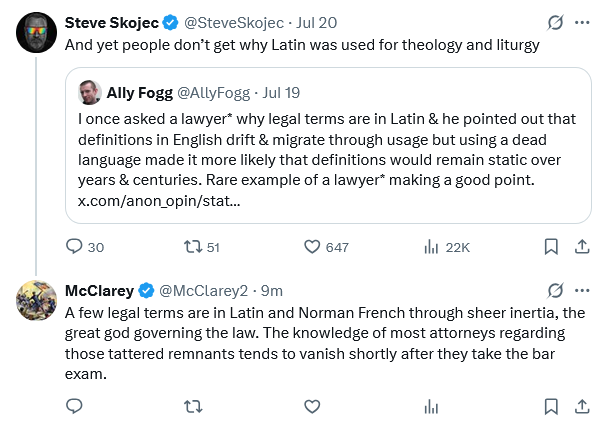
The Law tends to be a practical profession as well as a busy one, not given to much introspection. Once something has been established, it tends to endure until legislatures decide otherwise. A good example of this is The Rule in Shelly’s Case:
“When the ancestor by any gift or conveyance takes an estate of freehold, and in the same gift or conveyance an estate is limited either mediately or immediately to his heirs in fee simple or in fee tail; that always in such cases, “the heirs” are words of limitation of the estate, not words of purchase.”
To put it simply the restriction about heirs in a deed or other conveyance could not bind the person taking the land who would have the land in fee simple, and could convey it free of any interest in his heirs. This was the law in England from at least 1366, Shelly’s case from which the rule derives its name was decided in 1581, until it was abolished in England in 1925. Most American states have abolished it. For example I frequently have clients ask me to draft deeds in which they have a life estate and the remainder interest going to named individuals. All they can then convey after this is done, under Illinois law, is their life estate, with the named individuals getting the real estate after their death.
Although in most jurisdictions The Rule in Shelly’s Case is only a matter of historical interest, it still exists to flummox future minions of the Law taking the bar exam. The name demonstrates that whatever other attributes are necessary to practice the Law, imagination is not a requirement.


Mea sententia peculiaris sicut civis liber.
My personal opinion as a free citizen.
As I said elsewhere, Donald, I suspect you are one of the few honest lawyers left. I write the following with the preface that I speak for no person or organization (standard disclaimer).
Next year, God willing, I will have worked in nuclear energy – Naval and commercial – for a half century. During that time I have developed innumerable plans and procedures on a variety of very technical subjects, the latest one being a control plan for the use of artificial intelligence. That plan has been reviewed and accepted by two people with Masters degrees in AI, by the heads of IT, QA, and Regulatory Affairs, by 12 different technical persons throughout the company, but not by the new chief legal counsel because “the plan is too cumbersome and makes AI untrustworthy.” No $h1t, Sherlock; that’s the point.
Well, I told my boss and QA that I won’t compromise nuclear safety, regulatory compliance, or quality for the sake of expediting the use of AI or for anything else that has similar dangers. I’ve been told not to worry about; they’ll handle it. But frankly, Donald, I don’t trust lawyers any longer, because this is the first time in almost 50 years that anyone in Legal (either in the Navy or in commercial nuclear power) has ever pushed back on the level of rigor that I write into the plans and procedures which I develop. Most lawyers used to recognize that when it comes to nuclear energy technical details, they need to rely on those with experience. But this person, having become adept at using Chat GTP or Grok or whatever it is he does use, thinks he knows better. That kind of attitude gets people injured or killed, and I have seen that happen.
I have seen a man lose an arm (flesh cooked off the bone) in a submarine 270 vdc battery well because he thought he didn’t have to follow procedure and the regs. I saw another man get burned alive by a fireball from a 6.9 KV reactor coolant pump breaker because he thought he didn’t have to follow procedure and the regs. No sir, I am not going down that road. AI is untrustworthy and dangerous without specific guardrails and protocols on its use, and those guardrails must include independent verification of its results by alternate means. Any lawyer who thinks otherwise is a damn fool.
LQC:
Thank you very much
[…] Analysis, Punditry, and News:Sheer Inertia; Why Use of Latin in Law (& Norman French Too) – The American CatholicA Note For Supporters Of President Trump – David Griffey at […]
Mea sententia peculiaris sicut civis liber.
My personal opinion as a free citizen.
Update: certain leaders have spoken with the General Counsel about the control plan that I wrote to use AI at Neutrons ‘R Us. I thank them very much. May the Lord Jesus be praised. Common sense has prevailed, or maybe fear of the nuclear regulator. You never want to be standing at the Green Table in front of either US NRC or the Bureau of Naval Reactors. But it doesn’t matter. We’re going to do the right thing whether by prudence or by trepidation. I truly thank the Lord that my anxieties will not see fruition.
Ave Maria, gratia plena, ora pro nobis et pro nostra Patria America 🇺🇸.