
41 Then he shall say to them also that shall be on his left hand: Depart from me, you cursed, into everlasting fire which was prepared for the devil and his angels. 42 For I was hungry, and you gave me not to eat: I was thirsty, and you gave me not to drink. 43 I was a stranger, and you took me not in: naked, and you covered me not: sick and in prison, and you did not visit me. 44 Then they also shall answer him, saying: Lord, when did we see thee hungry, or thirsty, or a stranger, or naked, or sick, or in prison, and did not minister to thee? 45 Then he shall answer them, saying: Amen I say to you, as long as you did it not to one of these least, neither did you do it to me.
Matthew 25: 41-45
I have long thought that sins of omission are the greatest threat to salvation.


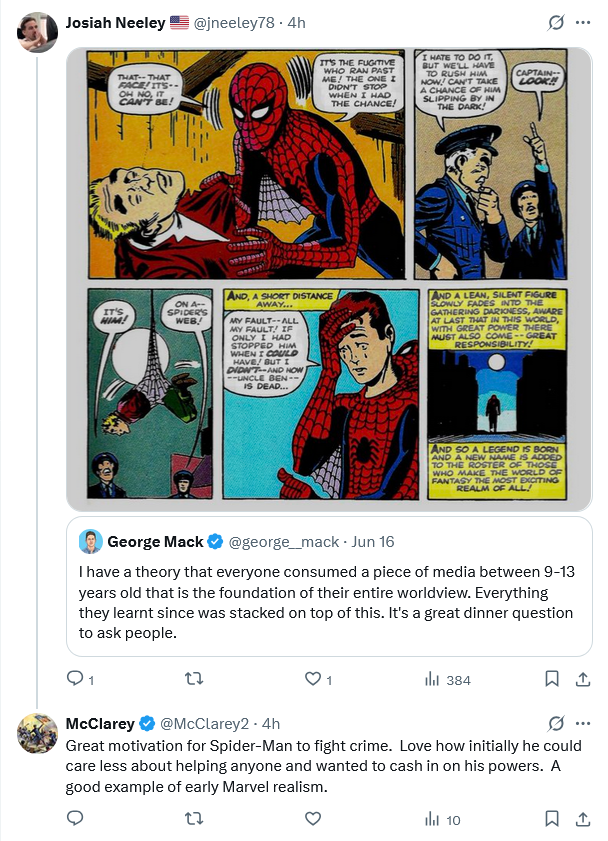
“I have a theory that everyone consumed a piece of media between 9-13
years old that is the foundation of their entire worldview.”
A solid theory and certainly true for me. I read that comic and many more besides. Still do to a lesser degree. But the idea that there is good and there is evil was ever present.
Sins of omission are more threatening and insidious than many Catholics realize. There is, of course, the obvious positive omission: “I’m not going to Mass today, I’m going to sleep in for a change.”
But these are easily recognized and (hopefully) repented of.
Much more difficult to root out are the sins of negative omission: i.e., things that we should have done but we left them undone without ever realizing that we should have done them–because we culpably never considered them as we ought to have.
Here’s an example: a priest fails to instruct his flock about certain things necessary for salvation, because he doesn’t know them himself. He never studied them at all back in seminary, because he distracted himself with other things, was lazy, etc. Now, he doesn’t realize how his sermon–by its omissions–is seriously sinful. He commits serious sin without even realizing it.
Another example: a Catholic man gets married outside the Church but continues to receive Holy Communion. He could easily have learned about matrimony and the requirements for a valid marriage, but he never turned his attention to researching anything about it, and he doesn’t necessarily realize he had a grave obligation to learn about something so fundamental. But all this is through his own fault, his own negligence. The fact that it never occurs to him that all this is true has nothing to do with his culpability.
Youth reading is important. My mother, though not a high brow woman of letters, was good enough to be an elementary librarian. She pointed out quality books to the children she served and no doubt changed their lives for the good. As for myself, she pushed the Hardy Boys series. I learned a great deal from Frank and Joe. I passed my collection on to my sons.
[…] CatholicIt’s Here! The 2025 Color of the Year – Meghan Ashley Styling, A Catholic StylistAnd For What I Have Failed to Do – Donald R. McClarey, J.D., at The American CatholicNeed Professional Fundraising Advice for […]
Far too much of the youth reading material today is whitewashed of any moral stance.
When there is a moral stance, it is relativistic, ecological, racial. Justice may factor, but usually not without “equity”
As the libraries stock up on pulp, it is increasingly vital to have a bookshelf at home. Anthologies of the earlier comics would not be out of place. Today’s stuff is often completely off the rails 💔
“Today’s stuff is often completely off the rails”
Too true. Which is why I said “ to a lesser degree” above. Current writers have an entirely different world view from Stan Lee or Jack Kirby.