
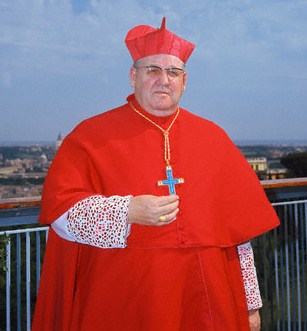
Born in 1907 in Saint Louis, from his earliest years Cody was destined for a career in the Church. He entered the Saint Louis Preparatory Seminary at age 13. At 19 he was sent to the North American Pontifical College in Rome, where he earned Doctorates in Philosophy and Sacred Theology. Ordained in 1931, he stayed in Rome for seven years working at the North American Pontifical College and in the Vatican Secretariat of State. In 1938 he earned a third Doctorate in Canon Law. A true Golden Boy of the Church to all appearances.
Back to his native Saint Loius his rise was meteoric, serving as the private secretary to Archbishop Glennon until 1940 and then made Chancellor of the Archdiocese. In 1947 he was appointed an auxiliary Bishop of the Archdiocese. In 1954 he was appointed coadjutor to the Bishop of Saint Joseph and in 1956 he was made Bishop of Saint Joseph. In 1961 he was appointed coadjutor to the Archbishop of New Orleans, becoming Archbishop himself in 1964. In 1965 he was made Archbishop of Chicago, where he would spend the remainder of his career. He was raised to Cardinal in 1967. These were turbulent times, and Cody’s tenure was marked with strife, including accusation of massive financial “irregularities” by Cody and his relationship with a divorcee who followed him for 25 years from assignment to assignment and upon whom Cody was accused of lavishing large sums of money. Cody at one time said she was his cousin. She was not.
By this time he was considered a Church “conservative” and he often butted heads with radical priests. He attended both conclaves in 1978, dying in 1982. He was succeeded by Cardinal Bernardin shortly before his death.
Two conclaves in 1978 was an odd event in the life of the Church. Perhaps that helps explain why the Conclave turned to a man from a far country. Born in 1920 in Wadowice, Poland, Karol Wojtyla was the youngest of three children. His mother died when he was eight. His older sister Olga died before he was born and his brother Edmund, to whom he was quite close, was a physician who died of scarlet fever contracted from a patient when Karol was 11. His father died of a heart attack in 1941. As Karol noted:
“I was not at my mother’s death, I was not at my brother’s death, I was not at my father’s death. At twenty, I had already lost all the people I loved.”
This sad experience of tragedy turned his thoughts to the priesthood. He enrolled in the clandestine seminary operated by the Archbishop of Cracow, Adam Stefan Sapieha, a titan of the Church in Poland. The space of a blog post does not allow the relation of his experiences and good works during World War II in a nation occupied by the Third Reich which had a policy of causing most Poles to die, with only a small remnant of slaves to be left.
Ordained on All Saints Day in 1946, he was sent to the Pontifical University of Saint Thomas Aquinas in Rome. He earned a Doctorate in Philosophy in 1948. Years of pastoral work followed, along with teaching at universities, and in 1953 he received a Doctorate of Theology from Jagiellonian University. Throughout these years he began a literary output that was unusual in its breadth and depth considering all the other calls on his time. He also led an athlete’s life, especially when it came to skiing, swimming and hiking in rugged terrain . He was immensely popular with students and young people in general.
In 1958 Pope Pius XII appointed him auxiliary Bishop of Cracow. At 38 he was the youngest bishop in Poland and one of the youngest in the world. In 1959 he began to say Midnight Mass on Christmas in the fields at Nowa Huta, a city near Cracow, which the Communist government planned as a model workers’ community devoid of all churches. The huge crowds that attended the Midnight masses demonstrated the futility of this attempt to separate the workers from their Church. The Archbishop of Cracow died in 1962 and Bishop Wojtyla was appointed administrator of the Archdiocese. In 1964, at the age of 44, he was made Archbishop of Cracow. In 1967 he was made a Cardinal. The Communist regime ruling Poland began to fear that he posed a long term threat to their power.
Cardinal Wojtyla participated in both of the Conclaves in 1978. Initially the two strongest candidates at the second Conclave of 1978 were Cardinal Siri and Cardinal Benelli, the former being regarded as a conservative and the latter a liberal. The initial votes determined that neither of these men had sufficient support to be elected. Wojtyla’s name emerged as a compromise candidate and on the eighth ballot he was elected by a coalition of Siri supporters and cardinals considered moderate.
As Pope, John Paul II, as he chose to be called to honor his predecessor, was the most significant pope of the 20th century. A few of his accomplishments:
1. He largely stopped the post Vatican II chaos-After Vatican II the impulse to transform the Church into an institution fully reflecting the current views of cultural elites in the West wreaked much havoc. Paul VI, a good and holy man, drew a line in the sand with Humanae Vitae, but he lacked the stomach and the will to fight it out with those who would have transformed the Catholic Church into what the Anglican Church is now: a dying institution, adrift from any allegiance to traditional Christianity, and fully in accord with the mores and beliefs of the secular elite of the West. Many were rubbing their hands with glee after the death of Pope Paul, in confident assurance that a new liberal pope would complete the transformation of the Church into something akin to Unitarianism with fancy dress. Instead, they got John Paul II, a Polish fighter who had stood toe to toe with the atheist rulers of Poland and was not the least frightened or impressed by the forces in the West that sought to neuter Christ’s Church. The chaos and low morale of the Church could not be completely reversed in one papacy, but John Paul II began the process and made a huge amount of progress. Pope Francis did his worst to reverse his work, but the orthodox young priests of today show the continuing power of what John Paul II planted.
2. Presiding at the Funeral of Communism-During World War II, both the Nazis and the Communists slaughtered a huge number of Polish priests, viewing them as deadly enemies. How very right they were! The Polish Church, in the midst of one of the worst persecutions sustained by the Catholic Church in the last century, never lost faith that the Church and Poland would both ultimately outlast the totalitarian regimes and emerge triumphant. John Paul II was the embodiment of this robust confidence that Communism, like Nazism, was merely a brief historical aberration that could and would be defeated. The rise of Solidarity was completely predictable to him, and his embrace of it made a crackdown by the Polish Communist regime, and its Kremlin puppet masters, impossible. John Paul II and Ronald Reagan in the Eighties brought about the largely peaceful collapse of Communism in Eastern Europe and laid the groundwork for its collapse in the former Soviet Union. The heirs of Joseph Stalin learned to their sorrow that the type of power wielded by a skillful and determined pope cannot be counted in divisions but rather in human hearts.
3. Culture of Life-In the teeth of an overwhelming movement among Western elites to jettison the belief that human life is sacred, John Paul II rededicated the Church to that proposition and waged a long uphill struggle throughout his papacy against abortion and euthanasia. Like Moses, John Paul II did not live to see the victory in this fight, but ultimately we will win, and his brave stand at a crucial moment in history will be one of the reasons why.
4. Pope of the people-With modern means of transportation, a vigorous Pope can treat the whole world as his diocese by globe-trotting and that is precisely what John Paul II did. In the Nineteenth Century, modern means of communication, the telegraph, photography and newspapers, were skillfully used by Pius IX to forge a personal contact between the Pope and average Catholics. Pope John Paul II took this a step farther by bringing the Pope to the average Catholic. A masterful stroke and superbly executed.
5. Vocations-Pope John Paul II began the process by which the hemorrhaging of priests was stanched and laid the groundwork for the rebound we are now seeing in vocations to the priesthood in most of the Church outside of Europe. Much needs to be done still, but without the efforts of John Paul II the situation now would be of truly crisis proportions.
6. Theology of the Body-One of the crises of our time is the alienation between some men and women caused by rapidly changing relationships between the sexes brought on by modern life. John Paul II addressed this in his Theology of the Body. Go here for a good overview. The exalted view of John Paul Ii of the love between man and woman in marriage of course ties in perfectly with his defense of the sanctity of life. In many ways love was the central theme of the papacy of John Paul II.
7. Centesimus Annus-With the collapse of Communism, in 1991 John Paul II released Centesimus annus, an overview of the mistakes of Marxism and the challenges that remained in a world where Capitalism now seemed supreme. Go here to read it. The most significant two paragraphs:
Returning now to the initial question: can it perhaps be said that, after the failure of Communism, capitalism is the victorious social system, and that capitalism should be the goal of the countries now making efforts to rebuild their economy and society? Is this the model which ought to be proposed to the countries of the Third World which are searching for the path to true economic and civil progress?
The answer is obviously complex. If by “capitalism” is meant an economic system which recognizes the fundamental and positive role of business, the market, private property and the resulting responsibility for the means of production, as well as free human creativity in the economic sector, then the answer is certainly in the affirmative, even though it would perhaps be more appropriate to speak of a “business economy”, “market economy” or simply “free economy”. But if by “capitalism” is meant a system in which freedom in the economic sector is not circumscribed within a strong juridical framework which places it at the service of human freedom in its totality, and which sees it as a particular aspect of that freedom, the core of which is ethical and religious, then the reply is certainly negative.
8. Liberation Theology Rejected-In the Sixties and the Seventies of the last century, elements within the Church engaged in a strong flirtation with Marxism and the idea that the Kingdom of God could be brought about by class struggle and rebellion. The idea was completely hare-brained, but it attracted quite a following. John Paul II explained that the liberation that Christianity brought had nothing in common with the power grab the Marxists were seeking. Go here for resources regarding the statements of John Paul II on Liberation Theology.
This list only touches some of the main features of the papacy of John Paul II, a papacy that will be discussed endlessly as the centuries pass.
For me Pope John Paul II was a hero. When the Pope was in Nicaragua and a Sandinista organized group was attempting to shout the Pope down while he was giving a sermon during a vast outdoor mass, the Pope lost his temper and yelled out “Silencio!”, followed by applause from the vast majority of the worshipers.
The Pope was a man’s man of unusual physical courage. Nothing fazed him: Nazis, Communists of all stripes, an almost successful assassination attempt, parkinson’s, etc. This is certainly not the most important feature of the Pope, but I personally found it one of the most inspiring aspects of this great man. It was a privilege to live during his pontificate and to see the good guys win, always remembering that such victories often have to be won afresh in each generation.


Excellent short summary, Donald. For all but the final few months of his papacy, I was not Catholic, but was married in the Church in 1980 and always admired JP2. I still do, perhaps more so as time passes. There’s no doubt in my mind about his Sainthood, something I can’t always say about some recent canonizations. And while I wish he hadn’t made some of the arguable mistakes of his reign, such as failing to stop communion in the hand, and his many questionable, at best, episcopal appointments, no one but Christ is perfect. I sure wish we could get another one like him.
[…] Information:Cardinal Cody & the Second Conclave of 1978 – Don. R. McClarey, J.D., at the American CatholicThe History Behind ‘Habemus Papam’ […]
Yes. He was my Pope. On the great Jubilee Year 2000 I woke up from a spell that was self induced in 1979. Abandonment of the sacraments. 21 years later, under the leadership of Pope JP II, I was restored to new life. His radical advancements of Saints included Maximillian Kolbe….my life line to hoist me back in the BOAT. 😃
JP 2…a great man indeed.
A great man indeed. He is my Pope too. He was the perfect choice by God during a particular period in history which needed someone with courage to lead the Church and lead western democracy which was under attack. He did more good than he made mistakes. I miss him too.
Point No. 8 regarding JPII rightly laying to rest at the time the poisonous corpse of liberation theology: It is sad that one of the many pernicious heterodox “teachings” —-errors—-of P Francis was to resurrect this zombie and to even elevate and to praise two of its foremost nut jobs, Gustavo Gutierrez (d. Oct. 22, 2024, age 96) and the ex-Franciscan Leonardo Boff (still kicking at 86, old communists seem to never die).
Cleanup job on aisle 6 for the next pope, we pray.