There is a good monograph waiting to be written on the massive problems encountered by the Church in throne and altar alliances over the centuries.

There is a good monograph waiting to be written on the massive problems encountered by the Church in throne and altar alliances over the centuries.


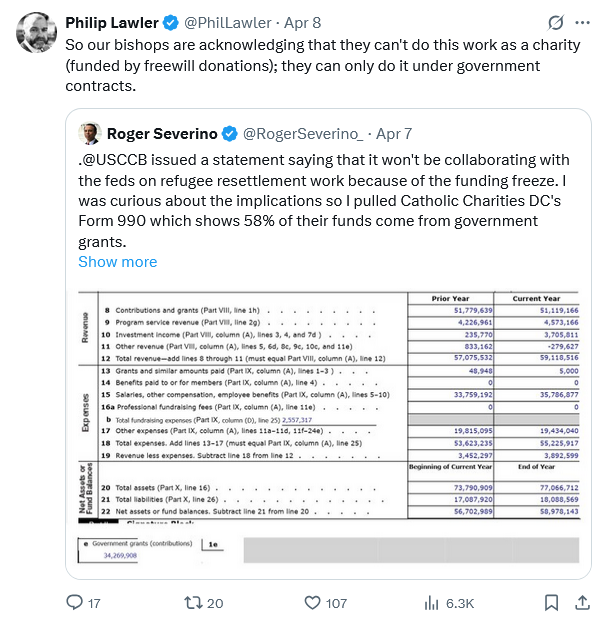
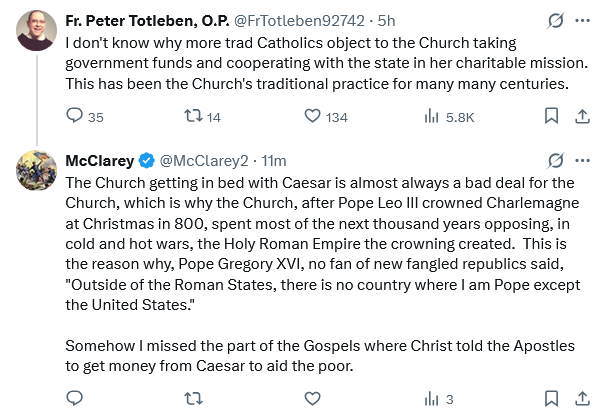
I don’t in principle object to the Church collaborating with the State in her charitable mission, but the strings attached are the devil in the details. It’s a mattter of a categorical difference between a collaboration that allows for or supports the evangelical and charitable mission to work together, and one that in principle bifurcates them, the latter of which is the recent experience here in the US.
Both can end certainly up working to cross purposes given sin and human nature, but one requires the Church to abandon its primary mission. If she then only has a charitable mission, she might do objectively good things, but she won’t be doing the great commission and thus has no real reason for existing.
IMO, government grants to corporate bodies and persons with institutional addresses ought to cease bar in a discrete set of circumstances. (1) from various governments to various parties in the course of disaster relief; (2) from the federal government to inter-governmental agencies to which it is prudent to belong; (3) from the federal government to state and territorial governments; (4) from the federal government to local governments; (5) from state and territorial governments to local governments.
==
IMO, there might be three-dozen intergovernmental agencies which do something useful (emphasis on might),
==
Our subventions to foreign governments should be strongly biased in favor of providing manpower, equipment, and credits to buy equipment with little in the way of cash.
==
Disbursements from the feds to state and territorial government should be per formulae and limited at this time to four: one for Medicaid, one for unemployment compensation, one for a residue of the federal highway program, and one unrestricted.
==
Disbursements from the feds to local government should be limited to paying the equivalent of property taxes on federal real estate (a program that might include the low census territories as well).
==
Disbursements by state and territorial government to local government ought to consist of paying the equivalent of property taxes on state-owned real estate and revenue sharing grants calculated according to formula. An ordinary state might cut two sets of checks – one to county governments and one to school districts. The counties then cut another set to municipalities. You might also impose an obligation to pay property taxes on philanthropic agencies on equal terms with other private parties, but grant them a right to full compensation from the state treasury for such payments.
==
Ideally, government contracting is done with few exceptions by soliciting sealed bids.
==
In such a system, higher education would get no grants per se. Public agencies would do their research in house or let out contracts. If institutions or corporations composed of professors wanted to fulfill the contract, they could submit sealed bids. If public agencies wanted to pick the brains of faculty, they could award term fellowships which included an indemnity for the professor’s home institution. Public institutions of higher education might have a research endowment whose income could finance research projects of resident faculty. It could be financed in part by private donations and in part by bond issues, but never by regular appropriations. The bond issues could be put on the ballot by petition campaigns. If you have a successful statewide campaign, the state issues the bonds and they are distributed between the state’s institutions according to a constitutionally specified formula. If you have an initiative in a particular bloc of counties and it passes, the obligation is apportioned among the counties according to population and the bonds distributed to schools in that bloc of counties per a constitutionally specified formula. Private institutions would have to rely on private sources to finance research.
==
The government might still distribute vouchers, set up insurance programs or distribute cash to individual households. In those cases, it would be up to the household in question to choose a service provider. You could limit vouchers and insurance to programs financing medical care, long-term care, and schooling. Since schools are expressive associations, you’d need constitutional safeguards to limit what the state could extort from private providers in regard to the content of their service program.
==
It’s time to shutdown the pipeline running from governments to the philanthropic sector.
Two comments here: First, the tax laws in this country are way too broad on granting tax exemption and deductibility of donations for things that are not truly charitable. Example: Planned Parenthood is a IRC 501(c)(3) tax exempt organization. Is this really a charitable activity? Many countries have narrower definitions of charities for deductibility of donations. They have to prove that the activity is charitable, not merely advocacy. That would be good to separate the Church from other NGO’s.
Second, I know it will never happen, but I think that the Church should get out of acting as an agent of the state for marriage purposes. I had this thought when the gay marriage push originally happened because it is probably only a matter of time until someone sued the Church claiming discrimination for refusing to marry a gay couple. If people think that it would never happen or the Church would be immune should talk to the Colorado baker. There is an increasing hostility to the Church and there is no reason why we should assume that they will stop now.
If you want to get confirmation of your civil marriage, go to the courthouse and get “married” for civil law purposes there. After that, if you want to be married in the Church, do what you need to do to have a Catholic sacramental marriage. You might need to go through two steps for a Catholic marriage, but after all, you have to go to the courthouse to get a marriage license so just do it then. Many people are just “living together” anyway now, so it isn’t too much to ask. This separates the civil marriage from the sacrament of marriage.
I assist people that seek annulments from the Church and I can tell you that the vast majority of people getting married in the Church (even now after the required premarital preparation) have no idea regarding Church teaching on sacramental marriage. Separating the two would impress upon those getting married that there IS a difference between the requirements for a civil marriage and a sacramental marriage. Some people might view the Church teaching as overly legalistic, but I consider it truly romantic. What stronger bond can there be between two people, completely and unreservedly committed to each other, for better or for worse for the good of each other and children, forsaking all others until death, striving to get each other into heaven? Like I said, romantic.
You want a civil marriage, go ahead and do it but you do it in the context that either party can get out of it easier than canceling your cable contract. If you want to receive the Sacrament of Marriage, taking the Church out of the civil aspects would be an opportunity for the Church to impress upon them that what they are committing do is infinitely different than what civil society thinks marriage is. There is a difference between lust at first sight and marital love. Getting the Church out of the civil aspects of marriage might help convince more that there is more to marriage than the party afterwards.
#Rantoff
Government money with no strings attached is a fairy tale and usually one with a non Disney ending.
Some years ago there was a proposal to allow everyone to claim their tax deduction for charitable contributions whether or not they itemized on their return. It went nowhere but now with this administration it might be time to consider it again.
I’m not exactly sure what Fr. Totleben is going on about. In the past, the crown (or others among the nobility) would grant endowments of land and goods. The land was alienated from the crown and no longer subject to the laws of the sovereign but of the Church (namely, the bishop or abbot nullius). Regular endowments of food or money were unusual: the original endowment was meant to provide for the church or abbey in perpetuity, usually with the stipulation of prayers for the monarch both in life and after death.
The modern arrangement in the U.S. at least is an annual expenditure of the federal budget while remaining within the jurisdiction of federal and state law. Apparently, certain religious exemptions disappear when an “NGO” like the Church accepts federal funds–regrettably, but understandably.
No, what I suspect is that Fr. Totleben is indulging in the old subterfuge of the “undistributed middle term”: one word or phrase has two different meanings within the same argument: “government funds.”
Oh, and also notice the aren’t-I-a-clever-boy tactic of throwing “traditional” into the mix. (Father T., get back to me when the federal gov’t alienates its ownership of a tract of land, with all its dues and appurtenances, to, say, the traditional Carmelites, stipulating only prayers for our elected officials.)
My suggestion would be to eliminate all deductions.
==
Exemptions could be limited to a general exemption of $x per household member (with the value of x adjusted annually pari passu with nominal personal income per capita in the country at large). You have such an exemption, then your liability is a flat rate on any income you have in excess of that. IMO, tax levies so structured should be for annual finance of a dedicated fund.
==
Your general income tax due for general revenues or a loosely dedicated fund would be x% of your taxable income less what you paid in special purpose income and payroll levies so structured that they are due on your 1st dollar in income or wages (as is FICA), less a credit of $z per household member (with the value of z adjusted annually pari passu with nominal personal income per capita). If the formula result is a positive number, that’s your liability. Subtract this years withholdings and you have what you are due to pay or due in a refund. If the resultant is a negative number, you are due a net rebate. The absolute value of the negative number would be the maximum you might be due. To discern what you are actually due, you have to calculate the cap applicable to your household to see if it is less that that maximal value. If neither signatory on the tax return qualifies as elderly or disabled, the cap is a function of one’s earned income. If both are elderly or disabled, it’s a function of nominal personal income per capita in your region. If one is and one is not, it is the average of these two. If you’ve had a phase change during the year, you calculate the cap for one part of the and the cap for another, and you calculate the weighted average.
==
The net rebate you were due would then be added to your withholdings for the year and the result distributed to your household in installments. Federally financed common provision could be limited to Social Security, Medicare, Medicaid, unemployment compensation, SSI, veterans’ benefits, disaster relief for households, the Job Corps, some subsidies for niche clients delivered through direct provision or federal contracting (e.g. the federal public defender), and these rebates. You could clear off the rest (e.g. SNAP, the school lunch program, Section 8 and other housing subsidies, TANF, guarantees on student loans, &c).
Second, I know it will never happen, but I think that the Church should get out of acting as an agent of the state for marriage purposes. I had this thought when the gay marriage push originally happened because it is probably only a matter of time until someone sued the Church claiming discrimination for refusing to marry a gay couple. If people think that it would never happen or the Church would be immune should talk to the Colorado baker. There is an increasing hostility to the Church and there is no reason why we should assume that they will stop now.
==
I don’t think turning church marriages into ceremonial without legal effect is going to work out the way you want it to work.
==
Nor do I think that will prevent anti-discrimination law from flooding the banks further. The gay lobby’s motors are a narcissistic insistence that people acknowledge that they are so very Special and a wish to injure and humiliate people who refuse. I’d prefer to go on the offensive and press for a restoration of freedom of contract and association, which would leave only a residue of anti-discrimination law. (I personally will be long dead if that ever happens).
He who pays the piper calls the tune.
Say no more.
Don:
Pope Leo needed help controlling the Lombards, and could no longer trust the Iconoclastic and internally-convulsed Byzantines who had left him de facto “Dux Romanus” of the province of Rome. A German emperor was perceived as close enough to call on in emergencies but too distant to interfere in daily matters (and lacking in the “efficient” tax-collecting and administrative organization of the East Romans). The popes and educated higher clergy were well aware of the abuses of state power under the old Empire, but wanted a uniform rule of law to protect their people from invaders (like Arab pirates) and a rapacious territorial nobility (like the House of Theophylact, responsible for the horrible time in papal history known as the Pornocracy). The best emperors did just that, Otto II and III helping to further the Cluniac reforms, for example. (My source is Christopher Dawson).
Our style of popular democracy could only work when reliable small arms became available to the mass of the people in the 18th century. Can’t see Pope Leo made a bad choice considering his options.
I’ve run into certain trad Catholics online who insist that there should be no separation of church and state, that this is a heretical idea, and ideally the Church should BE the state. While rigid separation of church and state has indeed caused many evils, getting the Church too closely entangled with the state leads to moral and spiritual corruption that only serves to discredit the Gospel.
If you have read Dante’s Inferno or any of his Divine Comedy, there are passages where he alludes to the (now known to have been a forgery) “Donation of Constantine” whereby Constantine supposedly gave the Pope supreme authority over the Western Roman Empire. Dante laments this as having been the crack that led to the massive corruption that the popes and bishops of his time were known for (there was a reason he put several popes in the Inferno).
Valid points, but I still think the creation of the ghost of the Roman Empire was a mistake. The popes developed an informal alliance with the Franks throughout the eighth century. Divide and rule among the powers arising out of the barbarian successor states I think would have been a better policy. There were some Emperors who were useful to the Church but they were outweighed by those antagonist to the Church or useless.
[…] Mobilizes to Hold 1,067 Rallies Defending Traditional Marriage – Trad, Family, & Prop9. Getting in Bed With Caesar – Donald R. McClarey, J.D., at the American Catholic10. The Anti-Iconoclast Mass of Passion […]
“Charity”, most properly understood, consists of monies being given by free will from one to another for a virtuous need. Government funds intrinsically stem primarily from taxes. Those are compulsory, not freely given. I thus consider that any organization which accepts even a penny of government funding, be municipal, state, or federal, ought not reference the effort as “charity”.
Regrettably, that does mean that Catholic Charities…isn’t a charity.
Art, I think your appraisal about “might” quite apt. I think it optimistic to consider as many as three dozen might be worthwhile.
No one seems to learn. From Constantine and Charlemagne, who thought themselves some form of secular Pope, to Beckett, Henry VIII, Russian Czars (Little Father), et al. Church/State as some sort of political marriage has been tried. It has never been a real partnership and most often a cool cooperation with much mutual wariness. If the Church needs money for charitable activities, let them raise it like the rest of the charities. If the government wants to get into the charity and relief business, there are numerous businesses to do that. Let everyone stay in their lane.