
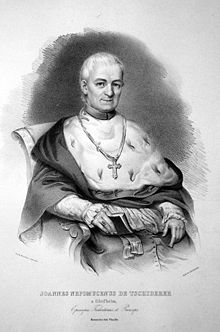
Johann was baptized moments after his birth at the Assumption church. He received his education from the Order of Friars Minor in 1786 after completing his initial education and resided with his maternal grandfather. He suffered from slight stuttering problems during his life. He relocated to Innsbruck with his parents in Austria in 1792 and underwent theological and philosophical studies at the college there.[3] He was elevated to the diaconate on 24 June 1800 and later received his ordination to the priesthood on 27 July 1800 both from Emmanuel Count von Thun, Bishop of Trent. Tschiderer celebrated his first Mass at San Antonio di Padua church at Collalbo.
From 1800 to 1802 he spent time as an assistant priest and then travelled to Rome for further studies and a pilgrimage where he was named as an apostolic notarius; he met the new Pope Pius VII several times during the course of 1802. He later returned and assumed pastoral work once more in the German part of Trento and was later made a professor of moral and pastoral theological studies at the episcopal seminary. In 1810 he became the parish priest at Sarentino – where he opened a small school – and then sent on 13 September 1819 as the new parish priest at Merano.[1][2]
On 26 October 1826 the Prince-Bishop Luschin appointed him as the cathedral canon and then on 26 December 1827 pro-vicar at Trento; on 24 February 1832 the Prince-Bishop Galura from Brixen selected him as Titular Bishop of Heliopolis – which received papal confirmation – and then as the vicar-general for Vorarlberg while also being named as an Auxiliary Bishop of Brixen at the same time. He received his episcopal consecration on 20 May 1832 in a Servite church.[2] In 1834 the Emperor Francis I nominated him as the new Bishop of Trent – or prince-bishop.[1][3] On 5 May 1835 he entered upon his office.
Bishop
Tschiderer spent his episcopate writing and preaching as well as teaching catechism. He devoted a considerable part of his revenues to the building and restoration of over 60 churches and to the purchase of books for the parsonages and chaplains’ houses. He used the third centennial of the opening of the Council of Trent to promote religious revival through popular pastoral initiatives. His charitable outreach to the poor and the sick was carried so far that he was often left without much himself. He left his residence to the institution for the deaf and dumb at Trento and to the educational institute for seminarians that he had founded and was later named after him as the “Joanneum”.[4] Tschiderer tended to the victims of cholera epidemics in 1836 and in 1855 as well as to those affected in a war in 1859; he intervened to prevent the 20 March 1848 uprising becoming a bloodbath and was hailed as a hero.[3] He tried to appeal to the Austrian forces to spare the lives of 21 members of the Franco-Italian forces who were captured but was denied so provided religious assistance and a solemn burial for them after their executions.[5] Tschiderer ordained as a priest Daniele Comboni in 1854. He promoted the Redemptorists and Jesuits in the region.
Tschiderer planned a pilgrimage to Rome in 1854 to commemorate the dogma of the Immaculate Conception but his ill health prevented him from doing so. He died during the evening of 3 December 1860 after suffering high fevers and being bedridden while also suffering from a heart ailment since 1859.[2] He received the Anointing of the Sick prior to his death and a papal blessing from Pope Pius IX.
Go here to read the rest.

