
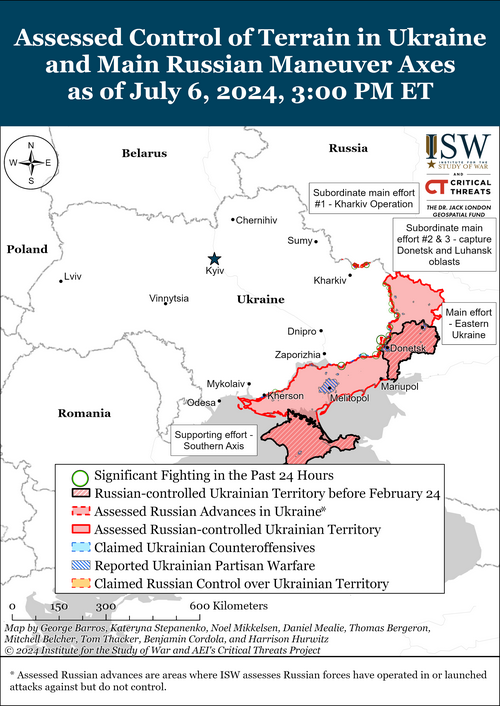
From The Institute for the Study of War:
Russian Offensive Campaign Assessment, July 6, 2024
Grace Mappes, Angelica Evans, Christina Harward, Riley Bailey, and Frederick W. Kagan
July 6, 2024, 4:20pm ET
Click here to see ISW’s interactive map of the Russian invasion of Ukraine. This map is updated daily alongside the static maps present in this report.
Click here to see ISW’s 3D control of terrain topographic map of Ukraine. Use of a computer (not a mobile device) is strongly recommended for using this data-heavy tool.
Click here to access ISW’s archive of interactive time-lapse maps of the Russian invasion of Ukraine. These maps complement the static control-of-terrain map that ISW produces daily by showing a dynamic frontline. ISW will update this time-lapse map archive monthly.
Note: The data cut-off for this product was 12:00pm ET on July 6. ISW will cover subsequent reports in the July 7 Russian Offensive Campaign Assessment.
Hungarian Prime Minister Viktor Orban continues to posture himself as a potential mediator to end the war in Ukraine despite Russian President Vladimir Putin’s rejection of mediation or serious negotiations. Orban is likely aiming to shift Western focus towards possible peace negotiations as part of his overarching effort to undermine European support for Ukraine. Orban published an op-ed in Newsweek on July 5 in which Orban accused NATO of choosing conflict over peace and stated that NATO was established to maintain peace.[1] Orban’s op-ed follows his visits to Kyiv on July 2 and Moscow on July 5 to advocate for Russia and Ukraine to start negotiations.[2] Orban’s efforts to push for negotiations are likely part of his ongoing effort to shift European focus to discussions about peace negotiations and away from discussions about military support for Ukraine. Orban has consistently opposed and undermined the European Union (EU)’s efforts to provide military assistance to Ukraine, and shifting Europe’s focus away from military assistance supports this broader aim now that Hungary has assumed the EU Council presidency.[3] Bulgarian Prime Minister Dimitar Glavchev offered on July 5 for Bulgaria to mediate peace negotiations between Ukraine and Russia and emphasized that negotiations must comply with the UN charter and international law.[4] Turkish Foreign Minister Hakan Fidan similarly pushed for Ukraine to widen and accelerate Ukraine’s ongoing peace process on July 6 to prevent “deepening polarization” and “prioritize diplomacy.”[5]
Orban’s and others’ calls for negotiations and Ukraine’s peace formula are distinct efforts with different aims, and Russian President Vladimir Putin has demonstrated that he is not interested in any negotiated agreements short of Ukraine’s capitulation. Putin rejected Russian participation in possible ceasefire negotiations processes and denied interest in a ceasefire altogether on July 4 and 5.[6] Putin instead demanded Ukrainian capitulation through “demilitarization” and the surrender of significant territory that Russia does not currently occupy — all following months of attempts to portray Russia as willing to negotiate but falsely painting Ukrainian officials as either unwilling or unable to negotiate.[7] Ukraine recently concluded the first of multiple summits with its partners to establish conditions for possible future negotiations that would result in an enduring peace on terms acceptable to Ukraine and its supporters, and dozens of partner states and international organizations, including Hungary, Turkey, and Bulgaria, signed a Joint Peace Communique affirming their support for Ukraine’s sovereignty and territorial integrity on June 16.[8] Ukraine’s ability to pursue its own peace process is contingent on its ability to liberate operationally-significant territory. Ukraine cannot undertake successful counteroffensive efforts in support of this aim without Western military support in the near- and medium-terms.
Ukrainian forces struck energy infrastructure in Krasnodar Krai with drones on the night of July 5 to 6. The Krasnodar Krai Operational Headquarters stated that Russian forces shot down Ukrainian drones near Leningradskaya, Yeysk and Pavlovskaya, Krasnodar Krai on the night of July 5 to 6 and that falling drone debris damaged a cell phone tower in Yeysk and caused a fire at an oil depot in Pavlovskaya.[9] The Krasnodar Krai Operational Headquarters also stated that Ukrainian drones struck a fuel tank in Leningradskaya, Krasnodar Krai. Russian opposition outlet Astra posted footage on July 6 of fires at fuel tanks in Leningradskaya and the Lukoil oil depot in Pavlovskaya.[10]
Iran announced on July 6 that Iran and Russia signed a bank agreement on July 4 enabling Russia and Iran to trade in the Russian ruble and Iranian rial.[11] Iranian Central Bank Head Mohammadreza Farzin announced that he and Russian Central Bank Head Elvira Nabiullina also signed a memorandum of understanding on unspecified joint measures for both banks.
The Russian government continues efforts to isolate the Russian people from material it considers antithetical to state interests and ideology. Russian federal censor Rozkomnadzor announced on July 4 that it recently blocked Russians from accessing 25 mobile virtual private network (VPN) services.[12] Russian outlet RBK reported on July 4 that it obtained a letter from the Russian Federal Security Service (FSB) demanding that Russian telecom operators prohibit clients from using foreign- and domestic-based Voice over Internet Protocol (VoIP) accounts, which allow clients to make phone calls via an Internet connection instead of a traditional phone line and are more difficult to trace.[13] The FSB alleged that the VoIP prohibition will help reduce fraud.[14] Rozkomnadzor announced in April 2024 that it began blocking 150 popular VPN services and restricting access to websites and social media posts that advertise VPNs as of March 1, 2024.[15] Russian State Duma Committee on Information Policy, Information Technology, and Communication Deputy Chairperson Oleg Matveychev stated in October 2023 that Rozkomnadzor is maintaining a list of VPNs that “comply” with existing Russian legislation and will continue to operate in Russia while Rozkomnadzor will block VPNs that “violate Russian laws.”[16] Kremlin-sponsored outlet Izvestia clarified in March 2024 that Rozkomnadzor considers any VPN services that allow Russians to access prohibited content and resources as violating Russian law and eligible to be blocked.[17]
The Russian Ministries of Education, Higher Education, Science, and Culture have approved a plan to develop criteria for an annual review of works of literature, art, media, or other materials to determine if a work uses an “excessive” amount of foreign vocabulary.[18] The order claims that developing the criteria is part of the Russian government’s efforts to protect Russia against “external destructive information, psychological influence, … and activities aimed at destroying [Russia’s] traditional values.” The Kremlin’s efforts to ban VPNs and identify works that employ “excessive use of foreign vocabulary” are part of ongoing efforts to consolidate control over the Russian information space and promote further Russian nationalist values domestically.
Key Takeaways:
- Hungarian Prime Minister Viktor Orban continues to posture himself as a potential mediator to end the war in Ukraine despite Putin’s rejection of mediation or serious negotiations. Orban is likely aiming to shift Western focus towards possible peace negotiations as part of his overarching effort to undermine European support for Ukraine.
- Orban’s and others’ calls for negotiations and Ukraine’s peace formula, are distinct efforts with different aims, and Russian President Vladimir Putin has demonstrated he is not interested in any negotiated agreements short of Ukraine’s capitulation.
- Ukrainian forces struck energy infrastructure in Krasnodar Krai with drones on the night of July 5 to 6.
- Iran announced on July 6 that Iran and Russia signed a bank agreement on July 4 enabling Russia and Iran to trade in the Russian ruble and Iranian rial.
- The Russian government continues efforts to isolate the Russian people from material it considers antithetical to state interests and ideology.
- Russian forces recently advanced near Kupyansk, Siversk, Toretsk, and Avdiivka.
- Russian federal subjects (regions) continue to increase monetary incentives to recruit contract soldiers (kontraktniki).
Go here to read the rest. Should Trump win in November he will doubtless call for negotiations to end the war. The reactions of both Putin and Ukraine should be instructive.

