
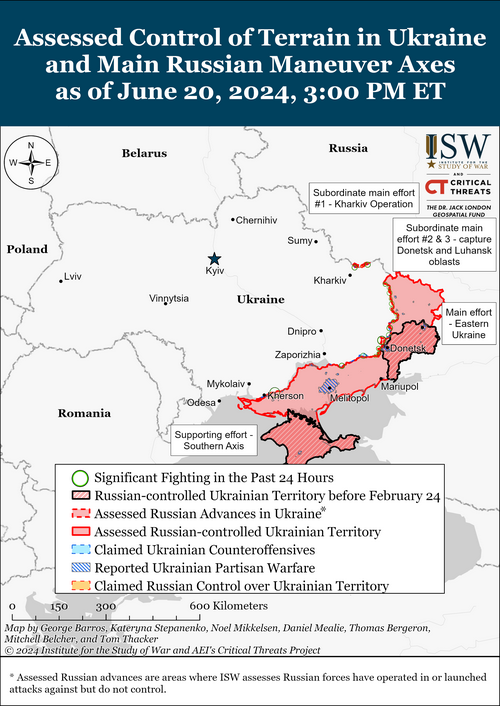
From The Institute for the Study of War:
Russian Offensive Campaign Assessment, June 20, 2024
Christina Harward, Kateryna Stepanenko, Angelica Evans, Karolina Hird, and George Barros
June 20, 2024, 8:30pm ET
Click here to see ISW’s interactive map of the Russian invasion of Ukraine. This map is updated daily alongside the static maps present in this report.
Click here to see ISW’s 3D control of terrain topographic map of Ukraine. Use of a computer (not a mobile device) is strongly recommended for using this data-heavy tool.
Click here to access ISW’s archive of interactive time-lapse maps of the Russian invasion of Ukraine. These maps complement the static control-of-terrain map that ISW produces daily by showing a dynamic frontline. ISW will update this time-lapse map archive monthly.
Note: The data cut-off for this product was 1:30pm ET on June 20. ISW will cover subsequent reports in the June 21 Russian Offensive Campaign Assessment.
Russian President Vladimir Putin launched a major information operation during his recent visit to North Korea and Vietnam on June 18 and 19 aimed at sabotaging efforts by Ukraine’s partners to clearly define a common strategic objective and strategy to decisively defeat Russia’s illegal war of conquest in Ukraine. Ukraine’s partners undertook several important steps in mid-June to cohere a common strategy and define the desired strategic outcome of the war. Over 80 Western and international officials recently established a principled position on supporting Ukraine’s sovereignty and territorial integrity as the foundation of lasting peace in Ukraine in a communique adopted during the Ukraine-led Global Peace Summit on June 16.[1] Ukraine also signed security agreements with the United States and Japan for 10 years on June 13, and numerous partner states reaffirmed their long-term support for Ukraine within the Group of 7 (G7) and the Ramstein formats.[2] US President Joe Biden stated that the United States will continue supporting Ukraine so that Ukraine “has victory and that Russia does not prevail” when discussing the US-Ukraine security agreement.[3] Putin’s strategy for winning the war relies on the Kremlin’s ability to mislead the United States, the European Union, and Ukraine’s international allies into ceasing support for Ukraine and abandoning key principles of international law – respect for state sovereignty and the inviolability of territorial integrity.[4] Allied strategic clarity and commitment to enabling Ukraine to decisively defeat Russia on the battlefield in Ukraine greatly undermines Putin’s center of gravity – and his ability to shape the will and decisions of allied decision makers.
Putin implicitly threatened to use nuclear weapons if the West enables Ukraine to decisively defeat Russia in order to undermine the international community’s cohering strategic vision of support for Ukraine. Putin stated in a press conference on June 20 following his trip to North Korea and Vietnam that Russia is considering making changes to its nuclear doctrine, claiming that Russia is aware that an unnamed “potential adversary” is working on new elements “related to lowering the threshold nuclear weapon use.”[5] Putin’s statement was likely partly in response to NATO Secretary General Jens Stoltenberg’s June 17 remarks that NATO members are discussing increased nuclear readiness in the face of growing threats from Russia and China, even though Stoltenberg did not discuss lowering the threshold for nuclear weapon use.[6] The Russian nuclear doctrine calls for Russia to only use nuclear weapons in the event of “exceptional cases” of threats to Russia’s sovereignty and territorial integrity, and Putin notably defined Russia’s possible strategic defeat in Ukraine as the “end of [Russia’s] statehood” following his mention of lowering thresholds for nuclear weapon usage.[7] Putin added that a defeat on the battlefield would signify the end of the “thousand-year history” of the Russian state and that Russia is better off fighting until the end. Putin’s rhetoric deliberately aims to present Russia’s aggression in Ukraine as an existential war for Russia’s sovereignty, and Putin likely invoked the possibility of lowering the threshold for nuclear weapon use to imply that he reserves the right to use nuclear weapons if his forces are decisively defeated on the frontlines in order to deter Ukraine’s allies from reaching a common strategic objective of decisively defeating Russia’s invasion of Ukraine — an outcome which is in the West’s interests.[8]
Putin’s nuclear threat is part of an ongoing Kremlin nuclear blackmail campaign aimed at dissuading Ukraine’s allies from decisively committing to defeating Russia’s illegal invasion of Ukraine and is therefore highly unlikely to result in actual nuclear escalation. A Russian strategic defeat in Ukraine does not threaten Russia’s sovereignty and territorial integrity (but it can threaten the stability of Putin’s regime). The Kremlin did not engage in nuclear escalation following Russia’s devastating defeats around Kyiv, Kharkiv, or Kherson oblasts in 2022, and these defeats certainly did not threaten Russian sovereignty or territorial integrity. Putin’s own nuclear threats have been riddled with contradictions since 2022. Putin claimed that Ukraine was not aggressive towards Russia but was threatening the occupied “Donbas republics” before Putin illegally annexed them.[9] Putin also noted in his discussion of the potential changes to the Russian nuclear doctrine that Russia does not need the ability to launch a preventative nuclear strike. Both of these statements are incompatible with the notion that Russia is fighting an existential war. Putin indicated that Ukrainian strikes on Russian territory with Western-provided weapons do not cross a supposed Russian “red line” that would result in Russian nuclear escalation after Ukrainian forces struck Belgorod Oblast with HIMARS armed with GMLRS.[10] ISW has also routinely assessed that the threat of a nuclear escalation will continue to be the core asset of Russia’s ability to manipulate the perceptions of foreign decision makers via its reflexive control campaign.[11] ISW continues to assess that Russia cannot defeat Ukraine or the West — and will likely lose — if the West mobilizes its resources to resist the Kremlin.[12]
South Korea responded to the Russian-North Korean comprehensive strategic partnership agreement on June 20 and stated that it would reconsider its previous ban on sending lethal military assistance to Ukraine. South Korea’s Yonhap News Agency reported that South Korean National Security Director Chang Ho-jin stated that South Korea will reconsider its stance on sending aid to Ukraine following the Russian-North Korean agreement and that South Korea is “grave[ly] concerned” and condemns the agreement.[13] South Korea has notably had a long-standing policy that prevents it from directly transferring arms into active conflict zones—a policy that has forced South Korea to send artillery shells to Ukraine via indirect transfers using third party intermediary states.[14] Chang also noted that any Russian military-technical cooperation with North Korea violates a series of United Nations Security Council (UNSC) resolutions and will result in unspecified corresponding retaliatory measures from South Korea. Chang stated that South Korea will also sanction four ships, five organizations, and eight individuals involved in the transfer of weapons and oil between Russia and North Korea in response to the agreement. North Korean state outlet Korean Central News Agency published the full text of the agreement on June 20, which includes provisions for “immediate military and other assistance… in the event of an armed attack by any state of several states” and “joint activities to strengthen [each country’s] defense capabilities… to prevent war.”[15] Several Russian and South Korean sources noted that the agreement is almost identical to the Treaty of Friendship, Cooperation, and Mutual Assistance that the Soviet Union and North Korea signed in 1961.[16]
Russian President Vladimir Putin simultaneously attempted to downplay aspects of the Russia-North Korea agreement potentially in response to South Korea’s concerns during a June 20 press conference in Vietnam. Putin reiterated several times during the press conference that the Russian-North Korean agreement mirrors the language of a previous security agreement that both countries signed in 1961 and that the agreement is only a “reproduction” of the terms of the 1961 agreement.[17] Putin stated that South Korea has “nothing to worry about” regarding the new agreement as long as South Korea does not perpetrate acts of aggression against North Korea. Putin threatened, however, that it would be a “very big mistake” for South Korea to supply lethal weapons to Ukraine and that Russia would take unspecified actions in response to such a policy. Putin claimed that the new agreement’s clause on providing mutual security assistance does not apply to the war in Ukraine because Ukraine committed acts of aggression towards the Donetsk and Luhansk People’s Republics (DNR/LNR) before Russia illegally annexed the territories and that Russia hopes that this agreement will be a “restraining factor” that prevents the situation on the Korean peninsula from intensifying. Putin also claimed that Russia has not asked anyone to “use [their] capabilities” in Ukraine and no one has offered to help Russia in this way, insinuating that there is no threat of third parties getting militarily involved in Ukraine. Putin may have tempered his rhetoric about Russia’s June 19 agreement with North Korea in order to quell South Korean concern about the agreement and lull South Korea into reassurance and away from reconsidering its policy on aiding Ukraine. ISW has previously observed that Russia at times seems to be trying to mend its relationship with South Korea to mitigate the impacts of a growing relationship with North Korea, and Putin may have followed up his visit to North Korea with such statements in an effort to appease Seoul.[18]
Putin also used the press conference to reiterate a series of known information operations feigning Russia’s interest in good faith negotiations with Ukraine, including by characterizing Russia’s offensive operation into Kharkiv Oblast as solely defensive. Putin claimed that he expected the West to reject his June 14 demands for Ukraine’s capitulation as a prerequisite for his envisioned peace negotiations and suggested that Russia has previously unsuccessfully presented these demands during “behind-the-scenes negotiations.”[19] Putin claimed that “sensible politicians” will realize that Putin’s demands for Ukraine to “completely withdraw” its forces from the administrative borders of Donetsk, Luhansk, Zaporizhia, and Kherson oblasts and officially abandon its intention to join NATO are “realistic” and acceptable conditions for peace. Putin’s terms for Ukraine’s capitulation violate the basic principles of the United Nations Charter and other cornerstones of international law. Putin stated that any peace negotiations predicated on Russia withdrawing its forces from occupied Ukraine will “never happen.” Russian officials made similar claims about how Kherson City would “forever” remain in Russian occupation before Russian forces abandoned Kherson City in November 2022.[20] Putin reiterated his claims that Russia remains open to peace negotiations to end the war in Ukraine, placing the onus on Ukraine and the West for the lack of progress toward peace negotiations despite the fact that Russian officials, including Putin, continue to publicly signal that they are unwilling to participate in good faith peace negotiations with Ukraine.[21] Putin also reiterated claims that Russian forces are conducting offensive operations in the Kharkiv direction to defend Belgorod Oblast from Ukrainian shelling and that Russian forces have “no goals of approaching Kharkiv [City].”
Putin also met with Vietnamese President Tô Lâm, Vietnamese Prime Minister Phạm Minh Chính, and General Secretary of the Central Committee of Vietnam’s Community Party Nguyễn Phú Trọng during his visit and discussed bilateral relations and the Soviet Union’s and Russia’s support of Vietnam during the 20th and 21st centuries.[22] ISW noted on June 19 that Putin appears to be pursuing a coalition of friendly states with historically warm ties to the Soviet Union that could form the basis of an alternative to the West and the current world order.[23]
Russian forces used the new FAB-3000 M-54 bomb with a unified planning and correction module (UMPC) to strike Ukrainian positions in Kharkiv Oblast for the first time, representing a new Russian capability with a high potential for destruction if Russian forces continue to be able to use such weapons uninhibited. Russian sources widely amplified footage of the first-ever FAB-3000 M-54 strike against a reported Ukrainian deployment point in Lyptsi, Kharkiv Oblast, on June 20, noting that the bomb caused substantial destruction even though it landed 10 meters away from its intended target.[24] Former Russian Defense Minister Sergei Shoigu first announced the serial production of FAB-3000 M-54s, dumb-bomb variants weighing over 3,000 kilograms that can be converted into guided glide bombs with the addition of the UMPC modification, during a visit to Nizhny Novgorod Oblast in March 2024.[25] Russian sources previously praised the production of FAB-3000s but noted that their weight and general dimensions would make them very difficult for most Russian tactical aircraft to deliver.[26] The fact that Russian forces have figured out how to launch FAB-3000s is a significant development and will increase the destructive potential of Russia’s ongoing glide bomb attacks against Ukrainian forces and infrastructure. Russian forces have already increased guided and unguided glide bomb use against Ukraine, particularly in Kharkiv Oblast, to devastating effect, and should Russian forces be able to launch massive barrages of FAB-3000s (or even heavier guided glide bombs) they will be able to cause even more widespread damage to Ukrainian frontline positions and critical infrastructure.[27] Russian milbloggers noted that the June 20 strike was not particularly accurate, but the destruction radius of the FAB-3000 will compensate for its lack of accuracy, especially if Russian forces are able to use them at scale uncontested as the Russian Air Forces has with 500-kilogram glide bombs.[28]
The United States made a policy change to prioritize delivering Patriot air defense interceptors to Ukraine against the backdrop of the increasing threat of Russian guided glide bomb use in Ukraine. US National Security Spokesperson John Kirby stated on June 20 that the US is going to “reprioritize” the export of Patriot missiles so that the missiles “rolling off the production line” will go straight to Ukraine.[29] Kirby characterized the decision as “difficult but necessary” to ensure that hundreds of Patriot and NASAM munitions produced for the next 16 months would go to Ukraine, regardless of which country ordered them. Kirby stated that Ukraine will receive the first shipments of Patriot missiles by the end of Summer 2024 and that other countries that ordered Patriot missiles will receive them on a “delayed timeline.” Kirby stated that other countries impacted by the delay were ”broadly supportive” of the decision to prioritize Ukraine’s air defense needs.[30] The Romanian Supreme National Defense Council announced on June 20 that Romania will donate one Patriot system to Ukraine due to Russia’s large-scale strikes on Ukrainian energy and civil infrastructure.[31] Ukrainian President Volodymyr Zelensky and Foreign Minister Dmytro Kuleba have recently emphasized Ukraine’s need for more Patriot systems.[32] ISW continues to assess that Ukraine’s ability to defend itself against devastating Russian glide bomb strikes is heavily contingent on Ukraine’s ability to target Russian aircraft within Russian airspace using US-provided air defense systems before Russian aircraft can launch strikes at Ukrainian cities, critical infrastructure, and frontline positions.[33]
US policy still prohibits Ukrainian forces from striking military targets with US-provided weapons in the operational and deep rear of Russian territory. Politico reported on June 20 that anonymous US government officials reiterated that the United States permits Ukrainian forces to strike Russian forces where Russian forces attack into Ukraine across the international border, likely meaning the international border near Ukraine’s Sumy, Chernihiv, and Kharkiv oblasts.[34] This report does not signify a change in US policy. The report makes clearer the contours of current US policy: Ukrainian forces may use HIMARS armed with GMLRS to strike Russian forces preparing to or actively attacking Ukraine, but likely may not strike all legitimate Russian military targets in range of Ukrainian HIMARS using GMLRS in Belgorod, Kursk, and Bryansk oblasts. The Politico report acknowledged that Ukrainian and European officials have urged the Biden Administration to further loosen its restrictions and allow Ukraine to strike all legitimate military targets in Russia.[35] US policy still protects the vast majority of Russia’s operational rear and deep rear, and US policy still forbids Ukrainian forces from using ATACMS anywhere in Russia.[36] The Biden Administration’s partial removal of Russian sanctuary is a step in the right direction but is by itself inadequate and unable to disrupt Russian operations at scale. ISW assesses that the West maintains the ability to substantially disrupt Russian operations at scale by allowing Ukraine to use Western-provided weapons to strike Russia’s operational rear and deep rear areas in Russian territory.[37]
The Russian military’s increased over-reliance on infantry-heavy frontal assault tactics has greatly degraded the distinctions between various Russian combat services on the battlefield in Ukraine, minimizing the operational efficacy of frontline troops. Ukrainian military observer Kostyantyn Mashovets reported on June 20 that he gained access to a 2024 training manual for Russian airborne (VDV) troops, entitled “Combat use of an assault company (group) in an offensive.”[38] Mashovets stated that the training manual is meant to integrate battlefield experiences from the war in Ukraine into VDV training doctrine and noted that the tactical solution to contemporary frontline challenges that the manual offers is the creation of dedicated VDV assault detachments, usually at the company level, pulled from units at the brigade-, regiment-, and battalion-level.[39] According to the manual, the assault groups should seize Ukrainian strong pints and individual firing points, as well as fortified terrain features, and ideally operate within a larger “assault detachment” or “assault battalion.”[40] Mashovets emphasized that Russian high command expects for these company-sized assault groups have a standard service life of two days maximum, as this is the timeframe in which the Russian high command has calculated that the assault group will completely expend its combat capabilities during attritional combat operations.
The concept of dedicated assault companies pulled from existing regiments, brigades, and battalions is not a novelty for Russian forces in Ukraine, and indeed has become the prevalent tactic of attack along most of the frontline for over a year, apart from occasional (mostly unsuccessful) mechanized assaults. ISW first began reporting on the creation of such specialized assault detachments within non-VDV Russian forces in February 2023 and observed the use of such assault-focused detachments in infantry-heavy frontal assaults leading to high levels of attrition throughout the course of 2023.[41] The fact that VDV forces are now relying on the same frontal assault tactic as ordinary Russian infantry and mechanized forces is notable, and further suggests that the VDV and other formations that were previously considered “elite” within the Russian military prior to 2022 have lost those distinctions due to the way that the Russian command writ large is prosecuting the war.[42] The codification of the assault group into VDV training doctrine further supports ISW’s long-standing assessment that the way that Russia is fighting in Ukraine has blurred previously relevant distinctions among various services, largely reducing all frontline troops to understrength and low-quality motorized rifle units.[43] A prominent Russian commentator, who previously served as an instructor for a “Storm-Z” assault unit (which notably used similar tactics to those outlined in the VDV training manual), criticized Russia’s reliance on attritional infantry-led frontal assaults on June 20, noting that this practice maintains constant pressure on Ukrainian defenders but does not achieve operationally significant results.[44] The current style of Russian assaults in Ukraine, however, corresponds with Russian President Vladimir Putin’s recently articulated theory of Russian victory in Ukraine, which suggests that all Russian forces need to do is gradually achieve creeping advances while keeping tension on Ukraine and its partners in order to win a war of attrition against Ukraine.[45]
Russian Defense Minister Andrei Belousov used a working visit to the Eastern Military District in Vladivostok, Primorsky Krai to create the appearance of a strict but engaged defense minister. Belousov visited the military camp of the 155th Naval Infantry Brigade, residential buildings for military personnel, the Okeansky military sanatorium, and a branch of the Nakhimov Naval School in Vladivostok on June 20.[46] Belousov issued instructions concerning multiple construction projects at these facilities and stated that the rehabilitation of Russian servicemembers and the allotment of housing to Russian servicemembers’ families are priorities of the Russian Ministry of Defense (MoD). Belousov repeatedly emphasized the need to complete these construction projects before the set deadlines and even threatened the director of a construction company that was touring the 155th Naval Infantry Brigade’s military camp with Belousov with criminal liability should the construction company not complete the project on time.[47] Belousov also notably spoke about Russian servicemembers’ possible return home from the war in Ukraine for the first time, stating twice on his tour that unspecified Russian soldiers will start to return home and that Russian authorities need to make sure that everything is “worthy” and “ready” for the soldiers.[48] The Russian decree on partial mobilization does not allow for the termination of mobilized Russian servicemembers’ contracts before the end of Russia’s “special military operation” in Ukraine, however, and it is unclear if Belousov was speaking about the return of soldiers in near or longer term, or purely theoretically.[49] The Kremlin has repeatedly publicly congratulated and awarded the 155th Naval Infantry Brigade over the course of the war in Ukraine, despite the fact that the unit has suffered significant losses and has had to reconstitute multiple times.[50] The Russian MoD may be paying special attention to the 155th Naval Infantry Brigade’s military and social facilities in Vladivostok in order to appease the soldiers and their families who may be angered by the unit’s heavy losses. Belousov’s strict orders about the timely fulfillment of military construction projects may also be part of efforts to create the appearance that Belousov is spearheading an anti-corruption campaign in the Russian MoD.[51]
Ukrainian forces conducted drone strikes against at least two oil facilities in Russia on the night of June 19 to 20. Ukrainian outlet RBK-Ukraine reported on June 20 that sources stated that Ukraine’s Security Service (SBU) conducted drone strikes against the Tambovnefteprodukt fuel and lubricants warehouse in Tambov Oblast and the Lukoil-Yugnefteprodukt “Enemska” oil depot in the Adygea Republic.[52] Geolocated footage shows fires at the oil depot in Platonovka, Tambov Oblast and the oil refinery in Enem, Adygea Republic.[53] Tambov Oblast Head Maskim Egorov acknowledged that a Ukrainian drone caused an oil tank at the Platonovka oil depot to catch fire.[54] Adygea Republic Head Murat Kumpilov stated that a Ukrainian drone strike started a fire at the Enem oil depot.[55] The Krasnodar Krai Operational Headquarters claimed that a drone fell on a house in Slavyansk-on-Kuban, and a Russian milblogger claimed that Ukrainian forces may have been targeting the Slavyansk Eko oil refinery in Slavyansk-on-Kuban.[56] Other Russian milbloggers claimed that Ukrainian forces struck the Afipsky oil refinery near Neftekachka, Krasnodar Krai.[57] The Krasnodar Krai Operational Headquarters claimed that information about a fire at the Afipsky refinery is not reliable.[58] ISW cannot independently verify that the Ukrainian strike on the Afipsky refinery, and the Afipsky and Enem oil refineries are notably fewer than 10 kilometers apart from each other. The Russian MoD claimed that Russian forces destroyed six drones over the Adygea Republic and three drones over Krasnodar Krai but did not mention activity over Tambov Oblast.[59]
Key Takeaways:
- Russian President Vladimir Putin launched a major information operation during his recent visit to North Korea and Vietnam on June 18 and 19 aimed at sabotaging efforts by Ukraine’s partners to clearly define a common strategic objective and strategy to decisively defeat Russia’s illegal war of conquest in Ukraine.
- Putin implicitly threatened to use nuclear weapons if the West enables Ukraine to decisively defeat Russia in order to undermine the international community’s cohering strategic vision of support for Ukraine.
- Putin’s nuclear threat is part of an ongoing Kremlin nuclear blackmail campaign aimed at dissuading Ukraine’s allies from decisively committing to defeating Russia’s illegal invasion of Ukraine and is therefore highly unlikely to result in actual nuclear escalation.
- South Korea responded to the Russian-North Korean comprehensive strategic partnership agreement on June 20 and stated that it will reconsider its previous ban on sending lethal military assistance to Ukraine.
- Russian President Vladimir Putin simultaneously attempted to downplay aspects of the Russia-North Korea agreement potentially in response to South Korea’s concerns during a June 20 press conference in Vietnam.
- Putin also met with Vietnamese President Tô Lâm, Vietnamese Prime Minister Phạm Minh Chính, and General Secretary of the Central Committee of Vietnam’s Community Party Nguyễn Phú Trọng during his visit and discussed bilateral relations and the Soviet Union’s and Russia’s support of Vietnam during the 20th and 21st centuries.
- Russian forces used the new FAB-3000 M-54 bomb with a unified planning and correction module (UMPC) to strike Ukrainian positions in Kharkiv Oblast for the first time, representing a new Russian capability with a high potential for destruction if Russian forces continue to be able to use such weapons uninhibited.
- The United States made a policy change to prioritize delivering Patriot air defense interceptors to Ukraine against the backdrop of the increasing threat of Russian guided glide bomb use in Ukraine.
- US policy still prohibits Ukrainian forces from striking military targets with US-provided weapons in the operational and deep rear of Russian territory.
- The Russian military’s increased over-reliance on infantry-heavy frontal assault tactics has greatly degraded the distinctions between various Russian combat services on the battlefield in Ukraine, minimizing the operational efficacy of frontline troops.
- Russian Defense Minister Andrei Belousov used a working visit to the Eastern Military District in Vladivostok, Primorsky Krai to create the appearance of a strict but engaged defense minister.
- Ukrainian forces conducted drone strikes against at least two oil facilities in Russia on the night of June 19 to 20.
- Ukrainian forces recently advanced near Vovchansk, and Russian forces recently advanced near Chasiv Yar, Avdiivka, and Donetsk City.
- Russian milbloggers complained that the Russian military command is failing to properly incentivize Russian servicemen to fight and explain the purpose of the Russian full-scale invasion to its troops.
Go here to read the rest. Putin seems to be on a bizarre nostalgia tour. Vietnam is concerned about Chinese expansionism and has no concerns about its trading partner and potential ally, the US. The Korean war is long over and North Korea is a pariah state ruled by a manifestly crazy dictator. Sending ships to Cuba, an utterly bankrupt state without any influence beyond its borders, was completely futile and pathetic. Putin is like an aging rocker, sure that the year is still 1968 and he is really in his twenties rather than his eighties. Over indulging in nostalgia can be detrimental in individuals. It is always a disaster for a Sate.

