
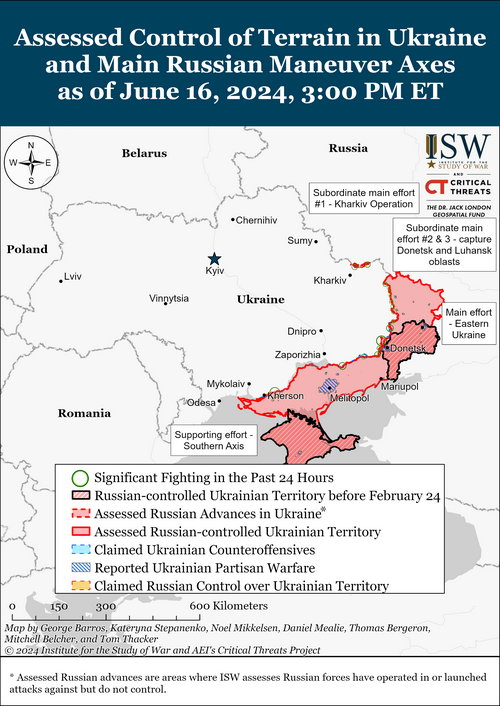
From The Institute for the Study of War:
Russian Offensive Campaign Assessment, June 16, 2024
Grace Mappes, Nicole Wolkov, Christina Harward, Karolina Hird, and George Barros
June 16, 2024, 5:20pm ET
Click here to see ISW’s interactive map of the Russian invasion of Ukraine. This map is updated daily alongside the static maps present in this report.
Click here to see ISW’s 3D control of terrain topographic map of Ukraine. Use of a computer (not a mobile device) is strongly recommended for using this data-heavy tool.
Click here to access ISW’s archive of interactive time-lapse maps of the Russian invasion of Ukraine. These maps complement the static control-of-terrain map that ISW produces daily by showing a dynamic frontline. ISW will update this time-lapse map archive monthly.
Note: The data cut-off for this product was 12:30pm ET on June 16. ISW will cover subsequent reports in the June 17 Russian Offensive Campaign Assessment.
The vast majority of the countries and international organizations that participated in the Ukraine-initiated Global Peace Summit in Switzerland on June 15-16 signed a joint communique on June 16 reaffirming support for Ukraine’s sovereignty and territorial integrity.[1] The communique also reaffirmed support for Ukrainian operation and control over the Russian-occupied Zaporizhzhia Nuclear Power Plant (ZNPP) to ensure the safety of nuclear energy and installations, “free full, and safe” commercial navigation in the Black Sea to ensure global food security, the exchange of all prisoners of war (POWs), and the return of all “deported and unlawfully displaced Ukrainian children” and other unlawfully detained Ukrainian civilians. Over 80 countries and international organizations signed the communique, although Saudi Arabia, India, South Africa, Armenia, Bahrain, the United Arab Emirates (UAE), and Brazil (which attended the summit as an “observer”) were among the countries that did not endorse the communique.[2] The Ukrainian President’s Office emphasized that the purpose of the summit was to facilitate “fair peace … based on the United Nations (UN) Charter and international law,” highlighting Ukraine’s effort to garner support from the international community in ending the war on terms that do not violate international law by compromising Ukraine’s territory integrity or sovereignty.[3] Dutch Prime Minister Mark Rutte stated on June 16 at the summit that “Russia should not be at the [negotiating] table now” and that there will only be peace in Ukraine “when Russia agrees to international principles and the UN Charter.” ISW continues to assess that Russian President Vladimir Putin is not interested in good-faith negotiations and only feigns interest in negotiations in specific instances as part of a wider informational effort to seduce the West to preemptively make concessions that would violate Ukraine’s sovereignty.[4] Putin is unlikely to be interested in good faith negotiations for the foreseeable future given that he recently outlined a theory of Russian victory in Ukraine based on the assumption that Russian forces are capable of indefinite creeping advances on the battlefield to outlast Western support for Ukraine.[5]
A limited prison break and hostage situation at a Russian pretrial detention center in Rostov-on-Don, Rostov Oblast, prompted Russian ultranationalist complaints highlighting Russia’s failure to crack down against domestic Islamic extremism following the March 22 Crocus City Hall terrorist attack. Russian state media reported on June 16 that around six prisoners at Pretrial Detention Center No. 1 in Rostov-on-Don broke out of their cells and took two employees of the pretrial detention center hostage in the central courtyard.[6] Rosgvardia and Russian Federal Penitentiary Service forces later stormed the pretrial detention center and reportedly killed the detainees, freeing the hostages.[7] Russian state media claimed that the prisoners had links to the Islamic State (IS) or had been convicted of terrorism-related charges prior to the June 16 incident.[8] ISW is unable to verify the identities or affiliations of these prisoners or the extent of IS involvement in the prison break at the time of this publication.
Russian ultranationalist milbloggers largely fixated on the hostage situation in Rostov-on-Don to complain about the perceived prevalence of Islamic extremism in Russia and the Russian penal system. Russian milbloggers largely circulated the alleged identities, affiliations, and charges of each of the prisoners, as well as footage showing the prisoners with an IS flag, IS paraphernalia, and knives at the pretrial detention center.[9] The milbloggers complained that Russian authorities failed to crack down against extremist groups and used racist and xenophobic rhetoric to emphasize this point; the milbloggers complained that the pretrial detention center allowed the prisoners to have well-kept facial hair in accordance with their religious beliefs and that the prisoners had planned this attack on a Muslim holy day to coincide with the Eid al-Adha holiday on June 16.[10] The milbloggers also complained that the Russian penal system has failed to maintain security given that the prisoners managed to obtain an IS flag, weapons, and communication devices and break from their cells, and that some of the prisoners had been convicted of terrorism but had yet not been transported to penal colonies because their sentences had not yet begun.[11] Some milbloggers complained more widely that the Russian penal system has fallen apart, blaming reforms under then-President Dmitry Medvedev in the mid-2000s and Russia’s failure to adequately compensate Federal Penitentiary Service employees for creating the situation.[12]
The Kremlin has attempted to posture that it has been cracking down against domestic extremism since the Crocus City Hall attack, but the June 16 attack and subsequent discussions undermine this Kremlin effort.[13] Russian opposition outlet Baza claimed that the prisoners had planned this attack for several months and that actors with alleged IS ties smuggled the weapons, IS flag, and communication devices to the prisoners inside the pretrial detention center.[14] Opposition outlet Verstka reported that the Rostov Oblast prosecutor’s office has conducted monthly inspections of the detention conditions of Pretrial Detention Center No. 1 after reports that the center was overcrowded, while the Rostov Oblast Public Monitoring Group conducted three inspections in October 2022, February 2023, and November 2023 and did not find any violations.[15] Some Russian officials seem content to minimize this situation in the near-term; Rostov residents criticized Rostov Oblast Head Vasily Golubev for not responding to the hostage situation until two hours after the situation concluded, and Russian opposition outlet Meduza reported that Golubev’s social media accounts deleted comments on his page before turning off the ability to comment altogether.[16] Russian Investigative Committee Head Alexander Bastrykin demanded a report on the initial investigation into the hostage situation on June 16.[17] The Kremlin will likely use the June 16 incident to continue posturing the need for domestic crackdowns against all definitions of extremism beyond the domestic terror threat to Russia while masking or deflecting its actual security failures to prevent the March 22 and June 16 attacks.
The Kremlin and Kremlin affiliates continue efforts to use Russia’s relationship with Republika Srpska (the Serbian political entity within Bosnia and Herzegovina) to destabilize the Balkans. Russian Foreign Minister Sergei Lavrov claimed at the opening of the Russian embassy in Banja Luka on June 11 that ties between Russia and Republika Srpska are at an all-time high.[18] Lavrov claimed that the Russian Ministry of Foreign Affairs (MFA) will prioritize the construction of religious and cultural institutions in Banja Luka that are critical for the strengthening of the “ties of brotherhood” between the people of Russia and Republika Srpska. A prominent, Kremlin-affiliated Russian milblogger claimed on June 16 in an interview with a Republika Srpska TV channel that Russia will support Republika Srpska’s independence and that the opening of the Russian embassy in Banja Luka demonstrates the friendship and cooperation between Russia and Republika Srpska.[19] The milblogger claimed that Russia may open a Russian cultural center (Russia house – Russkii dom) in Republika Srpska. Moldovan and Ukrainian officials have previously warned that Russian officials use Russkii dom to promote Russian propaganda and conduct “subversive work” abroad.[20] The same milblogger’s channel claimed in April 2024 that it opened a “media school” in the Balkans and that the channel’s team spent a week in Serbia and Republika Srpska giving lectures on how to operate Telegram channels and fight “misinformation.”[21] Republika Srpska President Milorad Dodik stated on June 7 that Republika Srpska intended to hold a referendum on its independence from Bosnia and Herzegovina on an unspecified date.[22] The Kremlin has previously leveraged its relationship with Republika Srpska to further influence the Balkans, sow divisions in the West, and undermine the Dayton Accords to throw the Balkans into turmoil.[23]
The Financial Times (FT) reported on June 16 that Russia overtook the United States as Europe’s main gas supplier in May 2024, highlighting Europe’s continued reliance on Russian energy.[24] FT reported that the US became Europe’s largest gas supplier following Russia’s 2022 full-scale invasion of Ukraine, but that in May 2024 Russian gas and liquified natural gas (LNG) shipments to Europe rose to 15 percent of total supply, while the United States provided 14 percent. FT did note, however, that the shift in gas and LNG imports in May was partially a result of “one-time factors,” such as an outage at an American LNG export factory and a planned increase in Russian gas exports to compensate for shortcomings due to maintenance on a line sometime in June. FT concluded that Russia is unlikely to maintain the upper hand in the coming months, as it will be able to increase shipments of LNG to Asia via the Northern Sea Route, reducing exports to Europe, while US LNG production has stabilized after the recent one-time outage. FT previously reported on June 5 that Russian state-owned gas company Gazprom commissioned a report that found that Gazprom is unlikely to recover the vast majority of gas sales to Europe that it lost since 2022, highlighting that Gazprom’s business with Europe has significantly decreased overall, notwithstanding this short-term decrease in US gas exports to Europe in May 2024.[25] Russia remains reliant on oil and gas revenues to support its wartime economy and increased its energy exports to China significantly over the course of 2023, likely in part to offset impacts from the loss of the European market in 2022.[26]
Key Takeaways:
- The vast majority of the countries and international organizations that participated in the Ukraine-initiated Global Peace Summit in Switzerland on June 15-16 signed a joint communique on June 16 reaffirming support for Ukraine’s sovereignty and territorial integrity.
- A limited prison break and hostage situation at a Russian pretrial detention center in Rostov-on-Don, Rostov Oblast, prompted Russian ultranationalist complaints highlighting Russia’s failure to crack down against domestic Islamic extremism following the March 22 Crocus City Hall terrorist attack.
- The Kremlin and Kremlin affiliates continue efforts to use Russia’s relationship with Republika Srpska (the Serbian political entity within Bosnia and Herzegovina) to destabilize the Balkans.
- Russian forces recently advanced near Vovchansk and Donetsk City.
- The Russian military reportedly continues to coerce Russian conscripts into signing military service contracts with the Russian Ministry of Defense (MoD), likely as part of ongoing crypto-mobilization efforts.
Go here to read the rest. The hostage taking in Rostov was apparently quickly quelled, but Russia has a big problem with Islam that it is ignoring.


Putin is making Justinian’s mistake with Islam (and in the longer run with China). It’s more glorious to advance in the West than protect the East, but the East is more essential to his security. Justinian’s successors lost both in the end.
Putin’s definition of long term is quite myopic and his dabbling with China, Chechnya and other peripheral entities will come back to bite him. It would appear that he knows less about History that he does about the military. A study of Roman “barracks emperors” and what happens when troops tire of being cannon fodder as the instrument of foreign policy might offer him some perspective.