
From The Institute for the Study of War:
Russian Offensive Campaign Assessment, June 13, 2024
Grace Mappes, Angelica Evans, Christina Harward, Karolina Hird, and George Barros
June 13, 2024, 6:45pm ET
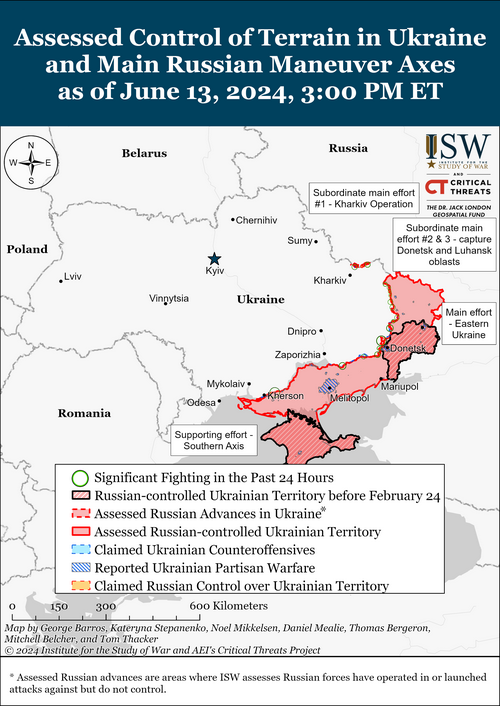
Click here to see ISW’s interactive map of the Russian invasion of Ukraine. This map is updated daily alongside the static maps present in this report.
Click here to see ISW’s 3D control of terrain topographic map of Ukraine. Use of a computer (not a mobile device) is strongly recommended for using this data-heavy tool.
Click here to access ISW’s archive of interactive time-lapse maps of the Russian invasion of Ukraine. These maps complement the static control-of-terrain map that ISW produces daily by showing a dynamic frontline. ISW will update this time-lapse map archive monthly.
Note: The data cut-off for this product was 1:15pm ET on June 13. ISW will cover subsequent reports in the June 14 Russian Offensive Campaign Assessment.
Ukraine signed bilateral ten-year security agreements with the United States and Japan on June 13 as other partner states reaffirmed their long-term support for Ukraine within the Group of 7 (G7) and Ramstein formats. Ukrainian President Volodymyr Zelensky announced on June 13 that he signed bilateral ten-year security agreements with US President Joe Biden and Japanese Prime Minister Fumio Kishida on the sidelines of the ongoing G7 Summit.[1] The US-Ukraine agreement provides for long-term cooperation in defense and security, economic recovery and reform, and the advancement of Ukraine’s Euro-Atlantic integration.[2] The Japan-Ukraine agreement provides for Japan’s $4.5 billion contribution to Ukraine in 2024 and continued ten-year long support in security and defense, humanitarian aid, technical and financial cooperation, reconstruction efforts, and sanction measures against Russia.[3] Zelensky lauded both agreements as historic breakthroughs for Ukraine’s bilateral relations with both the United States and Japan.[4] The United Kingdom (UK) Prime Minister’s Office reported on June 12 that UK Prime Minister Rishi Sunak will announce up to £242 million (about $208 million) in bilateral assistance for Ukraine’s humanitarian, energy, and economic and social recovery needs while at the G7 Summit.[5] French outlet France24 reported that G7 leaders are also finalizing details on the transfer of up to $50 billion in frozen Russian assets to Ukraine by the end of 2024.[6] G7 countries collectively possess $235 billion in frozen Russian assets, and G7 leaders are reportedly brokering a deal that would rely on a US-led $50 billion loan that would reach Ukraine by the end of 2024 and be “topped up” with contributions by other allies.[7] NATO Secretary General Jens Stoltenberg also announced during a Ukraine Defense Contract Group at the Ramstein Airbase in Germany on June 12 that NATO partners will agree on a comprehensive military and financial aid package for Ukraine during the upcoming NATO summit in July 2024 and emphasized that NATO will lead efforts to provide security assistance and training for Ukraine.[8] Stoltenberg also stated that the supply of weapons to Ukraine may become mandatory for NATO members in order to ensure that NATO’s security assistance for Ukraine remains “reliable and large-scale.”[9]
The United States finally sanctioned the Moscow Exchange, other significant Russian financial institutions, and Russian defense manufacturers 839 days into Russia’s full-scale invasion of Ukraine. The US Department of the Treasury announced on June 12 sanctions against more than 300 individuals and entities supporting Russia’s wartime economy, including the Moscow Exchange and its subsidiaries; major banks VTB Bank, Sberbank, and Tochka Bank; and leading Russian defense industrial base (DIB) entities including state owned defense conglomerate Rostec, the state owned aerospace and defense company United Aircraft Corporation, vehicle and vehicle components manufacturer Kamaz, main Russian tank manufacturer Uralvagonzavod, and helicopter design and manufacturing company Russian Helicopters.[10] The UK also announced similar sanctions targeting Russian financial institutions, entities supporting the Russian DIB, and Russia’s shadow fleet of oil tankers.[11]
The Russian government appears confident that these new sanctions will minimally impact the Russian financial system, and the delay in US and other Western countries sanctioning these entities has given the Russian financial system time to prepare and mitigate such sanctions. The Moscow Exchange immediately suspended trading in US dollars (USD), euros, and Hong Kong dollars (HKP) in several markets on June 12 following the US sanctions announcement, and the Russian Central Bank instituted a fixed exchange rate for over-the-counter trading using the USD and euro on June 13.[12] Western and some Russian media widely circulated reports of some Russian banks appearing to sell USD to Russians at 100-200 rubles per dollar on June 12 and 13, but prominent Russian banks Sberbank and VTB quickly announced on June 12 that the new US sanctions would not impact their operations.[13] The Russian Central Bank has prepared for these sanctions and developed a procedure in October 2022 for setting currency exchange rates when it cannot obtain such data from the Moscow Exchange (data the Moscow Exchange can presumably no longer provide for USD).[14] The Russian Central Bank began publishing information on over-the-counter foreign exchange trade in April 2024.[15] The Russian Central Bank set its rubles per USD exchange rate for June 14 to 88.2080, only 88 kopecks lower than the previous rate, and the ruble-to-euro exchange rate only decreased by 91 kopecks to 94.8342 rubles per euro.[16] Bloomberg reported that multiple Russian metals producers and a fertilizer maker are not worried about the end of USD-ruble exchange trading and that Russian state-owned gas monopoly Gazprom has not used the Moscow Exchange for settlements “in a long time.”[17] Russian Security Council Deputy Chairperson Dmitry Medvedev complained about the new US sanctions, claiming that Russia is stable enough that it does not need to react to these sanctions out of economic need but that Russia should inflict “maximum harm” on the West in reaction to these sanctions because the United States and its allies “declared war on us [Russia] without rules.”[18] Medvedev’s choice to publish this only on his Russian language Telegram account indicates he likely means to posture strength and stability to a domestic Russian audience rather than address international audiences.
Bloomberg assessed on June 13 that the new US sanctions would make it more difficult for Russian businesses to trade on the international market due to the increased costs of over-the-counter trading and reduced foreign willingness to do business with Russian entities due to the fear of secondary sanctions.[19] A source close to the Russian Central Bank told Bloomberg that Chinese banks will gradually reduce their cooperation with the Moscow Exchange given these issues but that these banks will still provide yuan liquidity to support imports. The source also stated that there is uncertainty whether the Russian Central Bank’s new exchange rates will work and how much costs of foreign trading and business will rise.
US President Joe Biden reiterated his opposition to allowing Ukrainian forces to strike military targets in Russia’s operational or deep rear areas in Russian territory with US-provided weapons. Biden acknowledged that it “makes a lot of sense” to allow Ukrainian forces to strike Russian forces on the immediate side of the international border in Russian territory but that the United States has not changed its restrictions prohibiting Ukraine from striking Russia’s operational or deep rear in Russian territory.[20] ISW assesses that the Biden Administration’s limited policy change permitting Ukraine to use US-provided weapons to strike some Russian military targets in a small area within Russian territory has reduced the size of Russia’s ground sanctuary by only 16 percent at maximum.[21] ISW assesses that the West maintains the ability to substantially disrupt Russian operations at scale by allowing Ukraine to use Western-provided weapons to strike Russia’s operational rear and deep rear areas in Russian territory.[22]
Sustained Ukrainian strikes against Russian military targets in occupied Crimea appear to be forcing the Russian military to commit additional air defense assets to Crimea in order to defend existing bases and logistics infrastructure, and further Ukrainian strikes against such air defense assets may render the peninsula untenable as a staging ground for the Russian military. Ukraine’s Main Military Intelligence Directorate (GUR) Head Lieutenant General Kyrylo Budanov reported on June 12 that Russian forces placed an S-500 air defense system (essentially a modernized version of the S-300) in Crimea as part of their efforts to strengthen Russia’s air defense umbrella over Crimea.[23] Budanov stated that Russian forces have not previously used an S-500 air defense system in combat and characterized the system as “experimental.” Forbes reported on June 12 that the Belbek Airfield in occupied Crimea is becoming an “attrition trap” for Russian air defenses following several successful Ukrainian strikes on air defenses near the airfield.[24] Forbes stated that it is possible that Ukrainian forces have destroyed elements of four or five S-400 batteries during recent strikes but noted that the Russian military has over 50 S-400 batteries. An X (formerly known as Twitter) user, citing satellite imagery, noted on June 11 that Russian forces have placed 17 barges near the Kerch Strait Bridge that connects occupied Crimea to Krasnodar Krai.[25] Russian forces likely intend for the barges to serve as defenses against Ukrainian naval drone strikes against the bridge, and Russian forces previously installed eight barges on the southern side of the bridge for similar reasons.[26] Ukraine’s current efforts to attrit the Russian air defense umbrella in Crimea notably may have the exploitable effect of drawing more Russian air defense assets to Crimea, making them vulnerable to further Ukrainian strikes. ISW previously assessed that Ukrainian forces may be conducting an organized effort to degrade Russian air defenses, which could enable Ukraine to more effectively leverage manned fixed-wing airpower (namely using F-16 fighter jets) in the long term.[27] The West has long supported Ukraine’s right to strike Russian military targets in occupied Crimea, and Ukrainian forces could in principle be able to replicate their successful strikes against military targets in Russia if the West approved such strikes in Russia’s rear.
The People’s Republic of China (PRC) is reportedly using diplomatic channels to convince other countries to not support the upcoming June 15-16 Global Peace Summit in Switzerland. Reuters reported on June 13 that 10 Beijing-based diplomats from unspecified countries stated that the PRC is using meetings with visiting foreign officials, phone calls, and messages on the WeChat platform to lobby other countries to support the PRC’s and Brazil’s suggested six-point peace plan, which called for a peace conference that includes both Ukraine and Russia.[28] Reuters reported that diplomatic sources stated that the PRC has not overtly criticized the upcoming peace summit in Switzerland when speaking with developing states and is instead trying to subtly bring about certain outcomes. One diplomatic source stated that the PRC has told developing states that the Swiss peace summit will prolong the war in Ukraine, and two diplomatic sources reportedly stated that the PRC has also been telling unspecified Western states that many developing states agree with the PRC’s views about the Swiss peace summit. Russian President Vladimir Putin reportedly asked PRC President Xi Jinping in May 2024 to “snub” the peace conference in Switzerland.[29] Ukrainian President Volodymyr Zelensky stated on June 2 that Russia is using Chinese influence and diplomats to disrupt the Global Peace Summit.[30] The Kremlin is likely trying to exploit the PRC’s greater diplomatic connections and influence in the world to forward Russian interests.
The United States, United Kingdom (UK), and Canada released a joint statement on July 13 acknowledging and condemning Russian subversive activity and electoral interference efforts in Moldova, which is consistent with ISW’s long-standing assessment of the Kremlin’s ongoing hybrid campaign to destabilize Moldovan democracy.[31] The statement noted that the United States, UK, and Canada share Moldovan President Maia Sandu’s concerns that the Kremlin is seeking to undermine Moldovan democratic institutions and practices in the lead-up to Moldova’s October 2024 presidential election and European Union (EU) membership referendum. The statement noted that the Kremlin is leveraging criminal groups to finance political activities that undermine Moldovan democracy and is supporting candidates for the presidency that are “exacerbating social tensions.” The statement heavily emphasizes the role of Russian disinformation campaigns targeting Moldovan democracy. ISW has written at length about recent Kremlin efforts to destabilize Moldova internally, including by supporting pro-Kremlin Moldovan political parties and conducting targeted disinformation campaigns.[32]
Key Takeaways:
- Ukraine signed bilateral ten-year security agreements with the US and Japan on June 13 as other partner states reaffirmed their long-term support for Ukraine within the Group of 7 (G7) and Ramstein formats.
- The US finally sanctioned the Moscow Exchange, other significant Russian financial institutions, and Russian defense manufacturers 839 days into Russia’s full-scale invasion of Ukraine.
- The Russian government appears confident that these new sanctions will minimally impact the Russian financial system, and the delay in US and other Western countries sanctioning these entities has given the Russian financial system time to prepare and mitigate such sanctions.
- US President Joe Biden reiterated his opposition to allowing Ukrainian forces to strike military targets in Russia’s operational or deep rear areas in Russian territory with US-provided weapons.
- Sustained Ukrainian strikes against Russian military targets in occupied Crimea appear to be forcing the Russian military to commit additional air defense assets to Crimea in order to defend existing bases and logistics infrastructure, and further Ukrainian strikes against such air defense assets may render the peninsula untenable as a staging ground for the Russian military.
- The People’s Republic of China (PRC) is reportedly using diplomatic channels to convince other countries to not support the upcoming June 15-16 Global Peace Summit in Switzerland.
- The US, United Kingdom (UK), and Canada released a joint statement on July 13 acknowledging and condemning Russian subversive activity and electoral interference efforts in Moldova, which is consistent with ISW’s long-standing assessment of the Kremlin’s ongoing hybrid campaign to destabilize Moldovan democracy.
- Ukrainian forces recently advanced north of Kharkiv City and Russian forces marginally advanced near Siversk and Avdiivka.
- Russian federal subjects (regions) continue to increase monetary incentives to recruit military personnel.
Go here to read the rest. Presumably the ten year “bi-lateral agreement” is an attempt to bind the hands of a future President Trump. If this is the goal, it is foolish. Such an agreement is not a treaty as no such agreement could gain the two-thirds vote in the Senate needed for passage. Trump could simply state that the US is not bound by the bi-lateral agreement. Ukraine could attempt to sue to enforce the agreement, and good luck with that.

