
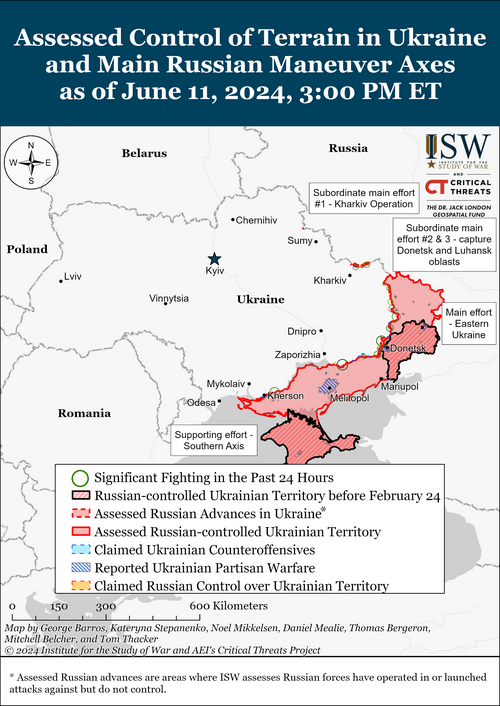
From The Institute for the Study of War:
Russian Offensive Campaign Assessment, June 11, 2024
Angelica Evans, Karolina Hird, Nicole Wolkov, Grace Mappes, and George Barros
June 11, 2024, 7:15pm ET
Click here to see ISW’s interactive map of the Russian invasion of Ukraine. This map is updated daily alongside the static maps present in this report.
Click here to see ISW’s 3D control of terrain topographic map of Ukraine. Use of a computer (not a mobile device) is strongly recommended for using this data-heavy tool.
Click here to access ISW’s archive of interactive time-lapse maps of the Russian invasion of Ukraine. These maps complement the static control-of-terrain map that ISW produces daily by showing a dynamic frontline. ISW will update this time-lapse map archive monthly.
Note: The data cut-off for this product was 1:30pm ET on June 11. ISW will cover subsequent reports in the June 12 Russian Offensive Campaign Assessment.
Ukraine’s Western allies continue to provide monetary and military assistance to Ukraine, including air defense systems. The Estonian Ministry of Defense (MoD) announced on June 11 that Estonia will provide an undisclosed number of Mistral man-portable short-range air defense systems and missiles to Ukraine as part of a new military assistance package.[1] European Commission President Ursula von der Leyen announced during the Ukrainian Recovery Conference in Berlin on June 11 that the European Union (EU) will transfer roughly 1.5 billion euros ($1.6 billion) worth of profits from frozen Russian assets to Ukraine in July, of which Ukraine will allocate 90 percent to defense spending and 10 percent to reconstruction.[2] Von der Leyen stated that the EU will also transfer an additional 1.9 billion euros ($2 billion) to Ukraine from the EU’s Ukraine Facility mechanism, which is a separate fund that provides for the EU to transfer up to 50 billion euros ($53.7 billion) to Ukraine between 2024 and 2027.[3] German Chancellor Olaf Scholz reiterated during the Ukrainian Recovery Conference that Germany will deliver a Patriot air defense system to Ukraine in the coming weeks and announced that Germany will also deliver an IRIS-T air defense system, an unspecified number of Gepard self-propelled anti-aircraft guns, and an unspecified number and type of missiles and ammunition to Ukraine in the coming weeks and months.[4] The German MoD initially announced the transfer of this third Patriot system in April 2024.[5] The New York Times, citing senior US administration and military officials, reported on June 11 that US President Joe Biden recently approved the transfer of another Patriot system to Ukraine following a series of high-level meetings and internal debates regarding the best ways to meet Ukraine’s need for additional air defenses.[6] Unnamed US officials stated that the new system could be deployed to the frontline within several days depending on any maintenance or modifications that the system may need, as the system is currently stationed in Poland.
The Kremlin continues efforts to codify legal instruments and repressive measures intended to broadly censor foreigners and foreign organizations in Russia. The Russian State Duma adopted a bill in its first reading on June 11 that seeks to codify the Russian government’s ability to recognize “any” foreign organization as “undesirable.”[7] The Duma first approved the draft version of this bill on May 27.[8] The Duma also adopted an additional bill in its first reading that introduces criminal penalties including fines and imprisonment for someone’s participation in “any” organization classified as “undesirable.”[9] Duma Chairperson Vyacheslav Volodin noted that this new bill will fill a gap in the existing legislation, which only has provisions to class foreign non-governmental organizations (NGOs) as “undesirable.”[10] The new bill will extend the undesirable classification to any foreign and international organizations, thereby broadening the Kremlin’s discretion to target and censor a wide range of foreign organizations operating within Russia. The Kremlin has previously used the “undesirable” designation to block opposition media outlets, civil society organizations, and human rights-focused organizations from entering or operating within Russia, as ISW has previously reported.[11] Kremlin-appointed Russian Commissioner for Human Rights Tatiana Moskalkova also notably called on June 11 for the establishment of a legal mechanism that would allow the Russian government to prosecute foreigners for “Russophobia as a manifestation of extremism.”[12] Russian authorities widely use accusations of “Russophobia” in an attempt to undermine any undesirable policy or rhetoric they deem to be “anti-Russian,” and have similarly used charges of extremism with broad discretion to suppress and discourage domestic opposition.[13]
A prominent Kremlin-awarded Russian milblogger channel announced that it opened a second “media school” in Bishkek, Kyrgyzstan, likely to support Kremlin efforts to expand its influence in the international information space, particularly in Central Asia. The Rybar Telegram channel claimed on June 11 that it is opening the “Rybar Media School” in Bishkek because Kyrgyzstan lacks military-political and industry expertise as well as a “blogosphere” and opinion journalism.[14] Rybar framed its establishment of a “media school” in Bishkek as an effort to coordinate and assert Russia’s position in Central Asia and warned that Russia could be “expelled” from Central Asia in three to five years if Russia fails to assert itself and manage its informational influence in the region. Rybar’s founder and manager Mikhail Zvinchuk gave a lecture to students at the Kyrgyz National University about the benefits of using Telegram to “solve problems” in the current information environment. Rybar claimed that Zvinchuk’s lecture was only the first in a series of lectures and trainings for Kyrgyz media workers, students, public relations professionals, and press services to learn how to use multimedia to develop local Kyrgyz journalism. Rybar claimed that journalists from the Kyrgyz-branch of the official Russian government outlet Rossiyskaya Gazeta, “complained” about the lack of Russian journalistic work in Central Asia and claimed that the West outbalances Russia in its support for Kyrgyz journalism. Zvinchuk gave a masterclass in December 2023 on the importance of Telegram and other social media to press heads at Russian state-owned defense conglomerate Rostec likely in an effort to normalize the war without directly involving the Kremlin or other official state bodies. Rybar announced that it opened a media school in an unspecified location in the Balkans in April 2024.[15] Rybar claimed that multiple Serbian and Republika Srpska (the Serbian entity within Bosnia and Herzegovina) outlets highlighted Rybar’s “debut” in the Balkans, while notably no Kyrgyz Russian- or Kyrgyz-language news outlets reported on the new “media school” in Bishkek as of this publication.[16] Rybar will likely attempt to expand its media influence in other foreign countries, and the Kremlin will likely seek to use coopted milbloggers like Rybar to expand Russian influence in international media.
Danish authorities arrested a Danish-Russian dual citizen accused of having connections to Russian intelligence services, which is likely part of the Kremlin’s continued efforts to re-intensify its hybrid campaign against Western countries. The Danish Broadcasting Corporation (DR) reported on June 11 that Danish authorities arrested an unidentified woman with dual Danish-Russian citizenship related to a recent investigation into the woman’s connections to Russian foreign intelligence.[17] DR reported on June 3, citing leaked documents from Western intelligence services, that the women’s legal aid clinic for Russian speakers received at least 338,000 Danish kroner (about $49,000) from the Russian Fund for the Support and Protection of the Rights of Compatriots Living Abroad (Pravfond), which DR describes as closely linked to the Russian Foreign Intelligence Service (SVR).[18] The Guardian, which saw the same leaked documents, reported that Pravfond’s leadership has multiple Russian intelligence agents, including longtime SVR officers Vladimir Pozdorovkin and Anatoly Sorokin.[19] The Guardian reported that Pravfond operates throughout Europe and that Pozdorovkin specifically oversees Pravfond’s operations in Nordic and Baltic countries while Sorokin oversees operations in the Middle East, Moldova, and Transnistria.[20] DR reported and that the woman is a “central figure” in Denmark’s Russian-speaking community and noted she has traveled to Russia and elsewhere for conferences with Pravfond participation or sponsorship.[21] The Kremlin has recently intensified its hybrid campaigns in Europe, and the Kremlin has been leaning into a narrative about protecting Russians and Russian-speakers outside of Russia — often called “compatriots abroad” — as part of its wider toolkit of hybrid manipulations.[22] The “compatriots abroad” narrative sets informational conditions for the Kremlin to justify hybrid operations or even direct interference against countries it claims do not adequately protect so-called Russian “compatriots” should these countries take actions unfavorable to the Kremlin. DR noted that several European intelligence sources stated that the Kremlin aims to use counseling and assistance centers — of which Pravfond funds at least 34 in 21 countries — to justify direct interference in other countries.[23]
Kremlin newswire TASS reported on June 11 that the former Head of the Russian Ministry of Defense’s (MoD) Military Academy, Grigory Molchanov, was appointed Deputy Secretary of the Russian Security Council.[24] Russian outlet RBK stated that Molchanov has served in the Russian military since 1973 and noted that the Security Council’s first new appointment since former Russian Defense Minister Sergei Shoigu became Security Council Secretary on May 13.[25] Russian outlet RTVI noted that there are currently eight deputy secretaries and one first deputy secretary in addition to Shoigu.[26]
Key Takeaways:
- Ukraine’s Western allies continue to provide monetary and military assistance to Ukraine, including air defense systems.
- The Kremlin continues efforts to codify legal instruments and repressive measures intended to broadly censor foreigners and foreign organizations in Russia.
- A prominent Kremlin-awarded Russian milblogger channel announced that it opened a second “media school” in Bishkek, Kyrgyzstan, likely to support Kremlin efforts to expand its influence in the international information space, particularly in Central Asia.
- Danish authorities arrested a Danish-Russian dual citizen accused of having connections to Russian intelligence services, which is likely part of the Kremlin’s continued efforts to re-intensify its hybrid campaign against Western countries.
- Kremlin newswire TASS reported on June 11 that the former Head of the Russian Ministry of Defense’s (MoD) Military Academy, Grigory Molchanov, was appointed Deputy Secretary of the Russian Security Council.
- Russian forces recently advanced southeast of Kupyansk and northwest of Avdiivka.
- Russia may have suffered a damaged or destroyed military naval vessel in the Barents Sea.
- Belarusian officials continue to implicate themselves in the illegal deportation of Ukrainian children to Belarus and their re-education in Belarusian programs.
Go here to read the rest. Now that there is no more political need for Putin’s mini offensives, they have largely stopped. I assume the Russians will now wait and see if Ukraine launches a new counter offensive. They may be waiting a very long time. I think the Ukrainians are now convinced that it lacks the military power to win the ground war, and future offensives this year will be minor and brief. We shall see.

