
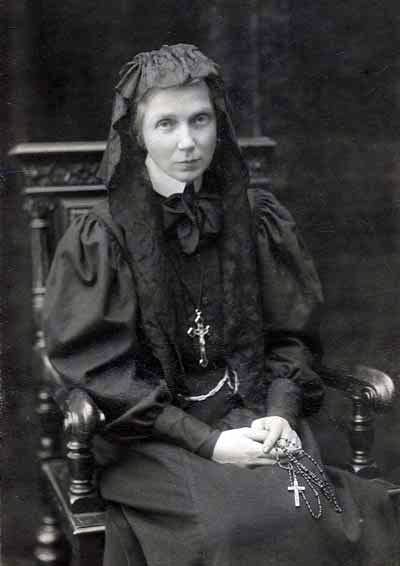
Julia Ledóchowska was born just after Easter on 17 April 1865 in Loosdorf into a prominent noble house as the fifth of ten children to Count Antoni Halka-Ledóchowski and his second wife Countess Josephine Salis-Zizers.[4] Mieczysław Cardinal Halka-Ledóchowski was her paternal uncle.[1]
Due to financial reverses in 1874 all relocated to Sankt Pölten where she and her sister Maria Theresia attended a grammar school that the Sisters of Loreto were managing.[3] In 1882 her father – who longed to return to his homeland knowing his end was near – acquired an estate in Lipnica Murowana near Tarnów and in 1883 moved there where her father died in 1885 due to smallpox; her sister Maria Theresia also contracted this but recovered from it. He died after having blessed her desire to become a nun. The siblings’ cardinal uncle took care of them after this.[2]
On 18 August 1886 she entered the novitiate of the Ursulines in Kraków. In 1887 she received the religious habit and was given the religious name Maria Ursula of Jesus; she made her perpetual vows on 28 April 1889.[3] In 1904 she was elected as the mother superior of the convent and remained in that position until 1907.
In Kraków the order opened a home for female college students and at that time it proved to be a new phenomenon.[1][4][2] Maria Ursula often spent hours in Eucharistic adoration. With a special blessing of Pope Pius X she went to St. Petersburg. There she worked to build up the Saint Catharine House which was a residence for Polish children and adolescents that were living there at the behest of its pastor Konstantin Budkiewicz.[3] The nuns were forced to wear civil clothes since Roman Catholic institutions were illegal in the Russian Empire. Once the tsarist government oppression to the faith grew she moved to the Russian-controlled Finland where she translated songs and a catechism for the Finnish fishermen who were Protestants for the most part. Maria Ursula also set up a free clinic for ill people as well as for the fishermen and their families. But her apostolic zeal soon attracted undue attention for the Russians began to monitor her moves and decided that enough was enough. In 1914 she was expelled from the Russian Empire and sought refuge in neutral Sweden though still kept in touch with the religious who remained in Russia.[1][2] While in Sweden she committed herself to ecumenism and to that end worked alongside the Lutheran archbishop Nathan Söderblom. In 1915 she set up the newspaper Solglimtar.
Ledóchowska settled in Stockholm and started a language school and a domestic science school for girls while there in 1917 published the book Polonica in three different languages. In Denmark in 1918 she founded an orphanage and a school of home economics in Aalborg. In 1920 she returned to Poland with 40 other nuns who had joined her in her mission and with permission from Rome changed a convent in Pniewy into the Congregation of the Ursulines of the Agonizing Heart of Jesus which were founded on 7 June 1920. It was in Poland that the apostolic nuncio Achille Ratti – future Pope Pius XI – encouraged and blessed her work.[4][2][3] In 1928 she founded a religious center in Rome where she had been living for sometime after Pope Benedict XV had invited her to manage the order there at the beginning of that decade.[1] In 1930 she sent 30 nuns to female Polish workers in France. Ledóchowska was a noted orator who often called for and defended the right for Polish independence; she spoke in various forums and often addressed national leaders and fellow nobles from time to time.
Go here to read the rest.


What an amazing womwn! Another Mother Cabrini. Although St. Ursula had more obstacles in her ministry. travelling between countries that were unfriendly unfriendly to R. Catholics.