
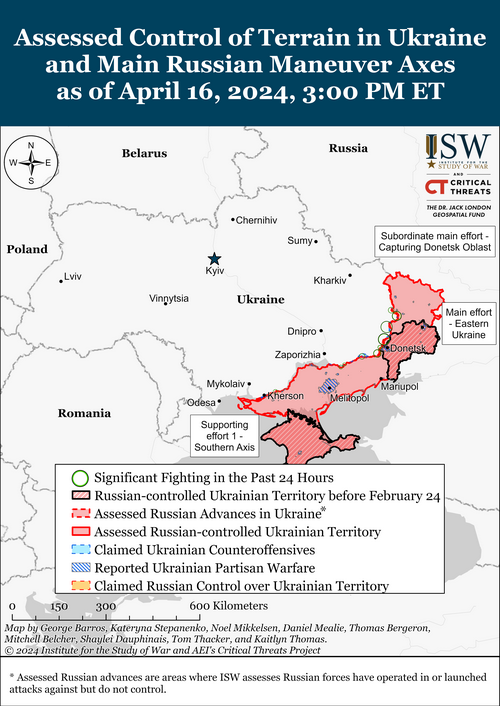
From The Institute for the Study of War:
Russian Offensive Campaign Assessment, April 16, 2024
Nicole Wolkov, Chistina Harward, Karolina Hird, Kateryna Stepanenko, Frederick W. Kagan
April 16, 2024, 8:15pm ET
Click here to see ISW’s interactive map of the Russian invasion of Ukraine. This map is updated daily alongside the static maps present in this report.
Click here to see ISW’s 3D control of terrain topographic map of Ukraine. Use of a computer (not a mobile device) is strongly recommended for using this data-heavy tool.
Click here to access ISW’s archive of interactive time-lapse maps of the Russian invasion of Ukraine. These maps complement the static control-of-terrain map that ISW produces daily by showing a dynamic frontline. ISW will update this time-lapse map archive monthly.
Note: The data cut-off for this product was 1:15pm ET on April 16. ISW will cover subsequent reports in the April 17 Russian Offensive Campaign Assessment.
Ukrainian President Volodymyr Zelensky emphasized that continued shortages in air defense systems and artillery are preventing Ukraine from effectively defending itself against Russian strikes and ground assaults. Zelensky stated in an interview with PBS News Hour, which aired on April 15, that Ukrainian forces continue to lack enough air defense systems to protect Ukraine’s critical infrastructure. Zelensky noted that Ukrainian forces were only able to destroy the first seven of the 11 Russian missiles launched against the Trypilska Thermal Power Plant (TPP) on April 11 before running out of air defense missiles, allowing the remaining four missiles to destroy the plant.[1] Zelensky also expressed frustration with the differential US response to strikes against Ukraine and Israel and stated that the United States and the West are continuing to limit military aid out of the false belief that such self-restraint will prevent further Russian aggression.[2] Zelensky reported that Ukrainian forces currently suffer from a 1-to-10 artillery shell disadvantage and that this artillery ammunition disadvantage allows Russian forces to push Ukrainian forces back each day. ISW continues to assess that continued US delays in security assistance to Ukraine limit Ukrainian forces’ ability to conduct effective defensive operations while giving Russian forces flexibility in conducting offensive operations — a dynamic that can lead to compounding and non-linear opportunities for Russian forces to make operationally significant gains in the future.[3] Russia and Ukraine are engaged in a constant air domain offense-defense innovation-adaptation race, in which Russia continues to adjust the timing, scale, composition, and targets of its strike packages to attempt to penetrate Ukraine’s air defense umbrella. Significant delays in US military assistance have already created shortages in Ukraine’s air defense missile stockpiles and hinder Ukraine’s ability to adapt to evolving Russian strike packages. Limited air defense systems and interceptors have forced Ukraine to make difficult decisions to allocate air defense systems between rear and frontline areas leaving frontline troops largely exposed to Russian air attack, and only the United States can rapidly provide air defense systems to Ukraine at the scale necessary to significantly improve Ukraine’s air defense capabilities.[4]
Zelensky signed a new mobilization law on April 16, codifying a difficult but critical decision in Ukraine’s efforts to stabilize its force generation apparatus and adequately prepare the Ukrainian fighting force both defensively and offensively.[5] The new mobilization law, which the Ukrainian Verkhovna Rada adopted on April 11, lowers the Ukrainian draft age from 27 to 25 years of age, cancels the status of “limited suitability” for military service, and requires citizens living abroad to register for military service in Ukraine. Ukrainian military officials have emphasized the exigency of a new Ukrainian mobilization law to address Ukraine’s manpower shortages that, together with the shortages of Western aid, are making Ukrainian defense on critical areas of the front extremely difficult.[6] Ukraine’s ability to defend throughout the theater and eventually contest Russia’s battlefield initiative is contingent on Ukraine’s ability to restore existing units and create new units, as well as on the provision of US military assistance to existing and new units.
Russian forces in eastern Ukraine are using smaller groups to conduct assaults and are reportedly suffering from morale issues, but Russian attacks are unlikely to culminate in the near term despite these challenges because of Ukrainian materiel shortages. Spokesperson of the Ukrainian National Guard Colonel Ruslan Muzychuk stated that Russian forces in eastern Ukraine have not recently used large units to conduct assaults but are instead using groups split into two detachments reinforced with armored vehicles to conduct ground attacks.[7] Muzychuk stated that Russian forces are also using small vehicles without protection to approach Ukrainian positions quickly and set conditions for a subsequent Russian infantry group to secure these positions. Muzychuk reported that Ukrainian drones destroyed about 70 percent of Russian armored vehicles last week, although it is unclear if Muzychuk is claiming that Ukrainian drones actually destroyed armored vehicles or temporarily rendered them hors de combat.[8] The press officer for the Ukrainian 26th Artillery Brigade, Oleh Kalashnikov stated that Russian forces in the Bakhmut direction are not conducting battalion-sized ground attacks because Ukrainian drones immediately detect them and that Russian forces are instead using company-sized groups at most.[9] Kalashnikov stated that Russian forces in the Bakhmut direction are suffering from low morale and are also using barrier troops to prevent Russian soldiers from retreating. Russian forces previously used mass infantry-led frontal assaults in their seizure of Bakhmut and in the beginning of the Russian effort to seize Avdiivka, but Russian forces appear to have shifted to using smaller infantry groups recently to conduct ground attacks.[10] Russian sources have also recently indicated that Russian forces suffered from exhaustion and lacked rotations but had to continue to fight on new lines west of Avdiivka following Russia’s seizure of Avdiivka.[11] ISW has previously (and not always accurately) assessed how low Russian morale and exhaustion affected the prospects of Russian offensive operations, but Ukraine’s current material shortages may make it difficult for Ukrainian forces to defend against Russian forces — even those that are exhausted and unmotivated.[12] ISW continues to assess that Russia’s opportunities to exploit Ukrainian vulnerabilities will widen as Ukrainian materiel shortages persist.[13]
A Russian Storm-Z instructor argued that Russian forces should capitalize on Ukrainian disadvantages brought on by materiel shortages to increase Russian guided glide bomb strikes to support Russian ground operations. The instructor claimed on April 15 that Ukrainian forces are unable to defend against Russian guided glide bomb strikes, which had caused significant damage to Ukrainian manpower, equipment, and other materiel.[14] The instructor claimed that Russian forces “linked” guided glide bomb strikes to Russian ground assaults on Avdiivka and more recently on Umanske (west of Avdiivka) to ensure Russian tactical advances. The instructor stated that Russian forces are conducting guided glide bomb strikes “situationally” and “episodically,” not systemically, and highlighted how Russian forces conducted guided glide bomb strikes near Terny in the Lyman direction but have not made significant advances in this area for months. The instructor claimed that Russian forces are currently “testing” Russian aviation near Chasiv Yar and may be able to turn local tactical successes into operational-level effects. The instructor claimed that Ukraine’s decreased air defense systems and man-portable air-defense systems (MANPADS) are allowing Russian reconnaissance drones to operate significantly further forward and called on Russian forces to optimize their use of multiple launch rocket systems (MLRS) to conduct counterbattery strikes and isolate the battlefield. ISW observed that sparse and inconsistent Ukrainian air defense coverage along the front resulting from shortages in Ukrainian air defense systems and missiles has facilitated Russia’s intensification of guided and unguided glide bomb strikes, which Russian forces used to tactical effect in their seizure of Avdiivka in February 2024 and which Russian forces are using again during their current offensive operations near Chasiv Yar.[15]
Russian President Vladimir Putin continued to show support for Iranian aggression against Israel during a March 16 call with Iranian President Ebrahim Raisi. Putin expressed hope that Israel and Iran would “show reasonable restraint” and not allow a “new round of confrontation,” effectively preemptively blaming Israel for any response to the massive but unsuccessful Iranian missile and drone strike.[16] The Russian Ministry of Foreign Affairs (MFA) reported that Raisi told Putin that Iran was “forced” to take “retaliatory measures” against Israel in response to the April 1 Israeli strike targeting Islamic Revolutionary Guard Corps (IRGC) officials in Damascus.[17] The Russian MFA claimed that Raisi stated that Iran’s response was “limited in nature,” despite the fact that Iran launched about 170 Shahed drones, 30 cruise missiles, and 120 ballistic missiles — a large-scale strike package very likely intending to cause significant damage.[18] The Russian MFA also claimed that Raisi expressed Iran’s disinterest in further escalation in the region. The Russian MFA’s portrayal of Raisi’s claims notably diverges from IRGC-affiliated Tasnim News Agency’s claim that Raisi stated that Iran will respond to any Israeli action that harms Iranian interests “more fiercely, widely, and painfully” than before.[19] Putin and the Russian government will likely continue to amplify information operations designed to justify Iran’s April 13 strikes against Israel and continue to rhetorically support Iran against Israel to the international community.
People’s Republic of China (PRC) President and General Secretary of the Chinese Communist Party (CCP) Xi Jinping met with German Chancellor Olaf Scholz on April 16 and proposed prerequisites for the end to the war in Ukraine in a manner that suggests that Xi is continuing to posture himself as a neutral mediator in the war despite increasing reports of China’s support for the Russian war effort. During a meeting with Scholz in Beijing, Xi proposed four tenets to “restore peace” in Ukraine — prioritizing peace and stability and “refrain from seeking selfish gain,” “avoid adding fuel to the fire,” creating the conditions for peace, and reducing the negative impact on the global economy and stability of global industry supply chains.[20] Xi’s language is fairly neutral and does not explicitly come down on one side or the other, which is generally consistent with Xi’s reticence to make the Sino-Russian partnership as deep as Putin desires, partially in order to maintain access to Western markets.[21] Xi and other Chinese officials have additionally refrained from calling the war in Ukraine a war. Various NATO and US officials have recently warned that China is helping to “prop up” the Russian defense industrial base and support Russia via microelectronics, optics, machine tools, and missile propellant deliveries.[22] Xi’s generally vague signaling to Scholz vis a vis Ukraine over the backdrop of reportedly intensifying Chinese support for Russia is therefore more likely an attempt to maintain China’s access to European markets by garnering goodwill with Germany than to show actual interest in facilitating an end to Russia’s invasion of Ukraine.
Ukraine’s Security Service (SBU) recently destroyed a Russian Nebo-U long-range radar station in Bryansk Oblast.[23] SBU sources told Ukrainian outlet Suspilne on April 16 that the Nebo-U station allowed Russian forces to surveil up to 700 kilometers into Ukrainian airspace, detect Ukrainian weapons, and support Russian bombers in targeting Ukrainian force concentrations.[24] The SBU also previously destroyed a Nebo-U station in Belgorod Oblast and recently targeted a Kasta-2E modern radar system near occupied Berdyansk, Zaporizhia Oblast.[25]
The Kremlin continues to centralize authority over Chechen Republic Head Ramzan Kadyrov’s “Akhmat” Spetsnaz forces via the Russian Ministry of Defense (MoD). Russian President Vladimir Putin signed a decree on April 16 appointing Commander of the Akhmat Spetsnaz Apty Alaudinov as the Deputy Head of the Main Directorate for Military-Political Work at the Russian MoD.[26] The Russian MoD’s Main Directorate for Military-Political Work is a department responsible for supporting “military-patriotic work” at the Russian Armed Forces such as ensuring that Russian forces subscribe to Russia’s political ideology.[27] Kadyrov stated that Alaudinov was relieved of his responsibilities as the Deputy Commander of the 2nd Luhansk People’s Republic (LNR) Army Corps but will continue to command Akhmat Spetsnaz forces.[28] Alaudinov’s appointment notably took place on the 15th year anniversary of the Kremlin declaring victory in Chechnya on April 16, 2009, under Kadyrov’s pro-Kremlin rule.[29] The appointment also follows Kadyrov’s recent announcement that 3,000 former Wagner Group personnel would join Akhmat Spetsnaz after Alaudinov reached an agreement with Wagner leadership on April 5.[30]
Putin is likely pursuing two objectives with Alaudinov’s appointment: establishing safeguards to ensure that Chechen leadership remains loyal to the Kremlin as Kadyrov continues to grow his forces and advancing the Kremlin’s ongoing force formalization efforts under the Russian MoD. Kadyrov has been steadily growing his forces since the start of the full-scale invasion and had used Russia’s reliance on Chechen forces to blackmail the Kremlin into ordering high-profile military command changes within the Russian MoD alongside deceased Wagner Group financier Yevgeny Prigozhin.[31] Alaudinov’s appointment into the Russian MoD, therefore, ensures that Kadyrov and Alaudinov can no longer exercise the same level of freedom to make similar demands as they did in late 2022 and early 2023. The Kremlin enforced similar measures to coopt the Russian milblogger community by appointing several milbloggers into Kremlin-led initiatives, effectively buying their loyalty.[32] One Russian political blogger observed that Alaudinov’s appointment formally ensures that Akhmat Spetsnaz is now officially part of the Russian MoD.[33] The observation is consistent with the Kremlin’s recent progress in subordinating irregular forces fighting in Ukraine, such as Kadyrov’s units, to the Russian MoD.
Russian federal censor Roskomnadzor is considering banning TikTok in Russia. The Russian Association of Professional Users of Social Networks and Messengers (APPSIM) recently appealed to Roskomnadzor to block TikTok, and Roskomnadzor announced on April 16 that it will consider the appeal until May 8.[34] TikTok banned Russian users from posting new content on the platform in March 2022 due to the “security implications” of Russia’s new law against spreading false information about the Russian military.[35] Russian TikTok users have since only been able to view videos from before 2022 but can bypass these restrictions in various ways including by using foreign SIM cards or VPNs.[36] The APPSIM called for Roskomnadzor to investigate if TikTok has adhered to Russian personal data laws, which require all companies that collect personal data on Russian citizens to use databases located on Russian territory.[37] APPSIM’s appeal to Roskomnadzor reportedly stated that TikTok announced its readiness to localize the data of Russian citizens in 2019 but that TikTok had not publicly reported if it had done this or not.[38] APPSIM claimed that blocking TikTok will increase audiences on Russian social media networks, such as VKontakte, which will boost the “professional community’s” number of subscribers on domestic platforms.[39] A Russian court fined Google 15 million rubles (about $159,000) in November 2023 for repeatedly refusing to localize the personal data of Russian users in Russia, and it is unclear if Roskomnadzor would ban TikTok for the same offense for which it simply fined Google.[40]
Key Takeaways:
- Ukrainian President Volodymyr Zelensky emphasized that continued shortages in air defense systems and artillery are preventing Ukraine from effectively defending itself against Russian strikes and ground assaults.
- Zelensky signed a new mobilization law on April 16, codifying a difficult but critical decision in Ukraine’s efforts to stabilize its force generation apparatus and adequately prepare the Ukrainian fighting force both defensively and offensively.
- Russian forces in eastern Ukraine are using smaller groups to conduct assaults and are reportedly suffering from morale issues, but Russian attacks are unlikely to culminate in the near term despite these challenges because of Ukrainian materiel shortages.
- A Russian Storm-Z instructor argued that Russian forces should capitalize on Ukrainian disadvantages brought on by materiel shortages to increase Russian guided glide bomb strikes to support Russian ground operations.
- Russian President Vladimir Putin continued to show support for Iranian aggression against Israel during a March 16 call with Iranian President Ebrahim Raisi.
- People’s Republic of China (PRC) President and General Secretary of the Chinese Communist Party (CCP) Xi Jinping met with German Chancellor Olaf Scholz on April 16 and proposed prerequisites for the end to the war in Ukraine in a manner that suggests that Xi is continuing to posture himself as a neutral mediator in the war despite increasing reports of China’s support for the Russian war effort.
- Ukraine’s Security Service (SBU) recently destroyed a Russian Nebo-U long-range radar station in Bryansk Oblast.
- The Kremlin continues to centralize authority over Chechen Republic Head Ramzan Kadyrov’s “Akhmat” Spetsnaz forces via the Russian Ministry of Defense (MoD).
- Russian federal censor Roskomnadzor is considering banning TikTok in Russia.
- Russian forces made confirmed advances near Bakhmut, Avdiivka, and Donetsk City and in western Zaporizhia Oblast amid continued positional engagements along the entire line of contact on April 16.
- The Republic of Tatarstan is reportedly preparing a new youth employment program that would allow minors aged 14 and older to work at Russian defense industrial base (DIB) enterprises, likely as part of an ongoing effort to expand the Russian DIB.
- Russian occupation officials are using the education system, particularly history courses, to Russify Ukrainian children living in occupied areas.
Go here to read the rest. I think the Ukrainians will soon get the 60 billion and then we will see what happens next. The Ukrainians obviously had no backup plan if their 2023 counteroffensive failed. Americans historically get war weary in the third year of any conflict and that is ominous for Ukraine unless they give evidence of being able to win this fight.

