
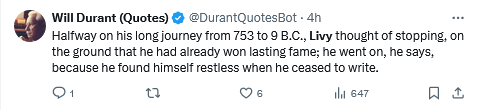
Most ancient historians agree that pre-battle speeches were made by Roman and Greek commanders in order to inspire the morale of their troops. Well and good. However, the speeches that have been handed down to us read suspiciously like what the historians have written rather than the actual speeches themselves. I have always wondered what those speeches were like. Robert Graves, a British novelist who survived serving as a combat infantry officer in the British Army on the Western Front, was curious also, and in his fictional memoir of the Roman Emperor Claudius gave an answer:
Livy: ‘Can’t I? Indeed I can,’ said Livy. ‘Do you mean to say that I mustn’t write a history with an epic theme because that’s a prerogative of poetry, or put worthy eve-of-battle speeches in the mouths of my generals because to compose such speeches is the prerogative of oratory?’
Pollio: ‘That is precisely what I do mean. History is a true record of what happened, how people lived and died, what they did and said; an epic theme merely distorts the record. As for your generals’ speeches they are admirable as oratory but damnably unhistorical: not only is there no particle of evidence for any one of them, but they are inappropriate. I have heard more eve-of-battle speeches than most men and though the generals that made them, Caesar and Antony especially, were remarkably fine platform orators, they were all too good soldiers to try any platform business on the troops. They spoke to them in a conversational way, they did not orate. What sort of speech did Caesar make before the Battle of Pharsalia? Did he beg us to remember our wives and children and the sacred temples of Rome and the glories of our past campaigns? By God, he didn’t! He climbed up on the stump of a pine-tree with one of those monster-radishes in one hand and a lump of hard soldiers’ bread in the other, and joked, between mouthfuls. Not dainty jokes but the real stuff told with the straightest face: about how chaste Pompey’s life was compared with his own reprobate one. The things he did with that radish would have made an ox laugh. I remember one broad anecdote about how Pompey won his surname The Great – oh, that radish! – and another still worse one about how he himself had lost his hair in the Bazaar at Alexandria. I’d tell you them both now but for this boy here, and but for your being certain to miss the point, not having been educated in Caesar’s camp. Not a word about the approaching battle except just at the close: “Poor old Pompey! Up against Julius Caesar and his men! What a chance he has”!’
Livy: ‘You didn’t put any of this in your history,’ said Livy.
Pollio: ‘Not in the public editions,’ said Pollio. ‘I’m not a fool. Still, if you like to borrow the private Supplement which I have just finished writing, you’ll find it there. But perhaps you’ll never bother. I’ll tell you the rest: Caesar was a wonderful mimic, you know, and he gave them Pompey’s dying speech, preparatory to falling on his sword (the radish again – with the end bitten off). He railed, in Pompey’s name, at the Immortal Gods for always allowing vice to triumph over virtue. How they laughed! Then he bellowed: “And isn’t it true, though Pompey says it? Deny it if you can, you damned fornicating dogs, you!” And he flung the half-radish at them. The roar that went up! Never were there soldiers like Caesar’s. Do you remember the song they sang at his French triumph?
“Home we bring the bald whoremonger,
Romans, lock your wives away.” ’
I, Claudius, Robert Graves


The current crop of commanding officers in the US military (whether Army, Navy, Marine Corps, Air Force, or Space Force) lack leaders like Julius Caesar who could inspire his troops with such ribald humor. In today’s ultra sensitive LGBTQ feminist environment, speaking like that would get you dismissed with a citation of loss of trust and confidence. Forgive my submarine sailor language, but this is called the pu$$ification of the US military command structure.
BTW, there is a continuing rash of commanding officer dismissals in all service branches. Recently the commanding officer of a guided missile nuclear submarine and a Marine Corps commanding officer were dismissed, one for DWI and the other for unspecified reasons. We are NOT ready for a conflict in the South China Sea. My prediction: we’ll lose 40% of our submarines and two nuclear powered aircraft carriers. Whoever is President will cry those immortal words, “Quintili Vare, legiones redde!“
I wonder…
I believe that on the cusp of a battle I would rather hear the St Crispins Day speech that Shakespeare gave to Henry V than Patton’s speech about greasing the the tank trades with the enemy’s guts.
But I am not a military man, so that might be the reason.
Rather difficult to accurately portray an extinct civilization when there are no first hand written accounts or reliable human memories of the people. Note that the reports by other areas regarding Carthage tend to emphasize the negative, probably due to envy or resentment. The accusations of child sacrifice, however, have been largely confirmed by recent archeological evidence, much to the distress of the Hannibal supporters who view him as some sort of hero fighting the expansionist Romans. A comprehensive look at the various countries and ethnic groups of the period pretty much reduces those genuinely pursuing moral virtue to be quite small. Then, as now, Israel and the Jews are the more outstanding examples.
My favorite scene in one of my favorite books. I love ten-year-old Claudius’ attempt to reconcile Livy and Pollio’s telling of history. Pollio’s is to persuade men to the facts, whereas Livy’s is to persuade men to virtue.
I love Livy and have read the extant parts of his history. Among the weaknesses of Livy was his evident lack of military experience. On explaining strategy he isn’t bad but his descriptions of battles have little detail and sometimes seem to follow a pattern to ease Livy’s description of the frequent battles. Heavily dependent upon his sources which we know little about.
[…] Battle Gear – A. VacchianoIsrael-Hamas War 2023 Summarized – The Armchair HistorianHannibal and the Roman Historian – Donald R. McClarey, Esq., at The American CatholicJan Sobieski – Savior of Christendom […]
Donald, I’ve always loved Livy’s account of the kings and the early Roman Republic. How much of it is historical is of course a matter of debate, but there’s no doubt of its literary quality.
Livy was a master writer.