
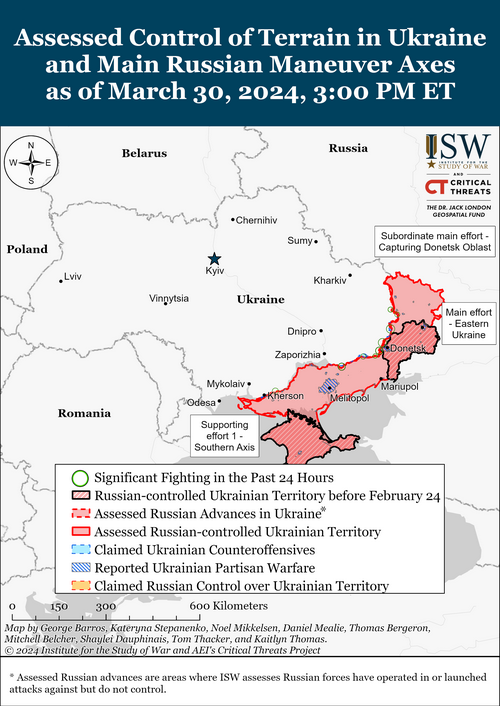
From The Institute for the Study of War:
Russian Offensive Campaign Assessment, March 30, 2024
Riley Bailey, Grace Mappes, Angelica Evans, Kateryna Stepanenko, and George Barros
March 30, 2024, 6:55pm ET
Click here to see ISW’s interactive map of the Russian invasion of Ukraine. This map is updated daily alongside the static maps present in this report.
Click here to see ISW’s 3D control of terrain topographic map of Ukraine. Use of a computer (not a mobile device) is strongly recommended for using this data-heavy tool.
Click here to access ISW’s archive of interactive time-lapse maps of the Russian invasion of Ukraine. These maps complement the static control-of-terrain map that ISW produces daily by showing a dynamic frontline. ISW will update this time-lapse map archive monthly.
Note: The data cut-off for this product was 1:30pm ET on March 30. ISW will cover subsequent reports in the March 31 Russian Offensive Campaign Assessment.
Ukrainian President Volodymyr Zelensky indicated that delays in American security assistance have forced Ukraine to cede the battlefield initiative and that these delays continue to threaten Ukraine’s defensive capabilities. The Washington Post published excerpts of an interview with Zelensky on March 29 in which Zelensky stated that Ukraine will not be able to defend its territory without American support, as Ukraine currently relies on air defense systems and missiles, electronic warfare jammers, and 155mm artillery shells from the United States.[1] Zelensky stated that continued materiel shortages will force the Ukrainian military to cede more Ukrainian territory and people “step by step” since a smaller but more stable frontline is preferable to a larger but unstable front that Russian forces could exploit to achieve a breakthrough. Zelensky stated that Ukrainian forces are “trying to find some way not to retreat” from unspecified frontline areas and noted that Ukrainian forces have stabilized the front near Avdiivka, Donetsk Oblast. Zelensky reiterated that the Ukrainian military’s planning ability to make decisions is contingent on US military assistance and that Ukraine cannot plan counteroffensive efforts without knowing whether Ukraine will receive US military assistance, and what future US military assistance will entail. Zelensky warned that Russia will exploit any future scenarios in which Ukraine must cede the initiative: “If you are not taking steps forward to prepare another counteroffensive, Russia will take [these steps].” Zelensky also stated that Ukraine has learned that “if you don’t do it, Russia will do it.” Zelensky also indicated that Ukraine is conducting rear-area strikes against Russian oil refineries to generate strategic effects as Ukraine cannot plan for or conduct counteroffensive operations without more information about US military assistance. Zelensky stated that Ukrainian strikes against Russian oil refineries and other strategic targets are in response to Russian strikes against Ukrainian energy infrastructure. Zelensky’s interview is consistent with Ukrainian Commander-in-Chief Colonel General Oleksandr Syrskyi’s recent statements that delays in Western military assistance are constraining Ukrainian forces and that Ukrainian forces are not able to completely compensate for battlefield shortcomings caused by material shortages.[2]
Russian missile strikes destroyed one of the largest thermal power plants in Kharkiv Oblast on March 22, as continued delays in US security assistance degrade Ukraine’s air defense umbrella and increase Russia’s ability to significantly damage Ukraine’s energy grid. Ukrainian electric company Tsentrenergo reported on March 29 that Russian missile strikes destroyed all power units and auxiliary equipment at the Zmiivska Thermal Power Plant (TPP) in Kharkiv Oblast on March 22.[3] Russian forces conducted the largest series of combined drone and missile strikes targeting Ukrainian energy infrastructure on the night of March 21 to 22 since the start of the full-scale invasion and have since heavily targeted Ukrainian energy infrastructure, including hydroelectric power plants (HPPs).[4] Russian strikes against Ukrainian energy facilities may aim to degrade Ukrainian defense industrial capacity, and Russian forces are likely trying to exploit Ukraine’s degraded air defense umbrella to collapse Ukraine’s energy grid.[5] The Washington Post reported on March 29 that Ukraine’s largest private energy company DTEK stated that Russian drones and missiles are increasingly penetrating Ukraine’s air defense and that more accurate and concentrated Russian strikes are inflicting greater damage against Ukrainian energy facilities.[6] Previous Russian strikes have recently rendered other Ukrainian energy facilities inoperable before, but the complete destruction of a TPP is rare and notable, and the recently accelerated degradation of Ukraine’s energy generation capabilities, if left unchecked, will likely constrain Ukraine’s ability to stabilize future disruptions to its energy grid in the long term.[7]
Russian forces are demonstrating technological and tactical adaptations and are increasingly using unmanned ground vehicles (UGVs) on the frontlines of Donetsk Oblast. Russian and Ukrainian sources amplified footage on March 29 and 30 showing Ukrainian forces striking Russian unmanned ground vehicles in southeastern Berdychi (northwest of Avdiivka) and in the Bakhmut direction.[8] Russian milbloggers claimed that these UGVs are equipped with AGS-17 grenade launcher systems, which reportedly can fire 50 to 400 grenades per minute.[9] Russian sources also amplified footage of other Russian small wheeled and tracked unmanned ground drones operating in unspecified areas, which Center for Naval Analyses (CNA) expert Samuel Bendett assessed to be involved in intelligence surveillance and reconnaissance (ISR), logistics, personnel evacuations, and light combat roles.[10] The US and NATO should study the rapidly evolving battlefield in Ukraine to develop a deeper understanding of the future of warfare and the characteristics of future warfare.
The Russian military is reportedly forming mobile fire groups to mitigate against Ukrainian drone strike threats but will likely struggle to field these groups at the required scale in the near term. Russian state outlet Izvestia reported on March 29 that Russian military sources stated that the Russian military is forming mobile fire groups within unspecified combined arms armies (CAAs) and air force and air defense armies to combat drones, and will equip these groups with thermal imagers, electronic warfare (EW) systems, and machine guns mounted on pickup trucks.[11] Izvestia did not report where the Russian military intends to field the mobile fire groups or the size or echelon of these groups. The Russian military notably faces Ukrainian drone threats both within occupied Ukraine as well as within Russia at oil refineries and other critical infrastructure supporting Russia’s war effort, and it is unclear if these mobile groups will be able to defend the extent of territory that Ukrainian drones target.[12] Izvestia’s description of the Russian mobile fire groups is similar to Ukrainian tactical mobile fire groups, which the Ukrainian military started to deploy at scale in the spring of 2023 to defend against routine Russian Shahed-136/131 drone strikes.[13] Ukrainian forces have long been conducting drone strikes against Russian targets in occupied Ukraine, and the Russian military command’s decision to form the mobile fire groups is likely in response to the recent intensification of Ukrainian drone strikes against Russian oil refineries in February and March.[14]
The Russian Ministry of Energy is reportedly working with Rosgvardia to deploy Pantsir-S1 air defense systems to strategic energy facilities within Russia, but Russian ultranationalists have complained that Russian bureaucracy and a Russian priority defending critical assets in the vicinity of Moscow and St. Petersburg are hampering these efforts.[15] The formation of the mobile fire groups indicates that Russia may be unable to deploy conventional air defense systems, such as Pantsir-S1 or S-300 /400 systems, to all critical facilities within western Russia. Russian forces will be more likely to successfully field mobile groups within occupied Ukraine, where there is relatively less airspace to cover and fewer possible Ukrainian flight vectors for Ukrainian drones, than within western Russia. Russian forces appear to struggle with properly deploying short-range air defense systems along expected flight vectors for Ukrainian drones, and the Russian military appears to have even failed to cover important potential targets in reportedly well-defended areas within Russia.[16] The mass deployment of mobile fire groups throughout western Russia could pose similar challenges for Russian forces, as the Russian military may not be able to sufficiently field the groups at scale.
Russian authorities continue to escalate legal pressure against migrants in the wake of the March 22 Crocus City Hall attack, prompting both Russian authorities to increase deportations and migrants to voluntarily leave Russia. Russian human rights project First Department reported on March 29 that St. Petersburg authorities have launched “Operation Anti-Migrant” and are conducting a large-scale operation to identify and deport migrants who reportedly violated migration laws from Russia.[17] One of First Department’s lawyers stated that Russian law enforcement is conducting raids on hostels and apartments in St. Petersburg and that temporary detention centers in St. Petersburg are overcrowded with migrants. The lawyer stated that Russian authorities deported 64 foreign citizens on March 28 and estimated that Russian authorities deported enough migrants to fill two full planes that recently flew from St. Petersburg to an unspecified destination. Russian opposition news outlet Astra reported on March 30 that more than 400 St. Petersburg police officers and Rosgvardia personnel are participating in the operation and that St. Petersburg police have inspected the paperwork of almost 1,500 foreign citizens, issued several hundred administrative violations, and initiated 10 criminal cases during the operation so far.[18] St. Petersburg City Courts Joint Press Service Head Daria Lebedeva stated that St. Petersburg courts over the past week ruled to forcibly deport 418 migrants and ordered an additional 48 migrants (who had been living in the city) to pay a fine and voluntarily leave Russia for violating migration laws.[19] Kremlin newswire TASS reported that Russian Federal Security Service (FSB) officers detained three Central Asian migrants accused of preparing to conduct a terrorist attack at an unspecified mass gathering in Stavropol Oblast.[20] Tajikistan’s Deputy Minister of Labor, Migration, and Employment Shakhnoza Nodiri stated that Tajikistan has observed an outflow of Tajik migrants from Russia following the Crocus attack and that many Tajik migrants are calling the Tajik government stating that they want to leave Russia out of fear and panic.[21] Nodiri stated that more people are entering Tajikistan than leaving, but that the government expects the outflow of Tajik migrants from Russia to be a temporary phenomenon.
Russian officials have thus far charged nine people for their supposed involvement in the Crocus attack, all of whom Russian authorities have identified as citizens of Tajikistan.[22] The BBC News Russian Service reported on March 27 that Russian authorities have significantly increased the number of criminal cases initiated for migration law violations since the Crocus attack, particularly against Tajik citizens.[23] Radio Free Europe/Radio Liberty (RFE/RL) reported that Russian citizens from ethnic minorities and migrants in Russia have grown increasingly concerned about ethnically motivated crimes and xenophobic rhetoric in the aftermath of the Crocus attack, and First Department similarly noted that anti-migrant and xenophobic sentiments have risen sharply in Russia following the attack.[24] The Russian ultranationalist community has intensified its calls for anti-migrant policies, and Russian officials recently proposed policies, such as limiting the entrance of migrants to Russia, introducing harsher punishments for crimes committed by migrants, and abolishing Russia’s visa-free regime with Central Asia countries.[25] Russian President Vladimir Putin expressed concern over heightened ethnic tensions in Russian society following the Crocus attack on March 28 and may have signaled to the Russian ultranationalist community that they should stop inflaming ethnic tensions.[26] Russian authorities may seek to detain a larger number of migrants to coerce them into signing military service contracts, given Russia’s previous reliance on migrants and prisoners in its crypto-mobilization campaign.[27] Anti-migrant policies could threaten Russia’s crypto-mobilization efforts and further worsen Russian labor shortages if Russia deports large numbers of migrants or if significant portions of Russia’s migrant communities emigrate, but Russian authorities are unlikely to be willing to give into Russian ultranationalists’ xenophobic demands at the expense of Russia’s war effort.
Key Takeaways:
- Ukrainian President Volodymyr Zelensky indicated that delays in American security assistance have forced Ukraine to cede the battlefield initiative, not contest the battlefield initiative, and continue to threaten Ukraine’s defensive capabilities.
- Russian missile strikes destroyed one of the largest thermal power plants in Kharkiv Oblast on March 22, as continued delays in US security assistance degrade Ukraine’s air defense umbrella and increase Russia’s ability to significantly damage Ukraine’s energy grid.
- Russian forces are demonstrating technological and tactical adaptations and are increasingly using unmanned ground vehicles (UGVs) on the frontlines of Donetsk Oblast.
- The Russian military is reportedly forming mobile fire groups to mitigate against Ukrainian drone strike threats but will likely struggle to field these groups at the required scale in the near term.
- Russian authorities continue to escalate legal pressure against migrants in the wake of the March 22 Crocus City Hall attack, prompting both Russian authorities to increase deportations and migrants to voluntarily leave Russia.
- Positional engagements continued throughout the theater on March 30.
- Russian mobilized personnel continue to suffer high casualties while fighting in Ukraine.
Go here to read the rest. So Ukrainian battlefield failures are now being blamed on the delay in US assistance? Predictable but erroneous. NATO and the US have given huge amounts of aid to Ukraine without an audit to see what happened to all those funds. It was not lack of US funds that caused the Ukrainian offensive to fail last year, but bad Ukrainian tactics and the belief of endless artillery obviating the need of closing with the enemy. The Ukrainians, overall have put up a good fight against the Russians. The US will help them in the future, but ultimately this is their War to win or lose.

