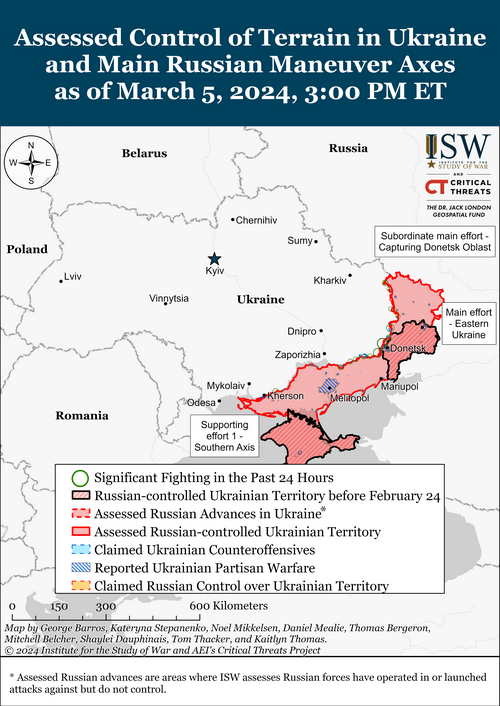
From The Institute for the Study of War:
Russian Offensive Campaign Assessment, March 5, 2024
Karolina Hird, Christina Harward, Kateryna Stepanenko, Grace Mappes, and George Barros
March 5, 2024, 8:15pm ET
Click here to see ISW’s interactive map of the Russian invasion of Ukraine. This map is updated daily alongside the static maps present in this report.
Click here to see ISW’s 3D control of terrain topographic map of Ukraine. Use of a computer (not a mobile device) is strongly recommended for using this data-heavy tool.
Click here to access ISW’s archive of interactive time-lapse maps of the Russian invasion of Ukraine. These maps complement the static control-of-terrain map that ISW produces daily by showing a dynamic frontline. ISW will update this time-lapse map archive monthly.
Note: The data cut-off for this product was 1:30 pm ET on March 5. ISW will cover subsequent reports in the March 6 Russian Offensive Campaign Assessment.
Please be advised: An expert analyst called our attention to the fact that we have not been using the doctrinal expression “Close Air Support” (CAS) in connection with Russian air operations around Avdiivka accurately. The analyst rightly pointed out that CAS requires close coordination with the maneuvering ground units, which ISW has not observed and does not assess has occurred. We used the expression (incorrectly) because the glide-bomb attacks were clearly meant to shape and support tactical actions, which is one of the purposes of CAS. But Russian air operations around Avdiivka were not properly CAS, and we were mistaken to use that expression. ISW apologizes for this mistake.
Ukraine destroyed the Project 22160 Sergei Kotov large patrol ship of the Black Sea Fleet (BSF) off the coast of the Kerch Strait on the night of March 4-5.[1] Ukraine’s Main Military Intelligence Directorate (GUR) reported on March 5 that GUR special unit “Group 13” conducted the attack against the Sergei Kotov using Magura V5 naval drones, inflicting severe damage on the port and starboard sides of the ship, killing seven sailors, and wounding six.[2] GUR noted that Russian forces were likely able to evacuate 52 other crew members, but that the loss of the ship cost Russia a total of $65 million.[3] Ukrainian sources noted that the Sergei Kotov had either a Ka-29 or Ka-27 helicopter on board, which Ukrainian forces destroyed along with the ship.[4] A Russian insider source claimed that after the initial naval drone strike, BSF forces tried to tow the ship back to port, but that the damage was so severe that the ship sank five kilometers off the coast of Cape Takil, southeastern Crimea.[5] The Sergei Kotov was one of the BSF’s newest vessels and only entered service in January 2021.[6] The Ukrainian Armed Forces Center for Strategic Communications (StratCom) reported that Ukrainian forces had disabled about 33 percent of the BSF’s warships as of early February 2024, including 24 ships and one submarine.[7]
Russian milbloggers responded to the sinking of the Sergei Kotov by decrying the Russian military command’s lack of response to the incident and mounting a wider critique against the bureaucratic inertia of the Russian military apparatus. Russian milbloggers alleged that this is the fourth Ukrainian attack on the Sergei Kotov since Russia’s full-scale invasion began and that the crew managed to repel similar Ukrainian attacks in July, August, and September of 2023.[8] A prominent Kremlin-affiliated milblogger noted that the Sergei Kotov was inadequately equipped to defend itself against such an attack, and many milbloggers questioned why the ship did not have systems to defend against naval drones considering the crew had experienced similar attacks before.[9] One prominent milblogger stated in a post published on March 5 (which has been viewed 1.7 million times as of this writing) that the Russian military command has no response to the sinking of the Sergei Kotov because no one likes to tell the truth to the military command and that the military command refuses to learn important lessons from past experiences to improve the military.[10] Another milblogger emphasized that it would be very important for the Russian command to listen to the crew of the Sergei Kotov to improve and modernize naval vessels and defensive procedures in the future.[11] Another milblogger responded to this assessment and claimed that the Russian command is extraordinarily unlikely to do so because of an ”administrative guillotine” in the Russian military bureaucracy that prevents such learning and innovation, as well as the command’s larger cultural proclivity to cover up mistakes instead of addressing them.[12]
The ire expressed by Russian milbloggers towards the Russian military apparatus represents a longstanding source of discontent for pro-war military commentators. Miroslava Reginskaya, the wife of imprisoned ultra-nationalist and former Russian officer Igor Girkin, posted on March 5 an archival letter written by Girkin in 2018 wherein Girkin complained about the incompetence of Russian commanders causing the deaths of Russian soldiers and called for “Stalinist level repressions” against such commanders.[13] Girkin emphasized that all echelons of the Russian command are filled with such “scum” that contribute to “thousands of large and small disasters, based on incompetence, stupid immense greed, and disregard for people.” Girkin’s 2018 critique about the inability and lack of willingness of the Russian command to address its mistakes, internalize lessons learned, and disseminate them across the Russian military remains a central component of Russian information space critiques against the Russian military machine nearly six years later in 2024.
Russian aircraft appear to be continuing to conduct a relatively high volume of glide bomb strikes in Ukraine despite Ukrainian officials’ reports that Ukrainian forces have downed several bomber aircraft in recent weeks. Forbes reported on March 4 that Russian Su-34 aircraft, escorted by Su-35 aircraft, are conducting one hundred or more sorties per day to conduct glide bomb strikes on Ukrainian positions at a range of 25 miles (about 40 kilometers).[14] The New York Times reported on March 5 that Russian tactics are shifting to intensify operations in the air domain and that Russian forces’ “more aggressive” air support on the front lines has helped Russian forces to advance recently in eastern Ukraine.[15] These reports suggest that the Russian Air Force is maintaining a high tempo of fixed-wing air missions in Ukraine and is possibly willing to tolerate risks to fixed-wing aircraft, likely because the Russian command may have decided that the positive effects generated by such air operations outweigh the costs associated with flying such missions. Russian forces used glide bomb strikes to tactical effect in their seizure of Avdiivka in mid-February and are likely attempting to replicate such effects to support ongoing offensive operations elsewhere on the front. ISW cannot independently verify Ukrainian reports of the shootdowns of several Su-34 aircraft in recent weeks.
Forbes also reported that Ukrainian forces are using French-provided AASM Hammer glide bombs after France started supplying Ukraine with 50 of these bombs per month in January 2024.[16] Forbes noted that Ukrainian forces previously conducted strikes with US-provided Joint Direct Attack Munition (JDAM) glide bombs, but the supply of these bombs has halted due to the recent lack of US aid provisions to Ukraine.
Russia and China are deepening their strategic space cooperation, including cooperation on satellite surveillance and space exploration. Russian space agency Roscosmos Head Yuri Borisov stated on March 5 that Russia and China are considering delivering and constructing a nuclear power plant on the moon in 2032-2035.[17] Though Borisov’s proposal to create a nuclear power plant on the moon is odd, Borisov’s statement is indicative of warming relations and Chinese willingness to foster a long-term strategic partnership with Russia to posture against and possibly threaten the West. The Russian government approved a Russian-Chinese cooperation agreement on space cooperation through 2027 in November 2023 that Roscosmos and the Chinese National Space Administration (CNSA) initially signed in November 2022.[18] The agreement outlines three phases to develop and build the International Scientific Lunar Station and jointly explore the moon’s surface. Roscosmos and CNSA also signed an agreement in September 2022 on the joint placement of Russian GLONASS and Chinese BeiDou satellite navigation system stations in six Russian and Chinese cities.[19] Russia is reportedly developing a space-based anti-satellite weapon, and a strategic space partnership with China suggests that Russia would be unlikely to use this or similar technology against China and that both states would mutually benefit from Russia’s posturing against the West through space and satellite technology.[20]
The International Criminal Court (ICC) issued arrest warrants for two senior Russian commanders for their responsibility in perpetrating Russian war crimes – the first time the ICC has charged Russian military commanders. The ICC issued arrest warrants on March 5 for Lieutenant General Sergei Kobylash, the commander of the Russian Aerospace Forces’ Long-Range Aviation, and Admiral Viktor Sokolov, the former commander of the Black Sea Fleet (BSF), for their role in the war crimes of directing attacks at civilian objects and causing excessive or incidental harm to civilians or damage to civilian objects and the crime against humanity of inhumane acts under the Rome Statute between at least October 10, 2022, to at least March 9, 2023.[21] The ICC last issued arrest warrants for Russian officials’ involvement in war crimes in Ukraine in March 2022 against Russian President Vladimir Putin and Kremlin-appointed Children’s Rights Commissioner Maria Lvova-Belova for the deportation of Ukrainian children to Russia.[22]
Russian forces are reportedly operating a “black market” to sell Ukrainian prisoners of war (POWs), including to Russian paramilitary groups that may be conducting their own POW exchanges with Ukraine. British outlet The Times, citing Ukrainian Spokesperson for the Coordination Headquarters for the Treatment of POWs Petro Yatsenko and a Ukrainian POW, reported on March 4 that Chechen paramilitary groups are buying Ukrainian POWs from other Russian military units on a black market for trafficking POWs.[23] The Chechen units are reportedly then using the Ukrainian POWs in exchange for Chechen POWs held by Ukrainian forces. The Times stated that Chechen units are likely turning to the black market because Chechen units are currently largely acting in policing or logistics roles in rear areas of Ukraine where there are fewer opportunities to capture Ukrainian POWs and exchange them for Chechen POWs. The Times stated that although there are no articles in the Geneva Convention that explicitly prohibit the POW trades, this practice is likely in violation of the clause that “no special agreement shall adversely affect the situation of prisoners of war.” Reports of Chechen units apparently conducting their own POW exchanges with Ukraine suggest that some paramilitary units within the Russian military, like the Chechen Akhmat Spetsnaz units, are likely not included in wider, higher-level Russian-Ukrainian POW exchanges. Russian milbloggers have repeatedly criticized Chechen forces for their incompetence and lack of involvement in Ukraine, and Chechen forces have been relegated to rear areas or less active sectors of the front after participating in major Russian offensive operations in 2022.[24]
The director of the Moldovan Intelligence and Security Service, Alexandru Musteata, stated on March 5 that the Kremlin has begun to conduct multi-year hybrid operations aimed at destabilizing Moldova and preventing its accession to the European Union (EU). Musteata stated that the Kremlin is conducting an “unprecedented level” of hybrid operations aimed at preventing Moldova from joining the EU and keeping Moldova in Russia’s sphere of influence.[25] Musteata stated that the first stage of Russian hybrid operations began with attempts to compromise local elections in 2023 and that Russia intends to also interfere in Moldova’s upcoming presidential election in late 2024 and parliamentary elections in the summer of 2025. Musteata stated that pro-Kremlin Moldovan politicians with ties to the Kremlin, either directly or through Russian and Moldovan organized crime groups, will try to promote pro-Russia policies in the Moldovan Parliament. Musteata warned that Russia plans to provoke protests and incite inter-ethnic conflict and economic and social crises in Moldova, including in the pro-Russian autonomous region of Gagauzia and the pro-Russian breakaway republic of Transnistria. Musteata stated that Moldovan authorities have already observed an increase in the use of social media platforms to spread anti-EU sentiment. ISW previously warned that the Kremlin could intensify hybrid operations aimed at destabilizing and further polarizing Moldova ahead of Moldova-EU accession negotiations and the 2024 presidential election or a suite of other courses of action against Moldova that are not mutually exclusive with hybrid actions.[26]
Key Takeaways:
- Ukraine destroyed the Project 22160 Sergei Kotov large patrol ship of the Black Sea Fleet (BSF) off the coast of the Kerch Strait on the night of March 4-5.
- Russian milbloggers responded to the sinking of the Sergei Kotov by decrying the Russian military command’s lack of response to the incident and mounting a wider critique against the bureaucratic inertia of the Russian military apparatus.
- Russian aircraft appear to be continuing to conduct a relatively high volume of glide bomb strikes in Ukraine despite Ukrainian officials’ reports that Ukrainian forces have downed several bomber aircraft in recent weeks.
- Russia and China are deepening their strategic space cooperation, including cooperation on satellite surveillance and space exploration.
- The International Criminal Court (ICC) issued arrest warrants for two senior Russian commanders for their responsibility in perpetrating Russian war crimes – the first time the ICC has charged Russian military commanders.
- Russian forces are reportedly operating a “black market” to sell Ukrainian prisoners of war (POWs), including to Russian paramilitary groups that may be conducting their own POW exchanges with Ukraine.
- The director of the Moldovan Intelligence and Security Service, Alexandru Musteata, stated on March 5 that the Kremlin has begun to conduct multi-year hybrid operations aimed at destabilizing Moldova and preventing its accession to the EU.
- Russian forces recently made confirmed advances near Donetsk City amid continued positional engagements along the entire line of contact on March 5.
- Russian authorities are reportedly disbanding elements of the former Wagner Group that were supposed to join Rosgvardia or are currently in Belarus.
- Russian law enforcement is likely intensifying crackdowns against Crimean Tatars in occupied Crimea.
Go here to read the rest. The war at sea in the Black Sea continues to demonstrate the power of unmanned boat drones to eliminate naval targets. May our admirals be taking copious notes.