
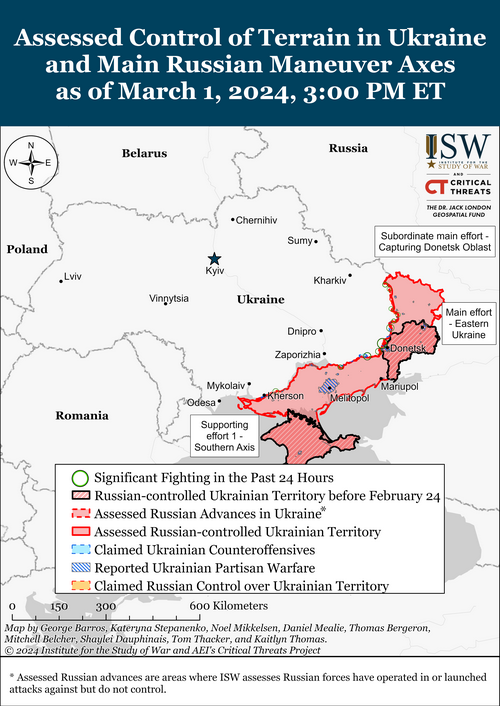
From The Institute for the Study of War:
Russian Offensive Campaign Assessment, March 1, 2024
Christina Harward, Angelica Evans, Nicole Wolkov, Riley Bailey, and Karolina Hird
March 1, 2024, 6:15pm ET
Click here to see ISW’s interactive map of the Russian invasion of Ukraine. This map is updated daily alongside the static maps present in this report.
Click here to see ISW’s 3D control of terrain topographic map of Ukraine. Use of a computer (not a mobile device) is strongly recommended for using this data-heavy tool.
Click here to access ISW’s archive of interactive time-lapse maps of the Russian invasion of Ukraine. These maps complement the static control-of-terrain map that ISW produces daily by showing a dynamic frontline. ISW will update this time-lapse map archive monthly.
Note: The data cut-off for this product was 12:30pm ET on March 1. ISW will cover subsequent reports in the March 2 Russian Offensive Campaign Assessment.
Reported details of Russian-Ukrainian peace negotiations that occurred in Istanbul in April 2022 indicate that Russia has consistently envisioned a settlement for its illegal invasion of Ukraine wherein Ukraine would be unable to defend itself from a future Russian attack – an objective Russia continues to pursue under calls for Ukraine’s “demilitarization.” The Wall Street Journal (WSJ) reported on March 1 that documents it obtained of the draft treaty from the 2022 Ukrainian-Russian peace negotiations indicate that both sides initially agreed that Ukraine would be a “permanently neutral state that doesn’t participate in military blocs.”[1] The draft treaty also reportedly banned Ukraine from receiving any foreign weapons or hosting any foreign military personnel. The WSJ reported that Russia pushed for the Ukrainian military to be limited to 85,000 soldiers, 342 tanks, and 519 artillery systems, whereas Ukraine wanted the caps to be 250,000 soldiers, 800 tanks, and 1,900 artillery systems. Russia also reportedly demanded that Ukrainian missiles be limited to a range of 40 kilometers, a range that would allow Russian forces to deploy critical systems and materiel close to Ukraine without fear of strikes. The Kremlin has repeatedly called for the “demilitarization” of Ukraine since its full-scale invasion but has not previously provided details on what that would specifically entail.[2] The Ukrainian military in 2014 – before Russia’s first invasion – consisted of about 130,000 personnel, and the documents from 2022 indicate that Russia intended to drastically reduce Ukraine’s military to such a level that Ukraine could no longer defend itself.[3] Russian President Vladimir Putin has most recently emphasized the idea of a “demilitarized” or “sanitary” zone in Ukraine that would place Russian territory – including occupied Ukraine – out of range of both Ukrainian frontline artillery systems and Western-provided long-range systems.[4] Putin likely aims for the ”demilitarization” of Ukraine to allow him to enforce his will upon Ukraine without any substantial resistance.
Reported details of the draft treaty suggest that Russia intended to use the treaty to set conditions for future attacks against Ukraine while also prompting the West to make concessions on Ukraine’s sovereignty. The WSJ reported that the United States, United Kingdom, China, France, and Russia were to be guarantors of the treaty.[5] Russia also reportedly wanted to include Belarus as a guarantor. The guarantor states were supposed to “terminate international treaties and agreements incompatible with the permanent neutrality of Ukraine,” including military aid agreements. The WSJ did not specify if other non-guarantor states would have to terminate their agreements with Ukraine as well, although this is likely considering that the treaty would ban Ukraine from having foreign-supplied weapons. It is unclear what Russia considers to be “incompatible” with a permanently “neutral” Ukraine, although the Kremlin most certainly would have broadly interpreted this as forbidding Ukraine from joining NATO, which is stipulated by Ukraine’s constitution, thereby likely demanding that Ukraine amend its constitution.[6] Russia reportedly wanted all guarantors to agree on a response should Ukraine be subject to any attacks, but the WSJ stated that the guarantor states were unlikely to agree on a response should Russia attack Ukraine again – likely due to the guarantor states’ diverging interests. This stipulation likely intended to allow Russia to influence, predict, and prepare for the international response to any possible future Russian attacks on Ukraine. ISW continues to assess that any ceasefire would benefit Russia, giving it time to reconstitute and regroup for future offensive operations.[7]
Russia’s territorial objectives beyond the areas it occupied in 2022 likely prevented Russia and Ukraine from agreeing on the status of Russian-occupied areas in Ukraine in April 2022. The WSJ reported that Russian President Vladimir Putin and Ukrainian President Volodymyr Zelensky were to hold “face-to-face talks” to discuss areas of eastern Ukraine that Russian forces have occupied since 2014, but that this meeting never took place.[8] The need for Putin and Zelensky to discuss the matter independently and separately suggests that the Russian and Ukrainian negotiating delegations were unable to reach an agreement on the status of the Russian-occupied territories in Donetsk and Luhansk oblasts, likely due to Russia’s wider expansionist territorial desires, as Kremlin officials have repeatedly indicated.[9] The WSJ did not report on any clauses in the treaty concerning Russian-occupied territory outside of Donetsk and Luhansk oblasts.
Russian authorities suggested that the Kremlin has likely adopted a more extensive set of goals regarding Ukraine over the course of Russia’s war against Ukraine. Kremlin Spokesperson Dmitri Peskov responded to the leaked April 2022 draft agreement between Russia and Ukraine, claiming that the draft agreement is “no longer relevant” and that “conditions have changed.”[10] Peskov’s statements are likely part of a current trend of increased Russian confidence in the Russian military’s capabilities and the attainability of Putin’s maximalist war objectives following the recent seizure of Avdiivka and prolonged US debates about military aid to Ukraine.[11] ISW continues to assess that Russian President Vladimir Putin maintains his maximalist objectives in Ukraine, which are tantamount to complete Ukrainian and Western capitulation, and that Russia has no interest in good-faith negotiations with Ukraine.[12]
Russian President Vladimir Putin appeared to disparage Russian elites in his February 29 Federal Assembly speech, more closely aligning himself with the veteran and military community and drawing praise from ultranationalist milbloggers. Putin attempted to distance himself from the Russian elite by claiming that the individuals who “lined their pockets due to economic processes in the 1990s” are not the elite, but that the ”real elite” are workers and military servicemen who proved their loyalty to Russia.[13] Putin used this subverted definition of elites to praise the Russian military and align himself more strongly with the veteran and military community, stating that military veterans should hold leading positions in Russian society, business, and government and “should be entrusted with Russia’s future” and implying that veterans should take on roles traditionally occupied by Russian elites. Several Russian milbloggers supported Putin’s claim that Russian military veterans should hold prominent and influential roles in Russian society and framed Putin‘s statements as the start of a campaign to change the “elites” of Russia.[14] Putin also proposed expanding and creating multiple economic support measures including “more fairly distributing the tax burden toward those with higher personal and corporate incomes.”[15] One Russian milblogger explicitly expressed support for economic reforms that would replace “oligarch capitalism“ with ”equal opportunities and minimal stratification in living standards.”[16] Putin’s criticism of Russian elites and economic proposals that would, in theory, reduce their influence may intensify an existing rhetorical line among pro-war milbloggers criticizing Russian elites.[17]
Kremlin officials met with leaders of the pro-Russian Moldovan autonomous region Gagauzia and emphasized Russia’s support for Gagauzia against perceived Moldovan “oppression” on March 1. Russian Federation Council Chairperson Valentina Matviyenko met with Gagauzian Governor Yevgenia Gutsul and People’s Assembly Chairperson Dmitry Konstantinov in Moscow and criticized Moldovan authorities for “Russophobic” policies that are supposedly antithetical to Moldova’s national interests.[18] Matviyenko added that the Russian Federation Council is prepared to provide “all possible assistance” in expanding Russian-Gagauzian relations.[19] The Russian Ministry of Foreign Affairs (MFA) announced that 10 Russian federal subjects signed a range of bilateral agreements emphasizing economic and humanitarian ties with Gagauzia.[20] A Kremlin-affiliated milblogger who has previously focused on discontent in Gagauzia and pro-Russian Moldovan breakaway region Transnistria stated that Gutsul and Konstantinov are ”following the example of Transnistria” by asking for Russia’s support in the face of Moldovan ”oppression.”[21] The Transnistrian Congress of Deputies recently met and adopted a series of decisions that likely aim to provide the Kremlin with justifications for a wide range of possible escalatory actions against Moldova that the Kremlin can either pursue immediately or over the long term.[22] ISW has observed indications that the Kremlin hopes to use pro-Russian actors in Gagauzia as another basis to justify future intervention and hybrid operations aimed at destabilizing and polarizing Moldova to prevent or slow Moldova’s integration in the European Union (EU).[23]
Ukraine and the Netherlands signed a 10-year bilateral security agreement on March 1.[24] Ukrainian President Volodymyr Zelensky stated that the Netherlands announced that it would provide 2 billion euros (about $2.17 billion) in military aid to Ukraine in 2024 and additional security assistance over the next 10 years.[25] Zelensky stated that the bilateral security agreement prioritizes assistance in air defense and artillery systems and naval and long-range weapons.[26] The Dutch Ministry of Defense (MoD) announced that it will provide Ukraine with 14 rigid-hull inflatable boats, eight paramilitary river patrol boats, and CB90-class fast assault craft.[27] The Dutch MoD also announced that it is increasing its contribution to the Czech initiative to provide artillery shells to Ukraine from 100 million euros (about $108 million) to 250 million euros (about $271 million).[28]
Key Takeaways:
- Reported details of Russian-Ukrainian peace negotiations that occurred in Istanbul in April 2022 indicate that Russia has consistently envisioned a settlement for its illegal invasion of Ukraine wherein Ukraine would be unable to defend itself from a future Russian attack – an objective Russia continues to pursue under calls for Ukraine’s “demilitarization.”
- Reported details of the draft treaty suggest that Russia intended to use the treaty to set conditions for future attacks against Ukraine while also prompting the West to make concessions on Ukraine’s sovereignty.
- Russian authorities suggested that the Kremlin has likely adopted a more extensive set of goals regarding Ukraine over the course of Russia’s war against Ukraine.
- Russian President Vladimir Putin appeared to disparage Russian elites in his February 29 Federal Assembly speech, more closely aligning himself with the veteran and military community and drawing praise from ultranationalist milbloggers.
- Kremlin officials met with leaders of the pro-Russian Moldovan autonomous region Gagauzia and emphasized Russia’s support for Gagauzia against perceived Moldovan “oppression” on March 1.
- Ukraine and the Netherlands signed a 10-year bilateral security agreement on March 1.
- Russian forces made confirmed advances near Avdiivka and Donetsk City on March 1.
- Russian authorities will likely use annual combat training for Russian reservists to support crypto-mobilization efforts.
Go here to read the rest. Any peace negotiations by Putin would be done like Hitler at Munich, to shear enough territory away from the victim state to render it defenseless against future aggression. There is no negotiating an end to this War that does not involve the ultimate destruction of the Ukrainian State.

