Donald R. McClarey
Cradle Catholic. Active in the pro-life movement since 1973. Father of three, one in Heaven, and happily married for 43 years. Small town lawyer and amateur historian. Former president of the board of directors of the local crisis pregnancy center for a decade.
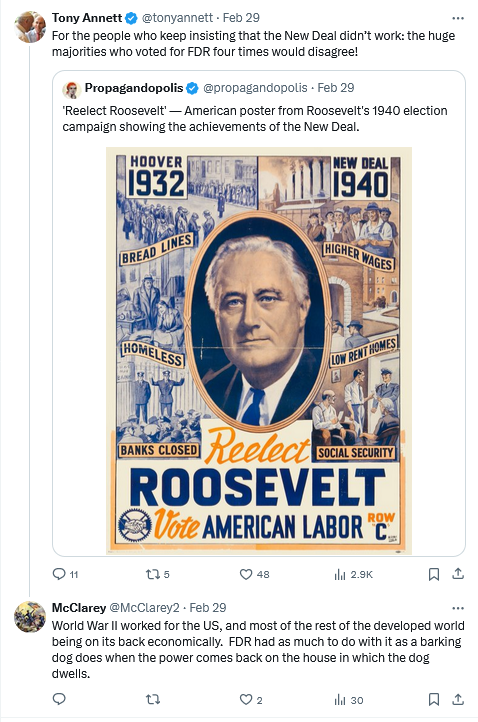



I’m not comparing FDR to Hitler, but Hitler had huge majorities too. The fact that you can convince a lot of people to go insane all at once isn’t an argument that it was a good idea.
Compare the non-actions taken during the Harding administration which limited both the depth and length of the post WW I depression to less than 20 months to the Great Depression which was continually worsened by such government actions as raising tariffs, siphoning off funds for welfare programs that didn’t work, and micromanaging the economy which interfered with private initiative. Finally in 1937, when the depression finally started to wane, government raised taxes and reduced the money supply, strangling the economy until war production brought a semblance of conformity to economic laws of supply, demand and sound money.
I’m not comparing FDR to Hitler, but Hitler had huge majorities too. The fact that you can convince a lot of people to go insane all at once isn’t an argument that it was a good idea.
==
FDR did not convince anyone to go insane and Hitler never won ‘large majorities’.
The family dog did not chew on the wires and then received credit for the power being restored.
FDR is a good candidate for Father of Government Overreach. We still suffer from those emergency precedents today.
Compare the non-actions taken during the Harding administration which limited both the depth and length of the post WW I depression to less than 20 months to the Great Depression which was continually worsened by such government actions as raising tariffs, siphoning off funds for welfare programs that didn’t work, and micromanaging the economy which interfered with private initiative. Finally in 1937, when the depression finally started to wane, government raised taxes and reduced the money supply, strangling the economy until war production brought a semblance of conformity to economic laws of supply, demand and sound money. ==
The 1920-21 recession was coincident with rapid retrenchment in fiscal and monetary policy. You had a similar retrenchment in 1945-47. The retrenchment was over by the time Harding took office, because policy-makers had achieved their objects.
==
The Hoover Administration made ill-advised hortatory appeals to industrial magnates to maintain nominal wages (practical effect difficult to measure), agreed to tariff hikes enacted by Congress (ill-advised, but of limited consequence to the American economy as the United States only exported 5% of its domestic product and usually ran trade surpluses), and set up some sort of revolving fund to manipulate commodity prices. That’s what they did from October of 1929 to March of 1932. They finally changed course because production and real income had careered downhill for 29 months. In changing course, they persuaded Congress to enact a mix of measures, some ill-advised (a large income tax hike) and some not (a government lending corporation and the beginning of open market operations by the Fed). Production and income levels found a floor, more or less.
==
That was the condition of the economy when Roosevelt took office. Congress and the President undertook a number of measures to shore up the financial system and initiate a fiscal and monetary expansion. Per capita product increased by 9.5% per year during the period running from 1933 to 1936. (Per capita product declined by 9.5% per year during the period running from 1929 to 1933). The sources of the economic implosion that occurred from the beginning of 1937 to the middle of 1938 are disputed. However it was much smaller than the previous economic implosion. The year-over-year decline in per capita product between 1937 and 1938 was 7%. That between 1929 and 1933 was 32%. The economy resumed rapid growth in 1938 and continued expanding until the end of the war.
After 1932, the federal government made grants and loans to state and local government and some of the largesse was used for relief programs. The federal program enacted was Social Security, which did not come online until 1940, by which time per capita product exceeded the levels of 1929. What the federal government did do during the period running from 1933 to 1940 was institute a mess of public employment programs, most saliently the Works Progress Administration, the Civilian Conservation Corps, and the Public Works Administration. The labor market was in wretched shape when Roosevelt took office. The unemployment rate declined from 1933-37, increased from 1937 to 1938, and declined from 1938 onward. When you say work-relief progams ‘didn’t work’, you need to state what was your definition of ‘worked’.
Your last sentence in the quotation above is weird. The war economy was characterized by price controls, rationing, and massive government spending.
You want to critique the Roosevelt Administration, get the story straight.
DR is a good candidate for Father of Government Overreach. We still suffer from those emergency precedents today.
==
The one you’re suffering from was the erasure in law of the distinction between inter-state and intra-state commerce. The most salient element of that was an appellate court decision issued in 1942, after the Depression was over.
[…] Matt MargolisTrump Wins Idaho GOP Caucus After Missouri, Michigan Victories – Jacob BurgTony Annett and a Barking Dog – Donald R. McClarey, Esq., at The American CatholicBiden Would Go Further Left – J.T. […]