
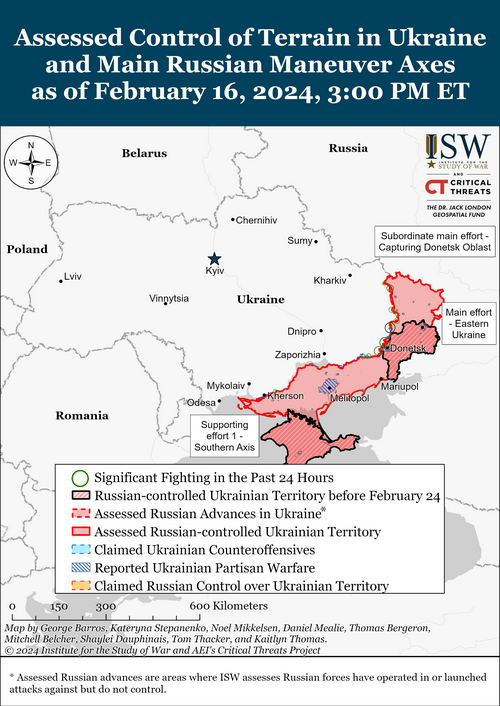
From The Institute for the Study of War:
Russian Offensive Campaign Assessment, February 16, 2024
Riley Bailey, Karolina Hird, Angelica Evans, Grace Mappes, Christina Harward, and Frederick W. Kagan
February 16, 2024, 8:00pm ET
Click here to see ISW’s interactive map of the Russian invasion of Ukraine. This map is updated daily alongside the static maps present in this report.
Click here to see ISW’s 3D control of terrain topographic map of Ukraine. Use of a computer (not a mobile device) is strongly recommended for using this data-heavy tool.
Click here to access ISW’s archive of interactive time-lapse maps of the Russian invasion of Ukraine. These maps complement the static control-of-terrain map that ISW produces daily by showing a dynamic frontline. ISW will update this time-lapse map archive monthly.
Note: The data cut-off for this product was 2:20pm ET on February 16 (excluding information pertaining to Avdiivka). ISW will cover subsequent reports in the February 17 Russian Offensive Campaign Assessment.
Ukrainian forces have begun to withdraw from Avdiivka, and Russian forces appear to be focused on complicating or preventing a complete Ukrainian withdrawal. Ukrainian Commander-in-Chief Colonel General Oleksandr Syrskyi stated early in the morning Ukrainian time on February 17 that he ordered Ukrainian forces within Avdiivka to withdraw to more favorable defensive positions in order to avoid encirclement and save the lives of Ukrainian personnel.[1] Syrskyi’s announcement comes after several confirmed Russian advances on the outskirts of Avdiivka in the past 24 hours. Geolocated footage published on February 16 indicates that Russian forces advanced further south along Hrushevskoho Street on Avdiivka’s western outskirts and south of the Avdiivka Coke Plant in northwestern Avdiivka, made marginal gains in dacha areas in northeastern Avdiivka, and captured the Avdiivka City Park in central Avdiivka.[2] The Ukrainian Tavriisk Group of Forces acknowledged earlier on February 16 that Ukrainian forces withdrew from an established fortified position south of Avdiivka and that Ukrainian forces are withdrawing from unspecified positions to new prepared defensive positions.[3] Ukrainian officials reported that Ukrainian forces are transferring reinforcements to the area to stabilize the situation and further degrade attacking Russian forces.[4] It is normal practice to bring in reinforcements to function as a receiving force that can allow withdrawing units to reconstitute behind prepared defensive positions. Russian sources claimed that Ukrainian forces are withdrawing en masse and that Ukrainian withdrawals are becoming increasingly chaotic and costly.[5] ISW has not observed any visual evidence of large or chaotic Ukrainian withdrawals, however, and the continued marginal rate of Russian advance in and around Avdiivka suggests that Ukrainian forces are currently conducting a relatively controlled withdrawal from Avdiivka.
Russian sources claimed that Russian forces also advanced in eastern Avdiivka, up to the southwestern outskirts of Avdiivka, further south along Hrushevskoho Street, and west of Avdiivka in the direction of dirt roads that Ukrainian forces are using to supply positions in eastern and southern Avdiivka.[6] Russian milbloggers claimed that Russian forces are close to cutting or have already cut one dirt road connecting Avdiivka with Lastochkyne (west of Avdiivka).[7] Russian sources claimed that Russian forces are close to encircling the remaining Ukrainian forces within central, eastern, and southern Avdiivka, with one Russian milblogger claiming that little more than a kilometer separates the Russian positions on the western outskirts of Avdiivka and the Russian positions in southern Avdiivka.[8] ISW currently assesses that roughly three and a half kilometers separate Russian advances in these two areas based on available visual evidence. Russian milbloggers claimed that up to 5,000 Ukrainian personnel remain in Avdiivka and are effectively trapped in the settlement, but Ukrainian Tavriisk Group of Forces Commander Brigadier General Oleksandr Tarnavskyi stated that Russian forces have not encircled any Ukrainian units in Avdiivka as of 1300 on February 16.[9] Ukrainian military observer Kostyantyn Mashovets stated that Russian forces are determined to prevent Ukrainian forces from withdrawing from Avdiivka in an organized manner.[10]
Ukrainian forces may have to conduct counterattacks to conduct an orderly withdrawal from Avdivika, and Russian efforts to complicate or prevent a Ukrainian withdrawal may become increasingly attritional. Ukrainian forces may have to stabilize the frontline by counterattacking in the area where Russian forces are trying to close the encirclement of Ukrainian forces in Avdiivka in order to conduct an orderly withdrawal. A Ukrainian brigade that recently redeployed to conduct counterattacks within Avdiivka stated on February 16 that it has recently helped Ukrainian forces render elements of the Russian 74th Motorized Rifle Brigade (41st Combined Arms Army [CAA], Central Military District [CMD]) and the 114th Motorized Rifle Brigade (Donetsk People’s Republic [DNR], 1st Army Corps [AC]) combat ineffective.[11] Further Russian gains within Avdiivka aimed at complicating the Ukrainian withdrawal and Ukrainian counterattacks covering withdrawing Ukrainian forces will likely result in further Russian losses. Russian forces would likely struggle to advance west of Avdiivka towards secondary prepared positions to which Ukrainian forces are withdrawing and would likely suffer considerable losses if they decided to frontally attack these Ukrainian positions across open fields. Russian forces likely aim to complicate or prevent the Ukrainian withdrawal in hopes of inflicting operationally significant losses on Ukrainian forces in the area, since the capture of Avdiivka itself would not offer any operationally significant benefits or avenues for operationally significant advances.[12]
Germany and France both signed bilateral security agreements with Ukraine on February 16. Ukrainian President Volodymyr Zelensky signed a long-term bilateral security agreement with German Chancellor Olaf Scholz on February 16 providing for bilateral cooperation in the military, political, financial, and humanitarian spheres until 2034.[13] The agreement also states that Germany will provide over €7 billion ($7.5 billion) in military aid to Ukraine in 2024, including a €1.1 billion ($1 billion) aid package that is currently being prepared and will include 36 howitzers, 120 thousand artillery shells (including 50,000 155mm artillery rounds), two Skynex air defense systems, missiles for the IRIS-T air-to-air missile system, 66 armored personnel carriers (APCs), several mine-clearing vehicles, and various reconnaissance drone models.[14] Zelensky also met with German Federal President Frank-Walter Steinmeier to discuss the launch of joint weapons production.[15] Zelensky later met with French President Emmanuel Macron to sign a bilateral security agreement and reported that France will provide Ukraine €3 billion ($3.2 billion) in military assistance over the course of 2024.[16]
NATO officials are increasingly warning that Russia poses a significant threat to NATO’s security. The Financial Times (FT) reported on February 16 that recent new assessments of Russia’s military capabilities and potential threats to NATO states have led Western leaders to recognize Russia’s continued military potential and to increase defense investment.[17] FT quoted unnamed British military intelligence officials who warned that Russia’s aggressive intent has persisted and that Russian air and naval assets are still ”largely intact” while Russian land forces have been degraded in Ukraine. The Russian Black Sea Fleet has been badly degraded by Ukrainian strikes, but most of the Russian Navy is stationed outside the Black Sea. FT noted that most Western officials expect that Russia would be able to reconstitute its forces ”within five to six years” (it is unclear if the officials are referring to 2030 or to a period starting with the end of the war, whenever that is) despite suffering major losses in Ukraine. This observation is consistent with ISW’s previous assessment that an end to the war on Russia’s terms would allow Russian forces to reconstitute rapidly and restore capabilities that Russia could use to attack NATO states.[18] Several European defense officials quoted by FT emphasized that there is a ”credible threat” that Russia could attack a NATO country in as few as three to five years. NATO officials’ increased warnings about the current state of the Russian threat align with ISW’s assessment that a Russia that emerges victorious in Ukraine poses a considerable threat to NATO and European security and that the West’s continued support for Ukraine to prevent Russian victory is therefore imperative for NATO‘s, and America’s, vital security interests.[19]
Independent Russian survey data suggests that most Russians are largely apathetic towards Russia’s war in Ukraine, particularly Russians who have not personally lost family members in Ukraine and are thus able to avoid thinking about the war entirely. Russian opposition outlet Verstka reported on February 16 that independent Russian sociological data suggests the overwhelming majority of Russians have come to view the war as a background event that does not affect their daily lives.[20] Verstka stated that most Russians avoid thinking about or discussing the war unless they personally experience the loss of a family member.[21] Verstka reported that Russians who have lost loved ones and are suffering as a result of the war are the ”silent majority” and do not make efforts to influence the general mood of Russian society.[22] Verstka noted that there is growing discontent among the family members of mobilized and contact servicemen still serving in Ukraine, but that Russians largely view the concept of ”victory” in Ukraine as a benefit for the Russian government and do not expect any personal benefits from Russia’s war in Ukraine.[23] The New York Times reported on February 15 that the Pentagon estimates that Russia has suffered roughly 60,000 personnel killed and another 300,000 personnel wounded during fighting in Ukraine since February 2022.[24] Russian President Vladimir Putin recently met with family members of deceased Russian servicemen and may be using such meetings to cater to the sizable constituency of people affected by personnel losses in Ukraine ahead of the March 2024 presidential election.[25] Verstka’s findings, along with reports about how Russian officials deal with the deaths of servicemembers, suggest that Russian society has largely accepted and internalized the war and that individual instances of resistance to the war are siloed and not transmitted amongst wider communities.
The Russian reaction to the reported death of imprisoned opposition politician Alexei Navalny on February 16 was relatively muted. The Federal Penitentiary Service of Yamalo-Nenets Autonomous Okrug, where Navalny had been imprisoned, stated on February 16 that Navalny died at the penal colony after going on a walk and feeling unwell.[26] Kremlin Spokesperson Dmitri Peskov stated that the Kremlin did not know anything about Navalny’s death and that Putin is aware of the death, though Putin has yet to comment about Navalny.[27] Other senior Russian officials expressed anger at accusations that the Kremlin was somehow involved in Navalny’s death and called for people to wait for the results of an investigation into the death and the results of the autopsy.[28] Russians across the country laid flowers and held minor demonstrations near memorials for political prisoners, but Russian law enforcement largely prevented demonstrations from growing too large, and the Moscow Prosecutor’s Office warned against participating in an alleged planned large demonstration.[29] A few Russian ultranationalist milbloggers reiterated Kremlin lines criticizing Western accusations of Russian involvement in Navalny’s death.[30] A prominent Russian milblogger claimed that Navalny’s death is unimportant compared to the current situation in Avdiivka, Donetsk Oblast, and another milblogger claimed that it was a significant mistake for Russia to imprison Navalny and “let him die there” ahead of the March 2024 presidential election.[31] The Russian Strelkov (Igor Girkin) Movement (RDS) expressed fear that Navalny’s death in Russian state custody and the detention of many other opposition figures in state custody could leave no one to lead a domestic resistance movement should Russia go to war directly against Western states.[32] Girkin’s wife Miroslava Reginskaya expressed concern for Girkin himself but claimed that his health is good.[33]
Key Takeaways:
- Ukrainian forces have begun to withdraw from Avdiivka, and Russian forces appear to be focused on complicating or preventing a complete Ukrainian withdrawal.
- Ukrainian forces may have to conduct counterattacks to conduct an orderly withdrawal from Avdivika, and Russian efforts to complicate or prevent a Ukrainian withdrawal may become increasingly attritional.
- Germany and France both signed bilateral security agreements with Ukraine on February 16.
- NATO officials are increasingly warning that Russia poses a significant threat to NATO’s security.
- Independent Russian survey data suggests that most Russians are largely apathetic towards Russia’s war in Ukraine, particularly Russians who have not personally lost family members in Ukraine and are thus able to avoid thinking about the war entirely.
- The Russian reaction to the reported death of imprisoned opposition politician Alexei Navalny on February 16 was relatively muted.
- Russian forces recently made confirmed advances along the Kupyansk-Svatove-Kreminna line, northwest of Bakhmut, and near Avdiivka.
- Russian President Vladimir Putin continues to posture himself as an involved and effective wartime leader.
- Russian-controlled courts in occupied Ukraine continue to pass harsh sentences on Ukrainian prisoners of war (POWs).
Go here to read the rest. Putin’s murder of Alexei Navalny is quite similar to how he has dispatched many adversaries over the years. The way he did it immediately after the Tucker Carlson interview was meant to say to his people that he has complete contempt for the West, including those Westerners gullible enough to sympathize with him. Putin always has portrayed himself as the strong man Russia needs, and Russian history indicates that leaders never shy away from murders done for reasons of state.

