
From The Institute For the Study of War:
Russian Offensive Campaign Assessment, January 30, 2024
Nicole Wolkov, Grace Mappes, Christina Harward, Karolina Hird, and Frederick W. Kagan
January 30, 2024, 7:15pm ET
Click here to see ISW’s interactive map of the Russian invasion of Ukraine. This map is updated daily alongside the static maps present in this report.
Click here to see ISW’s 3D control of terrain topographic map of Ukraine. Use of a computer (not a mobile device) is strongly recommended for using this data-heavy tool.
Click here to access ISW’s archive of interactive time-lapse maps of the Russian invasion of Ukraine. These maps complement the static control-of-terrain map that ISW produces daily by showing a dynamic frontline. ISW will update this time-lapse map archive monthly.
Note: The data cut-off for this product was 1:15pm ET on January 30. ISW will cover subsequent reports in the January 31 Russian Offensive Campaign Assessment.
Note: ISW added a new section on Russian air, missile, and drone campaign to track Russian efforts to target Ukrainian rear and frontline areas, grow its drone and missile arsenals, and adapt its strike packages.
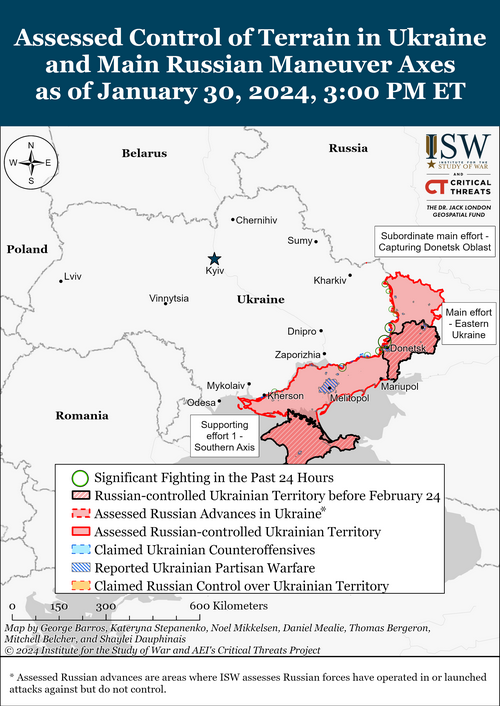
The anticipated Russian 2024 winter-spring offensive effort is underway in the Kharkiv-Luhansk Oblast border area. Ukrainian Main Military Intelligence Directorate (GUR) Head Lieutenant General Kyrylo Budanov stated on January 30 that the Russian offensive in Ukraine is currently ongoing and that Russian forces aim to reach the Zherebets River (in the Kharkiv-Luhansk Oblast border area) and the administrative borders of Donetsk and Luhansk oblasts.[1] Budanov forecasted that Russian forces would fail to achieve these objectives, however, and would likely be “completely exhausted” by the beginning of the spring.[2] Budanov’s statements are consistent with ISW’s observation that Russian forces have intensified offensive operations along this axis since the beginning of January 2024.[3] Russian forces have recently made tactical gains southeast of Kupyansk along the critical P07 Kupyansk-Svatove route near Krokhmalne and appear to be increasing assaults northwest and west of Krokhmalne towards the Oskil River.[4] Russian forces will likely be able to secure additional tactical-level gains in the Kupyansk area but are unlikely to be able to translate these tactical gains into wider mechanized maneuvers needed for operationally significant advances that could capture more territory in Kharkiv Oblast and push to the Luhansk and Donetsk oblast administrative borders.[5] ISW has observed that elements of the Western Military District’s 1st Guards Tank Army and 6th Combined Arms Army are active in the Kupyansk area and have been able to pursue infantry-led frontal assaults but have not shown the capacity to conduct large-scale mechanized maneuver since they were deployed to this axis over a year ago. ISW will soon publish a more detailed operational analysis of the situation on this Kharkiv-Luhansk axis.[6]
Ukrainian officials continued to deny rumors about the purported dismissal of Ukrainian Commander-in-Chief General Valerii Zaluzhnyi. Ukrainian Presidential Press Secretary Serhii Nykyforov stated on January 29 that Ukrainian President Volodymyr Zelensky did not dismiss Zaluzhnyi.[7]
Russian forces appear to be continuing to violate the Chemical Weapons Convention (CWC) to which Russia is a signatory. Ukrainian Tavriisk Group of Forces Spokesperson Colonel Oleksandr Shtupun reported on January 30 that Russian forces are using chemical weapons against Ukrainian positions in the Tavriisk direction (Avdiivka through western Zaporizhia Oblast).[8] Shtupun noted that Russian forces conducted at least five strikes using likely K-51 grenades carrying chloropicrin on January 29 alone. Chloropicrin is primarily used as a soil fumigant that can be fatal when inhaled, and it is sometimes classified as a riot control agent (RCA) due to its harmful and irritant effects.[9] The CWC prohibits the use of RCAs in warfare.[10]
Russian Army General Alexander Dvornikov was reportedly appointed the new chairperson of the Russian Volunteer Society for Assistance to the Army, Aviation, and Navy of Russia (DOSAAF).[11] Dvornikov had been the commander of the Southern Military District and the first overall theater commander in Ukraine from April to May 2022, and Russian President Vladimir Putin had sidelined Dvornikov without officially firing him following Dvornikov‘s failure to capture Donbas by May 2022.[12] Dvornikov was reportedly serving as an advisor to the Almaz-Antey Aerospace Concern as of October 2023.[13] Dvornikov’s newest appointment demonstrates Putin’s preference for rotating his failed generals through positions that are peripheral to combat duty as opposed to outright dismissing them.[14] DOSAAF is a Soviet-era youth movement that promotes military skills and has likely supported Russian youth education aimed at Russifying youth in occupied Ukraine.[15] Russian sources claimed that Dvornikov will need to “resuscitate” the “long-suffering” DOSAAF organization, and Dvornikov’s appointment may indicate increased Kremlin attention to military-patriotic youth education.[16]
Russian Security Council Deputy Chairperson Dmitry Medvedev made offensive and inflammatory comments about Japan while asserting Russia’s rights to the disputed Kuril Islands, likely as part of wider Kremlin efforts to demonstrate Russia’s support of China against the US alliance system in the Indo-Pacific. Japanese Prime Minister Fumio Kishida stated on January 30 that Japanese sanctions against Russia and support for Ukraine will continue but that Japan is interested in resolving its territorial issues with Russia and signing a peace treaty.[17] Japan never signed a formal peace treaty with the Soviet Union after the end of World War II. Russian Security Council Deputy Chairperson Dmitry Medvedev responded to Kishida’s statement and claimed that the disputed Kuril Islands are Russian and that the “territorial question” between Russia and Japan about the islands is “closed“ according to Russia’s constitution – referring to amendments to Russia’s constitution in 2020 that banned territorial concessions.[18] Medvedev claimed that Russia will “actively” develop the Kuril Islands and that their “strategic role” will grow as Russia stations new weapons there.[19] Russia has been installing military infrastructure on the Kuril Islands since at least 2015.[20] Medvedev used highly offensive language to imply that Russia would not negotiate with Japan about the islands and to criticize Japan’s relations with the United States.[21] Medvedev posted these comments on his English-language X (formerly Twitter) account as opposed to his Russian-language Telegram channel, suggesting that his objective was specifically to offend Japan in the English-speaking world and posture aggressively towards the US and its allies in the Indo-Pacific. The Russian Pacific Fleet also conducted an anti-submarine exercise in the South China Sea on January 29.[22] Medvedev’s claims and the Pacific Fleet exercises are likely aimed at demonstrating that Russia is a strong Pacific power that supports China against the US alliance system in the Indo-Pacific, as the Kremlin has routinely stressed in the past.[23]
Senior Russian officials may be intensifying their attempts to frame and justify Russia’s long term war effort in Ukraine as an existential geopolitical confrontation with the West by explicitly equating the United States with the Nazis. Russian Foreign Minister Sergei Lavrov stated at an international ambassadorial roundtable on “solving the situation in Ukraine” on January 30 that “Napoleon, Hitler, and now the US” have found a new way to attack Russia.[24] Lavrov quoted Nazi Reichskommissar (literally “imperial commissar”–the Nazi occupation governor) for Ukraine Erich Koch stating that “Ukraine is for [the Third Reich] only an object of exploitation… and that the population must be used as a second-class people in solving military problems” and claimed that the West today is fighting the war against Russia through Ukraine “with only the goal outlined by Reichskommissar Koch.”[25] Russian President Vladimir Putin and other senior Russian officials have recently started framing the war as an existential geopolitical conflict against an alleged modern Nazi movement in the West, though Lavrov’s claim that the West is pursuing the same goals and methods as a specified Nazi official is the most explicit framing yet.[26] ISW continues to assess that the Kremlin may have decided that the narrative that Russia and other countries are fighting a geopolitical Western “Nazi” force is a more effective immediate narrative than Putin’s attempt to appeal to ethnic Russians and Russian speakers in territories formerly colonized by the Soviet Union and Russian Empire with the “Russian World” (Russkiy Mir) ideology.[27] The Russkiy Mir framework is purposefully based on amorphous ethnic identities that are not universally agreed upon and that are at odds with Russia’s multi-ethnic composition. Lavrov’s intensification of portrayals of the United States and West as alleged Nazi actors at an international event is also noteworthy and may suggest that the Kremlin views the Nazi narrative as potentially more successful as a posturing tool with international audiences, particularly those that are not aligned with the United States and the West.
Russian opposition sources suggested that widespread internet outages in Russia on January 30 may be the result of Russian efforts to establish the “sovereign internet” system. Russian media reported that several major Russian entities experienced outages on January 30, including but not limited to Russian telecommunications giants Yandex, Megafon, MTS, Rostelecom, and Beeline; banks VTB, Sberbank, Alfabank; consumer goods companies Avito, Wildberries, Ozon, and Lamoda; and the social media site VK.[28] The Russian Ministry of Digital Transformation reported that a technical issue with the global Domain Name System Security Extensions (DNSSEC) caused the outage with .ru domains and that authorities have since restored service to users on Russia’s National Domain Name System.[29] Russian anti-censorship organization Net Freedoms Project and other opposition outlets noted that Russia has been trying to establish its “sovereign internet” system and connected the DNSSEC failure with attempts to transfer all Russian internet users to a Russian national domain name system (DNS) server separate from the global internet.[30] The Russian “sovereign internet” law, which came into force in November 2019, aims to create an independent Russian internet system protected from external actors and obliges Russian internet service providers to possess the technological means to counter these threats, and the Russian government will likely coopt this technology to increase surveillance and censorship in the Russian information space.[31]
The Kremlin has been intensifying efforts to consolidate control over the Russian information space in advance of the March 2024 Russian presidential election, and these efforts support the development of the “sovereign internet” system. Russian state newswire TASS reported that social media site Telegram experienced an outage on January 18; telecom operator Beeline experienced an outage on January 19; and YouTube experienced outages in Moscow, St. Petersburg, Novosibirsk, Nizhny Novgorod, and Rostov-on-Don on January 23.[32] Russian state censor Roskomnadzor tested blocking all major messaging platforms in the Russian Far East on January 23, and Russian opposition outlet SOTA reported that Roskomnadzor blocked internet access in the Republic of Sakha on January 24 to stymie unrest following an ethnically motivated murder.[33] The Russian Prosecutor General’s Office reported on January 8 that it blocked over 200,000 internet resources for allegedly promoting “fakes” and for “discrediting” the Russian military and that it prepared a bill allowing Roskomnadzor to rapidly block information that fails to comply with Russian censorship laws.[34] The Kremlin is also replacing blocked sites with its own analogs; Russian Wikipedia replacement “Ruviki” left beta testing as of January 15 and internet giant Yandex took an additional step to separate its Russian entity from its international entity on January 23.[35]
Key Takeaways:
- The anticipated Russian 2024 winter-spring offensive effort is underway in the Kharkiv-Luhansk Oblast border area.
- Ukrainian officials continued to deny rumors about the purported dismissal of Ukrainian Commander-in-Chief General Valerii Zaluzhnyi.
- Russian forces appear to be continuing to violate the Chemical Weapons Convention to which Russia is signatory.
- Russian Army General Alexander Dvornikov was reportedly appointed the new chairperson of the Russian Volunteer Society for Assistance to the Army, Aviation, and Navy of Russia (DOSAAF).
- Russian Security Council Deputy Chairperson Dmitry Medvedev made offensive and inflammatory comments about Japan while asserting Russia’s rights to the disputed Kuril Islands, likely as part of wider Kremlin efforts to demonstrate Russia’s support of China against the US alliance system in the Indo-Pacific.
- Senior Russian officials may be intensifying their attempts to frame and justify Russia’s long term war effort in Ukraine as an existential geopolitical confrontation with the West by explicitly equating the US with the Nazis.
- Russian opposition sources suggested that widespread internet outages in Russia on January 30 may be the result of Russian efforts to establish the “sovereign internet” system.
- The Kremlin has been intensifying efforts to consolidate control over the Russian information space in advance of the March 2024 Russian presidential election, and these efforts support the development of the “sovereign internet” system.
- Russian forces recently made confirmed advances near Bakhmut and Horlivka amid continued positional engagements along the entire line of contact on January 30.
- The UK Ministry of Defense (MoD) reported that the Russian defense industrial base (DIB) can produce at least 100 main battle tanks per month and is therefore able to replace battlefield losses, allowing Russian forces to continue their current tempo of operations “for the foreseeable future.”
- Russian authorities are planning to increase the deportation of Ukrainian children to Russia in 2024.
Go here to read the rest. Putin continues to electioneer on the battlefield.

