
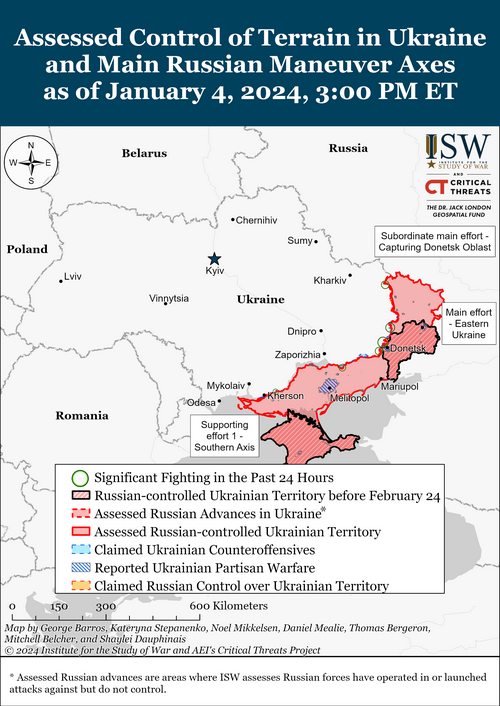
From The Institute for the Study of War:
Russian Offensive Campaign Assessment, January 4, 2024
Riley Bailey, Christina Harward, Nicole Wolkov, Angelica Evans, Grace Mappes, George Barros, and Frederick W. Kagan
January 4, 2024, 5:20pm ET
Click here to see ISW’s interactive map of the Russian invasion of Ukraine. This map is updated daily alongside the static maps present in this report.
Click here to see ISW’s 3D control of terrain topographic map of Ukraine. Use of a computer (not a mobile device) is strongly recommended for using this data-heavy tool.
Click here to access ISW’s archive of interactive time-lapse maps of the Russian invasion of Ukraine. These maps complement the static control-of-terrain map that ISW produces daily by showing a dynamic frontline. ISW will update this time-lapse map archive monthly.
Note: The data cut-off for this product was 12:10pm ET on January 4. ISW will cover subsequent reports in the January 5 Russian Offensive Campaign Assessment.
Ukrainian military officials reported that Ukrainian forces struck at least one Russian military target in occupied Crimea, while Russian officials and milbloggers claimed that the Ukrainian strike was unsuccessful. Ukrainian Armed Forces Center for Strategic Communications (StratCom) stated on January 4 that Ukrainian forces struck a Russian command post near Sevastopol in the afternoon.[1] Ukrainian Air Force Commander Lieutenant General Mykola Oleshchuk implied that Ukrainian strikes against Sevastopol and Yevpatoria may have targeted the locations of Russian military leaders.[2] Oleshchuk also amplified footage of a smoke plume geolocated to the eastern outskirts of Uyutne and a report by a Crimean source, which stated that a projectile reportedly struck a Russian air defense unit near Uyutne (just west of Yevpatoria).[3] The Russian Ministry of Defense (MoD) claimed that Russian forces shot down 10 Ukrainian missiles over Crimea.[4] Russian sources, including the MoD and Sevastopol occupation governor Mikhail Razvozhaev, claimed that Russian air defenses repelled the Ukrainian strike.[5]
US National Security Council Spokesperson John Kirby stated on January 4 that Russia has already launched ballistic missiles acquired from North Korea at targets in Ukraine and continues efforts to acquire similar missiles from Iran. Kirby stated that North Korea provided Russia with ballistic missile launchers and an unspecified number of ballistic missiles and that Russian forces launched at least one of the North Korean missiles into Ukraine on December 30, 2023.[6] Kirby also stated that Russian officials continue efforts to buy ballistic missiles from Iran. The Wall Street Journal (WSJ) reported earlier on January 4 that unspecified US officials stated that Russia could receive Iranian short-range ballistic missiles as early as spring 2024 but that the officials do not believe that Russia and Iran have yet completed a deal.[7]
Russia may be intensifying efforts to source ballistic missiles from abroad because these missiles appear to be more effective at striking targets in Ukraine in some circumstances. Russian forces routinely use short-range ballistic missiles to strike Ukrainian cities closer to the frontline, and these missiles appear to be more effective at penetrating or avoiding Ukrainian air defenses. Ukrainian air defenses have intercepted 149 of a reported 166 Russian cruise missiles in intensified attacks since December 29, 2023, but have only intercepted a handful of the ballistic missiles that Russia has launched at Ukraine in the same period, for example.[8] Russian forces have repurposed S-300 and S-400 air defense missiles for conducting strikes against surface targets in Ukraine, and Ukrainian officials have acknowledged that Ukrainian air defenses struggle to intercept these unorthodox missile attacks using their own S-300 and S-400 systems.[9] Ukrainian forces have also appeared to be less successful in intercepting Iskander ballistic missiles during recent strikes, although Ukrainian forces did intercept an Iskander-M missile during a less intense series of Russian missile and drone strikes on December 30.[10] Ukrainian forces reportedly intercepted all Iskander-M or S-300/S-400 missiles that Russian forces launched at Kyiv on December 12.[11] Ukrainian forces reportedly also intercepted all 10 Kinzhal missiles that Russian forces launched at Ukraine on January 2 with Western-provided Patriot systems.[12] The effectiveness of Russian ballistic missiles thus appears to depend in part on the configuration of Ukraine’s air defense umbrella in the target area and the strike package of which the missiles are part.
The relative success that Russian forces have had in striking targets in Ukraine with ballistic missiles in combination with cruise missiles and drones may be prompting an intensification of Russian efforts to source ballistic missiles from abroad. Russia can reportedly produce roughly 42 Iskander missiles and four Kinzhal missiles per month, although it is unclear how many S-300/S-400 missiles Russia can produce.[13] Russia‘s defense industrial base (DIB) likely cannot produce ballistic missiles at the scale required for a persistent strike campaign in Ukraine that relies on regularly expending a large volume of ballistic missiles, and Russia likely has to source ballistic missiles from abroad if it wishes to maintain large-scale missile strikes against Ukraine.
US National Security Council Spokesperson John Kirby dismissed recent Western reporting of Russian President Vladimir Putin’s willingness to engage in peace negotiations with Ukraine as “ballyhoo” during a press conference on January 3.[14] Kirby stated that Putin “sure doesn’t act like a guy who’s willing to negotiate,” referring to Russia’s recent large-scale strikes against Ukraine from December 29, 2023, to January 2.[15] Kirby added that Putin is doing everything possible to put Ukraine in a disadvantageous position and reiterated the importance of continued Western support for Ukraine.[16] Ukrainian Foreign Minister Dmytro Kuleba stated during an interview with CNN on January 3 that Ukraine is confident that Western aid to Ukraine will continue and that Ukraine does not have a “plan B.”[17] Kuleba noted that a theoretical Russian victory in Ukraine would embolden other world leaders with predatory expansionist objectives and cited recent Russia’s missile strikes against Kyiv and other Ukrainian cities as a clear indication of Putin’s unwillingness to negotiate with Ukraine.[18] ISW has long assessed that Putin does not intend to negotiate with Ukraine in good faith and that Russia’s goals in Ukraine — which are tantamount to full Ukrainian and Western surrender — remain the same.[19]
Russian President Vladimir Putin signed a decree strengthening procedures for granting foreign citizens Russian citizenship in exchange for Russian military service in Ukraine, likely as part of ongoing efforts to coerce migrants into the Russian military. The January 4 decree grants Russian citizenship to foreign citizens who have signed at least a year-long contract with the Russian military or “military formations,” likely referencing volunteer formations and private military companies (PMCs), during periods of “special military operations.”[20] The decree also grants Russian citizenship to the spouses, children, and parents of the foreigners serving with the Russian military.[21] The decree reduces the time it takes for these foreigners to receive and be considered for Russian citizenship from three months to one month.[22] Putin previously signed a decree in September 2022 simplifying the process of obtaining Russian citizenship and dropping some prerequisites for foreigners who signed contracts with the Russian military.[23] The January 4 decree likely aims to further streamline and simplify the citizenship application process while formalizing migrant recruitment efforts following increased raids on migrant communities since summer 2023 in which Russian officials have issued military summonses to migrants with Russian citizenship.[24]
Russian State Duma’s Information Policy Committee Head Alexander Khinshtein noted that the January 4 decree would “solve the problem” of foreign countries’ extradition requests for their citizens who fought in Ukraine.[25] Khinshtein prevented the deportation of an Uzbek citizen who allegedly fought in the Wagner Group and successfully requested that Russian Ministry of Internal Affairs (MVD) grant the Uzbek citizen asylum in Russia in December 2023.[26] Russian authorities have routinely offered Russian citizenship to migrants in exchange for Russian military service in Ukraine and have threatened to revoke Russian citizenship from naturalized migrants if they refuse to serve in the Russian military.[27] ISW continues to assess that the Kremlin does not have a clearly defined policy regarding migrants as Russian authorities continue to pursue incoherent and competing efforts to restrict them working in Russia, coerce them into the Russian military, and leverage them to offset Russian labor shortages caused by the war. Putin’s January 4 decree suggests that the Kremlin may be prioritizing coercing migrants into the military over relying on migrants to offset domestic labor shortages.
Kyrgyzstan sentenced a Kyrgyz citizen to five years in prison for participating in the war in Ukraine as a member of the Wagner Group. A court in Kyrgyzstan announced on January 4 that it sentenced Beknazar Borugul uulu, a Kyrgyz citizen, to five years in prison on December 7, 2023, under the article for participation “in armed conflicts or military operations on the territory of a foreign state or undergoing training to commit a terrorist act.”[28] Wagner reportedly recruited Borugul uulu while he was in a Russian prison. Kyrgyzstan previously sentenced another Kyrgyz citizen who joined a Luhansk People’s Republic (LNR) military unit to 10 years in prison on charges of mercenarism in May 2023, and the case was sent to a retrial in August 2023 after an appeal to replace the mercenarism charge with charges of participating in a military conflict in a foreign country.[29] Uzbekistan and Kazakhstan have also recently sentenced some of their citizens on mercenarism charges after those citizens fought with Donetsk People’s Republic (DNR) and Wagner forces in Ukraine.[30] ISW previously assessed that Russia’s continued use of Central Asian populations in Central Asia and Russia for force-generation purposes will likely create friction between Russia and its Central Asian neighbors.[31] Central Asian countries are charging and detaining their citizens for fighting in Ukraine upon their return to Central Asia, and Russian President Vladimir Putin’s decree granting foreigners expedited Russian citizenship in exchange for Russian military service may be aimed at combatting this issue.
Russia has begun negotiations with Algeria, the United Arab Emirates (UAE), and Saudi Arabia to open Russian cultural centers (Russkii dom) abroad, likely aimed at increasing Russian influence in the Middle East and North Africa. Russian Federal Agency for the Commonwealth of Independent States (CIS), Compatriots Living Abroad, and International Humanitarian Cooperation (Rossotrudnichestvo) Deputy Head Pavel Shevtsov told Kremlin newswire Tass on January 4 that Russia has begun similar negotiations with other unnamed countries and noted that he is confident that the agreements will be completed “quickly enough” due to mutual interest between parties.[32] Russian media previously reported that Russia is also in negotiations to open additional Russkii dom centers in Brazil, South Africa, Angola, and Mali by 2025.[33] Russia currently has over 80 Russkii dom centers concentrated in Europe, Africa, and Central and Southeast Asia aimed at promoting Russian culture, strengthening the influence of the Russian language, supporting “compatriots abroad,” and preserving historical sites abroad with significance to Russia.[34] Moldovan and Ukrainian officials have previously warned that Russian officials use Russkii dom centers to promote Russian propaganda and conduct “subversive work” abroad.[35]
Key Takeaways:
- Ukrainian military officials reported that Ukrainian forces struck at least one Russian military target in occupied Crimea, while Russian officials and milbloggers claimed that the Ukrainian strike was unsuccessful.
- US National Security Council Spokesperson John Kirby stated on January 4 that Russia has already launched ballistic missiles acquired from North Korea at targets in Ukraine and continues efforts to acquire similar missiles from Iran.
- Russia may be intensifying efforts to source ballistic missiles from abroad because these missiles appear to be more effective at striking targets in Ukraine in some circumstances.
- US National Security Council Spokesperson John Kirby dismissed recent Western reporting of Russian President Vladimir Putin’s willingness to engage in peace negotiations with Ukraine as “ballyhoo” during a press conference on January 3.
- Russian President Vladimir Putin signed a decree strengthening procedures for granting foreign citizens Russian citizenship in exchange for Russian military service in Ukraine, likely as part of ongoing efforts to coerce migrants into the Russian military.
- Kyrgyzstan sentenced a Kyrgyz citizen to five years in prison for participating in the war in Ukraine as a member of the Wagner Group.
- Russia has begun negotiations with Algeria, the United Arab Emirates (UAE), and Saudi Arabia to open Russian cultural centers (Russkii dom) abroad, likely aimed at increasing Russian influence in the Middle East and North Africa.
- Russian forces made confirmed advances near Kreminna and Avdiivka as positional engagement continued along the entire frontline.
- Ukrainian sources reported that Russian authorities are planning to mobilize Ukrainian teenagers living in occupied Ukraine.
- Russian President Vladimir Putin signed a decree on January 4 streamlining the process for certain Ukrainians to receive Russian citizenship.
Go here to read the rest.
From Strategy Page:
January 4, 2024: Russia believed 2023 would be the year they expanded their armed forces. Heavy losses in Ukraine and the impact of that information on the Russian people, especially military-age men, derailed the expansion plans. Early in 2023 Russia increased the legal maximum number of its active-duty military personnel from 1,013,628 to 1,150,628. It was believed unlikely that this number would ever be reached. At the end of 2021, months before the invasion of Ukraine, Russian ground forces had about 400,000 men while the navy and air force each had about 150,000. About a third of air force personnel were paratroopers or air-mobile infantry. The navy had about 12,000 marines, who guarded naval bases in peacetime. That means the heavy Russian losses since the invasion began, and failure to mobilize many replacements, reduced the Russian army to about 250,000 personnel (less than a third of the Ukrainian Army). The airborne forces and marines also suffered heavy losses but more of them are still in service.
Heavy combat losses reduced the personnel strength so sharply because the Russian army has major recruiting and training problems, plus far fewer soldiers providing logistic and transportation services. The latter are provided by government or private contractors to assemble and move supplies close to the combat zone, where military trucks and drivers move the supplies to army maintained collection points or the combat units. This works inside Russia where the state-controlled railroads are equipped for operation by civilians who are trained to provide such support to the military. For a major war against Russia, civilian trucks and drivers are mobilized to serve military needs. Such a mobilization disrupts the economy but that is seen as necessary t0 defend Russia.
This is why the Ukrainian invasion was not called a war but an internal operation in what Russia declared was Russian territory controlled by rebels. Russia did not expect the Ukrainians’ massive resistance or their destruction of so many Russian trucks and supply collection points. This dramatically weakened Russian supply capabilities inside Ukraine, especially after Ukraine received American guided GMLRS rockets that hit Russian supply depots because of information supplied by Ukrainians on the ground or NATO supplied aerial and satellite surveillance. Russian forces inside Ukraine are chronically short of ammunition, food, fuel and much else because of these Ukrainian attacks. Resort to looting civilian supplies in occupied areas only partially replaces the supplies destroyed in transit or stored inside Ukraine.
Russian armed forces were supposed to have over a million men, but that goal has never been met and at the end of 2021 the total was about 750,000. By the end of 2022 it was about 400,000, including the air force and navy. Mobilizations of new conscripts and men who had served as conscripts for one year failed to replace all the losses, in part because the mobilized men knew that the war in Ukraine was not going well, and most men sent there had little training, equipment or leadership. Most of the junior officers were killed or disabled during the first months of the war and replacements take months to train adequately, so new recruits get only a few weeks of training at best. Peacetime officer training takes years and now there is a shortage of trainers for troops and officers because most of the existing ones were sent to Ukraine as replacements for the catastrophic losses the Ukrainians were inflicting.
Ukraine had 250,000 active-duty troops in early 2022 and within months had half a million more in the form of volunteers and conscripts. Normally Ukrainian troops receive a lot more training than their Russian counterparts but in the first months of the war plenty of untrained Ukrainians were used to halt the invasion. Since then, Ukrainian troops received more training and are now led by effective officers and NCOs in combat. Ukrainian troops don’t suffer from supply shortages and suffer absolutely and relatively fewer casualties than the Russians. Russian dead, missing and wounded too severely for further service are at least six times those of Ukraine’s, while the Russian population only outnumbers Ukraine’s by 3.5 to one. If this is a war of demographic attrition, Russia is losing.
Since the invasion began in February 2022 Russia has suffered enormous losses in terms of combat personnel, military equipment and the reputation for quality, reliability and effectiveness of Russian weapons and military personnel.
Even the Ukrainians were surprised at how unprepared the invaders were for combat and dealing with Ukrainian superiority in weapons, which were often Western and superior in performance to Russian models. Ukrainian troops were commanded by Ukrainian officers and NCOs using tactics that emphasized minimizing Ukrainian losses and maximizing Russian casualties.
Russia’s leadership, especially supreme leader Vladimir Putin, was delusional about the continuing lack of military progress in Ukraine. Even Russians who thought restoring independent, since 1991, Ukraine to Russian control was a good thing and worth fighting for, began losing confidence in Putin’s ability to make that happen. Each time failure in Ukraine became obvious, Putin would come up with a new reason why Russia was winning, and each of these was soon shown to be false.
Putin now believes he can eventually prevail because of disagreements among NATO members about whether or how Ukraine can win against the Russian invaders. NATO members agree about Russia’s inability to win in Ukraine but many politicians in some of the larger, and more distant from the fighting NATO nations like the United States, Germany, France, and Italy, openly doubt Ukraine’s ability to regain control of lost territory. Putin supports this attitude by continuing to threaten use of nuclear weapons if Russia is faced with losing all its seized territory in Ukraine. Such a move is also unpopular in Russia and one of the growing number of reasons Russians are losing faith in Putin’s promises that Russia will win in Ukraine.
Many Russians now openly oppose the war even though Putin quickly created laws to make such public dissent illegal. The failure of such law’s soon became obvious in many ways. First, there are a growing number of anti-war demonstrations and physical attacks on military facilities, especially recruiting stations. Refusing to report when conscripted became more common. Another form of defiance is veterans of the Ukraine fighting providing details, based on personal experience, of why Russian forces are failing.
Many of these veterans are no longer in the military because they refused to renew their contracts. Many more soldiers remained in the army but refused to return to Ukraine and got away with it. Putin ordered that these soldiers be officially described, in their military records and military ID, as unreliable and unwilling to fight. In any other country a soldier who refuses to fight during wartime is subject to severe punishment, often execution. That still happens to reluctant Russian soldiers inside Ukraine where officers have the authority to shoot reluctant troops. Initially, as Russian casualties grew and progress was nonexistent, some officers did shoot troops refusing to fight. That soon changed as the troops threatened to and sometimes did shoot back or, in at least one known case, ran over an officer with a tank. Not to mention them sometimes shooting undesirable officers first. Ukrainian forces have provided additional confirmation of this violence and collapsing morale within Russian units. Many Russian troops will surrender to the Ukrainians at the first opportunity and admit it to Ukrainian, Russian, and foreign journalists. This prompted Ukraine to equip some of its quadcopters to notify and lead surrendering Russian troops safely to Ukrainian front-line forces.
The number of Russian military personnel is declining because of combat losses and veterans refusing to stay in, even though being a contract (volunteer) soldier is one of the few jobs Russians can get because of high unemployment rates caused by Western economic sanctions. Russian ground forces have been taking more casualties than could be replaced for the entire duration of the war and are now far outnumbered by Ukrainian ground forces, plus Ukrainian recruits now get adequate training by World War Two American and British standards (2-4 months), while Russian recruits get only 1-3 weeks.
Lack of combat infantry is the great unsolvable problem for Putin. He lacks the will to conscript a massive army for fear that would spark a rebellion. He refuses to withdraw from Ukraine for such a defeat would almost certainly doom his regime. And so he goes on, his only hope being the collapse of the Ukrainian will to fight on.


Side comment on Russian soldiers in the winter: From time to time the troops are reminded of the Russian winter victory at Stalingrad and the push West after that. While the Germans were eventually defeated due largely to human wave attacks, which cost the lives of many Russians, and supplies arriving from the US and Britain. Many of the present day Russian soldiers have heard stories of the success in WW II but also of the cost in Russian casualties. This has caused a reluctance to fight for no clear purpose. More recently, they are aware of the debacle in Afghanistan, much as we remember the experience in Vietnam. Little wonder that Putin and company feel a necessity to crack down on adverse comment regarding this fruitless war.