Donald R. McClarey
Cradle Catholic. Active in the pro-life movement since 1973. Father of three, one in Heaven, and happily married for 43 years. Small town lawyer and amateur historian. Former president of the board of directors of the local crisis pregnancy center for a decade.
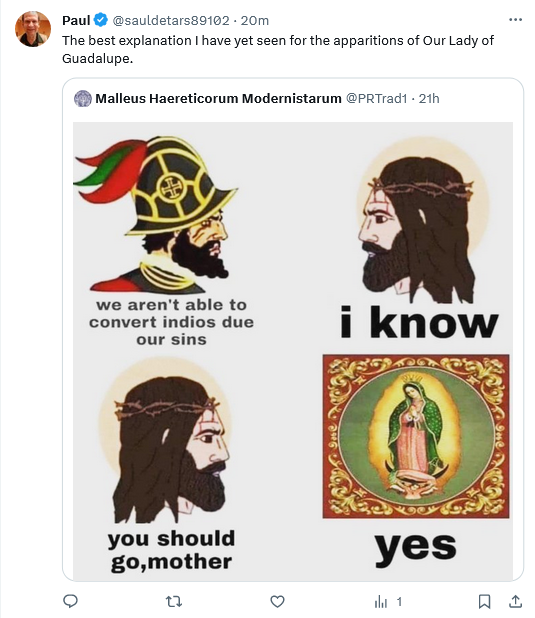



“You should go mother”. 🙌🏻
Thank you, Donald.
Our Lady always came from heaven by the grace of God and with the permission of God.
Women who want Holy Ordination into the priesthood do not have God’s permission.
I know it’s a meme and supposed to be light-hearted, but I admit that I choked up pretty hard reading it.
I have a lot of hope for Generation Z. The devout among them are beyond “traditional” or “tradition-friendly.” They are more like: “We want it back, and we want it all back!”
I would have more confidence in this if the Church gave attention to all the cultures who have professed Catholic faith. Somehow, this one winds up assuming we all need embrace faith via Hispanic or “native” culture.
….Somehow, this one winds up assuming we all need embrace faith via Hispanic or “native” culture. -JF
I see it differently.
1517 was the start of Luther’s burp. Protestantism was well underway by the time Our Lady appeared to Juan Diego, 1531.
In ten years, in the Americas, over 8 million became Catholic, while in Europe the Holy Catholic Church was feeling the effects of the split.
Just as Our Lady’s apparitions in France or Portugal didn’t push us to embracing their cultures, Our Lady of Guadalupe, to me, isn’t prompting us to embrace their culture.
Universal.
She is, has and always will be pointing us up.
Drawing us to the culture of forgiveness and love which her Son founded upon a scaffold so many years ago.
John Flaherty. The one thing that I do know about myself is that I don’t always understand others views very well in this format, so if I’m mis understanding your point please forgive me.
My brothers always said that my heart was bigger than my mind.
Philip, as always you make solid points, and I don’t disagree with any of them, except possibly in one respect. I took John Flaherty’s remarks as reflecting the same kind of…discomfort, I suppose is the right word…,as I feel when I see how virtually every N.O. parish I have attended or visited acts as if the entire story of Our Lady of Guadalupe is somehow the cultural property of Mexico, Mexicans, Mexican-Americans, and/or all Latinos. This is no more valid than treating the feasts of Our Lady of Lourdes or Our Lady of Fatima as if they are the property of French or Portugese Catholics, which as you noted, is not done. The feasts and their subjects belong to the whole Church, while still retaining obviously great importance for the local faithful where the apparitions occurred. Yet everywhere I have been, excepting only the Dallas diocese’s one and only FSSP parish, Masses for the feast days of St. Juan Diego and Our Lady of Guadalupe are always…always…”bi-lingual”, i.e. a seemingly random mix of Spanish and English. Decorations, posters, handouts, even Parish bulletins, are either all in Spanish or are, again, “bi-lingual.” All of this is, in my opinion, the fault of the USCCB, which strongly encourages it, and is tantamount to hollow virtue-signaling, if not outright liturgical abuse where the Mass and devotions are concerned. Go to Mass in Mexico and see how many parishes put on “bi-lingual” Spanish/English liturgies or Rosaries any time of the year. Let me know when you find one, anywhere. At least the Mexican bishops know that “vernacular” means the common language of the region or country where the Mass is celebrated, not that of immigrants or their progeny who have failed (or refuse) to assimilate to the local culture. And there are thousands, at least, of US expats living in Mexico and other Central American countries, yet no local parish I’ve ever heard of in those countries celebrates “bi-lingual” Mass or devotions. It is the very opposite of “pastoral” to encourage non-English speakers to remain that way while living here. The US practice helps no one, in my opinion, and needs to be stopped. In the US, the Mass and all public prayers ought to be in English or Latin. If you want another language, go to Mass in a country where that language is “the vernacular”, or to a parish where everything is in that language, such as the many Vietnamese, Eastern Rite, or Syro-Malabar parishes found in various places around this country.
Of course, none of this confusion would be nearly as prominent if we had never abandoned Latin as the language of the Liturgy, wherever it is celebrated. But there I go again…sorry. 😇
At least the Mexican bishops know that “vernacular” means the common language of the region or country where the Mass is celebrated, not that of immigrants or their progeny who have failed (or refuse) to assimilate to the local culture. And there are thousands, at least, of US expats living in Mexico and other Central American countries, yet no local parish I’ve ever heard of in those countries celebrates “bi-lingual” Mass or devotions. – Frank.
Excellent point.
Thank you. I wasn’t thinking along those lines.
Peace brother.