
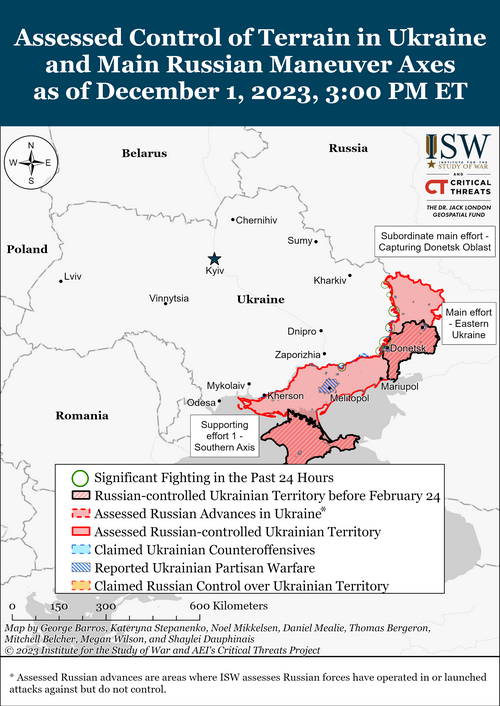
From The Institute For The Study of War:
Russian Offensive Campaign Assessment, December 1, 2023
Karolina Hird, Angelica Evans, Riley Bailey, Grace Mappes, George Barros, and Frederick W. Kagan
December 1, 2023, 7:15pm ET
Click here to see ISW’s interactive map of the Russian invasion of Ukraine. This map is updated daily alongside the static maps present in this report.
Click here to see ISW’s 3D control of terrain topographic map of Ukraine. Use of a computer (not a mobile device) is strongly recommended for using this data-heavy tool.
Click here to access ISW’s archive of interactive time-lapse maps of the Russian invasion of Ukraine. These maps complement the static control-of-terrain map that ISW produces daily by showing a dynamic frontline. ISW will update this time-lapse map archive monthly.
Note: The data cut-off for this product was 1pm ET on December 1. ISW will cover subsequent reports in the December 2 Russian Offensive Campaign Assessment.
Ukrainian President Volodymyr Zelensky and Ukrainian Commander-in-Chief General Valerii Zaluzhnyi signaled intent to increase Ukrainian defenses and fortifications around the Ukrainian theater, but notably did not include Zaporizhia Oblast in discussions of ongoing and future defensive measures. Zelensky stated on November 30 that Ukrainian forces will strengthen their fortifications in all critical directions of the front, including the Kupyansk-Lyman line, oblasts in northern and western Ukraine, and Kherson Oblast, but particularly emphasized the Avdiivka and Marinka directions and other areas of Donetsk Oblast.[1] Zelensky additionally met with various Ukrainian operational group commanders and discussed Ukrainian defensive operations in the Avdiivka and Marinka directions.[2] Zaluzhnyi spoke with Chairman of the US Joint Chiefs of Staff General Charles Brown to discuss Russian offensive operations in the Kupyansk, Lyman, Bakhmut, Avdiivka, and Marinka directions.[3] Zelensky’s and Zaluzhnyi’s statements notably identified the areas of the front where Ukrainian forces are chiefly focusing on defensive operations such as the Kharkiv-Luhansk Oblast border line (between Kupyansk and Lyman), most of Donetsk Oblast (likely in reference to Bakhmut and the Avdiivka-Donetsk City axis) and Kherson Oblast, but notably did not mention the Zaporizhia Oblast axis—suggesting that Ukrainian forces have not gone over to the defensive in this area. These statements generally accord with ISW’s assessment that Russian forces have been trying to regain the theater-level initiative in Ukraine since at least mid-November by conducting several simultaneous offensive operations in the areas where Ukrainian forces have transitioned to chiefly defensive actions.[4] In a separate interview with AP on December 1, Zelensky warned that in addition to the impacts that winter weather conditions are likely to have on the frontline, Russia will likely resume an intense air campaign against critical Ukrainian infrastructure.[5]
Russian Defense Minister Sergei Shoigu continues to falsely characterize Russian offensive efforts in Ukraine as part of an “active defense” in an effort to temper expectations about the Russian military’s ability to achieve operationally significant objectives. Shoigu stated on December 1 during a conference call with Russian military leadership that Russian forces are conducting an “active defense” in Ukraine and are capturing more advantageous positions in every operational direction.[6] Shoigu distinguished the 15th Motorized Rifle Brigade (2nd Combined Arms Army, Central Military District), 114th Motorized Rifle Brigade (1st Donetsk Peoples Republic [DNR] Army Corps), and the 4th and 123rd Motorized Rifle Brigades (both of the 2nd Luhansk People’s Republic [LNR] Army Corps) for their service.[7] All of these elements are reportedly or likely operating in areas where Russian forces are conducting offensive operations in eastern Ukraine and not defending against Ukrainian counteroffensive operations in Zaporizhia Oblast.[8] Shoigu and Putin both previously called Russian offensive operations to capture Avdiivka an “active defense” following the failure of the first Russian mechanized push to achieve significant tactical gains in early October 2023.[9] Russian forces launched two subsequent large-scale pushes to capture Avdiivka since early October 2023 and continue a high tempo of attritional infantry assaults around the settlement.[10] Russian officials’ characterization of these offensives as being part of an “active defense” are intentionally misleading. Ukrainian forces have never conducted offensive operations at scale in the Avdiivka area since the beginning of Russia’s full-scale invasion of Ukraine in 2022, and Avdiivka has been a famously static Ukrainian defensive position since 2014. Russian leadership has nevertheless continued to falsely frame operations around Avdiivka as an ”active defense” likely to recontextualize the lack of any major Russian progress around Avdivka despite over two months of large-scale Russian attacks there.[11]
The Russian military command would have to pursue an identifiable operational objective if it acknowledged the operations to capture Avdiivka as an offensive effort. The “active defense” framing, therefore, allows the Russian military leadership to declare success as long as Russian forces prevent Ukrainian forces from making any significant gains, an entirely achievable objective considering that Ukrainian forces are not conducting and never have conducted counteroffensive operations in the area. The Russian command’s “defensive” framing of the offensive effort around Avdiivka as well as localized offensive operations elsewhere in eastern Ukraine suggests that it lacks confidence in the Russian military’s ability to translate tactical gains into operationally significant advances.[12] Russian President Vladimir Putin, apparently concerned about decreasing Russian support for the war ahead of the 2024 Russian Presidential elections, has likely chosen to downplay the scale of Russian operations to the Russian public.[13] The increasing disconnect between heavy Russian losses in these offensive efforts and the Russian command’s framing of these operations may nevertheless fuel discontent in the wider Russian information space.
Ukrainian intelligence reportedly damaged another train along a section of the Baikal-Amur Railway on December 1 in an apparent effort to degrade Russian logistics in the Russian Far East. Ukrainian media reported that Ukrainian intelligence sources stated that the Security Service of Ukraine (SBU) conducted a special operation that damaged another train carrying fuel as it passed over a bridge along an unspecified part of the northern bypass of the Baikal-Amur Railway.[14] The SBU reportedly planned the operation to coincide with the expected rerouting of train traffic following the November 30 explosions in the Severomuysky Tunnel that disrupted a section of the East Siberian Railway in the Republic of Buryatia and damaged a fuel train, which Ukrainian media also connected to the SBU.[15] Russian sources claimed that the explosions on December 1 also occurred in the Republic of Buryatia and that six fuel tanks were completely or partially damaged.[16] Russian outlet Baza reported that travel is still blocked through the Severomuysky tunnel.[17] Ukrainian media reported that Ukrainian intelligence observed the Russian military using the railway to transfer equipment and supplies, although there are no indications that the December 1 explosions damaged the bridge along the Baikal-Amur Railway and will cause long-term disruptions.[18] The Baikal-Amur Railway and the Eastern Siberian Railway are the two major railways in the Russian Far East and connect Russia to China and North Korea, both countries on which Russia is increasingly relying for economic and military support to sustain its war effort in Ukraine.[19]
Russian President Vladimir Putin officially changed the composition of the Russian Presidential Council for Civil Society and Human Rights (HRC) on December 1, removing several members and appointing a prominent anti-opposition media figure. Putin signed a decree on December 1 that officially removed Russian lawyers Genri Reznik and Shota Gorgadze, Novaya Gazeta journalist Leonid Nikitinsky, North Caucasus-based missing person’s peacekeeping mission head Alexander Mukomolov, and Independent Expert Legal Counsel head Mara Polyakov.[20] Neither the text of the decree nor Russian media offered explanations for the removal of the aforementioned HRC members. The decree also notably nominates “public figure” Alexander Ionov to the HRC, along with several other Russian civil society figures.[21] Russian opposition media noted that Ionov has been a member of the Russian Federal Penitentiary Service since 2021 and that Ionov lodged successful appeals against Russian opposition outlets Meduza and The Bell, after which the Russian Ministry of Justice designated the outlets as “foreign agents.”[22] The US Treasury has sanctioned Ionov since July 2022 for his role in supporting “the Kremlin’s global negative influence operations and election interference efforts.”[23] Putin last changed the composition of the HRC in November 2022, which ISW assessed was an effort to stifle domestic opposition and give prominence to figures who propagate the Kremlin’s major informational lines.[24]
Chechen Republic Head Ramzan Kadyrov claimed that a second group of Palestinian refugees from the Gaza Strip arrived in Chechnya on December 1, possibly partially funded by his daughter’s ”Children of Chechnya – Children of Palestine” organization. NOTE: A version of this text appears in ISW-CTP’s December 1 Iran Update. Kadyrov published footage claiming to show 116 Palestinian refugees from the Gaza Strip, including 60 children, arriving in Chechnya and claimed that it is Chechnya’s “moral duty” to help the civilians of the Gaza Strip.[25] Kadyrov claimed that his daughter and head of the Grozny City Hall Preschool Education Department, Khadizhat Kadyrova, provided the children gifts through the ”Children of Chechnya – Children of Palestine” organization. Kadyrov announced Kadyrova‘s patronage of the organization in a Telegram post on November 11, encouraging his followers to purchase crafts made by Chechen preschoolers to fund humanitarian aid for Palestinian Muslims.[26] Regional outlet Caucasian Knot reported on November 15 that the organization raised more than 68 million rubles to purchase aid for Palestinians.[27] Caucasian Knot reported on November 16, citing unnamed Chechen government officials, that Kadyrov pressured Chechen officials to spend up to a third of their monthly salaries buying crafts from the “Children of Chechnya – Children of Palestine” organization.[28] Chechnya’s Ministry of Labor, Employment, and Development stated on November 18 that fundraisers for the organization are taking place “in all corners” of Chechnya.[29] ISW cannot independently verify this footage or any of Kadyrov’s claims, however. But if true, Kadyrov may be using the funds from this organization to at least partially finance the relocation of Palestinian refugees from the Gaza Strip, an effort that could help Kadyrov in his quest to balance his desire to curry favor with Russian President Vladimir Putin with the need to appeal to his own Chechen constituency.[30] Kadyrov posted footage on November 29 purportedly showing an initial group of 50 Palestinian refugees from the Gaza Strip arriving in Chechnya.[31] Kadyrov’s claims and the alleged work of the ”Children of Chechnya-Children of Palestine” organization reflect the Kremlin’s shift to a much more anti-Israel positions in the Israel-Hamas war.[32]
Russian milbloggers claimed that the Russian Ministry of Defense (MoD)’s disproportionate allocation of drones among frontline units and poorly-executed grassroots drone production campaigns are impacting frontline unit effectiveness. Russian milbloggers complained on December 1 that some decentralized grassroots campaigns aimed at arming Russian frontline units with new drones are failing to design battlefield-effective drones, sometimes developing “toys” instead of weapons.[33] The milbloggers complained that Russian drone manufacturers base the development of new drones on stylized and cinematic battlefield footage of Russian kamikaze drones striking Ukrainian equipment, resulting in these ineffective “toy” drones that can produce cinematic effects but struggle to further tactical objectives. The milbloggers claimed that the strikes that such footage depict are often “pretty” but ineffective, and claimed that Russian frontline units must conduct such strikes and produce such footage for the Russian MoD and grassroots drone manufacturers to continue allocating drones to those units.[34] These complaints are indicative of the struggles that the Russian MoD and other states with a highly centralized system face when implementing and integrating technological advances onto the battlefield. ISW has observed no indications that these frontline drone struggles have significantly impacted Russian military capabilities in Ukraine. The Russian milbloggers largely appear to focus on reiterating common complaints about the MoD prioritizing idealized lies that obfuscate harsh battlefield realities at the expense of Russian military personnel.[35] One milblogger claimed that the worst impact of these ineffective drones was that their ineffectiveness threatens frontline Russian soldiers.[36]
Russian sources complained that Russian soldiers’ continued use of personal electronics and messaging apps in frontline areas is jeopardizing Russian operational security (OPSEC). A prominent pro-Russian “hacktivist” released an alleged Ukrainian intelligence report on November 30 that shows Ukrainian intercepts of Russian personal communications from one day on one sector of the front.[37] The Russian source complained that this alleged report is relatively small compared to other such reports the source has obtained and complained that all WhatsApp and other messages that Russian military personnel send end up in Ukrainian interceptions, including documents, conversation screenshots, and media files.[38] One Russian milblogger responded to this post and claimed that neither warnings nor “detailed lectures” on the dangers of using WhatsApp and SMS systems in combat areas appear to affect Russian soldiers’ communication habits. The source concluded that “WhatsApp is killing” Russian personnel and that commanders need to crack down on Russian personnel’s use of these applications.[39] Another milblogger responded that Russian soldiers’ use of WhatsApp informs Ukraine where Russian forces are going to attack.[40] Russian units have continually struggled with proper adherence to OPSEC principles in key frontline and rear areas throughout the war thus far, particularly pertaining to personal cellphone use in combat areas.[41] The Russian military command largely blamed Russian cellphone use for a devastating Ukrainian strike on a concentration area in Makiivka, Donetsk Oblast, on New Years Eve 2022, and it appears as though Russian command has largely failed to remedy such issues over the course of the past year.[42]
Russian forces conducted another missile and drone strike against Ukraine on the night of November 30-December 1. The Ukrainian Air Force Command reported that Russian forces launched 25 Shahed 131/136 drones and two Kh-59 missiles primarily targeting areas in eastern and southern Ukraine and that Ukrainian forces downed 18 of the drones and one of the missiles.[43]
Key Takeaways:
- Ukrainian President Volodymyr Zelensky and Ukrainian Commander-in-Chief General Valerii Zaluzhnyi signaled intent to increase Ukrainian defenses and fortifications around the Ukrainian theater, but notably did not include Zaporizhia Oblast in discussions of ongoing and future defensive measures.
- Russian Defense Minister Sergei Shoigu continues to falsely characterize Russian offensive efforts in Ukraine as part of an “active defense” in an effort to temper expectations about the Russian military’s ability to achieve operationally significant objectives.
- Ukrainian intelligence reportedly damaged another train along a section of the Baikal-Amur Railway on December 1 in an apparent effort to degrade Russian logistics in the Russian Far East.
- Russian President Vladimir Putin officially changed the composition of the Russian Presidential Council for Civil Society and Human Rights (HRC) on December 1, removing several members and appointing a prominent anti-opposition media figure.
- Chechen Republic Head Ramzan Kadyrov claimed that a second group of Palestinian refugees from the Gaza Strip arrived in Chechnya on December 1, possibly partially funded by his daughter’s ”Children of Chechnya – Children of Palestine” organization.
- Russian milbloggers claimed that the Russian Ministry of Defense (MoD)’s disproportionate allocation of drones among frontline units and poorly-executed grassroots drone production campaigns are impacting frontline unit effectiveness.
- Russian sources complained that Russian soldiers’ continued use of personal electronics and messaging apps in frontline areas is jeopardizing Russian operational security (OPSEC).
- Russian forces continued offensive operations along the Kupyansk-Svatove-Kreminna line, near Bakhmut, near Avdiivka, west and southwest of Donetsk City, and in western Zaporizhia Oblast and advanced in some areas.
- Russian Security Council Deputy Chairperson Dmitry Medvedev claimed on December 1 that the Russian military has recruited over 452,000 personnel between January 1 and December 1, 2023.
- Russian occupation officials continue to set conditions for the deportation of Ukrainians to Russia under various vacation schemes.
Go here to read the rest. The Russian recruitment figure of 452, 000 is bad for them. All the recruits could not be sent to Ukraine and the number remaining likely could not replace the Russian killed and wounded sustained in the War this year. The Russian military in Ukraine is a diminishing asset.


I generally enjoy your commentary but your commentary on the Russian Ukraine war sounds like it comes right out of the Ukraine ministry of defense. Please provide unbiased information.
I call ’em like I see ’em Joe, as I do on all issues.
Don:
Your commentary largely squares with assessments given in the Moscow Times: that Russian military recruitment grows more desperate by the month. Russia has a long border with nasty neighbors and “commitments” abroad. They can draw down the troops facing Finland and Baltics, but China not so much. Pulling too many troops out of Syria or Africa would be a major propaganda egg-face for Putin. Then there’s the guys he has to hold in reserve to control antiwar protests and produce munitions and run an economy. It’s just a question of when and where the shell will break first.