
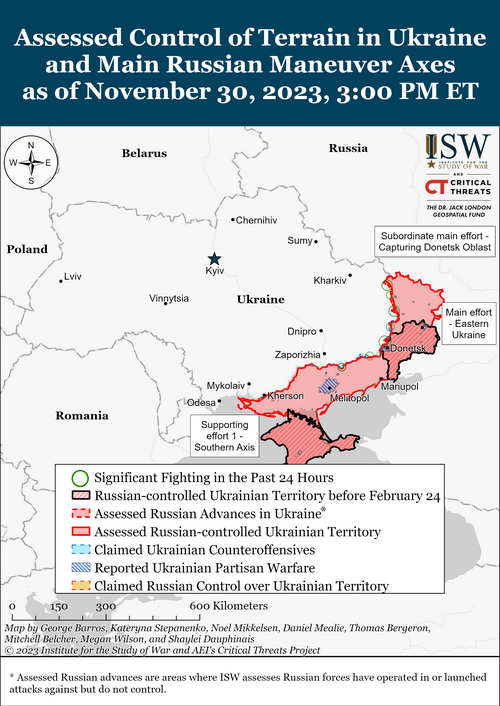
From The Institute For The Study of War:
Russian Offensive Campaign Assessment, November 30, 2023
Nicole Wolkov, Christina Harward, Angelica Evans, Grace Mappes, Riley Bailey, George Barros, and Frederick W Kagan
November 30, 2023, 6:45pm ET
Click here to see ISW’s interactive map of the Russian invasion of Ukraine. This map is updated daily alongside the static maps present in this report.
Click here to see ISW’s 3D control of terrain topographic map of Ukraine. Use of a computer (not a mobile device) is strongly recommended for using this data-heavy tool.
Click here to access ISW’s archive of interactive time-lapse maps of the Russian invasion of Ukraine. These maps complement the static control-of-terrain map that ISW produces daily by showing a dynamic frontline. ISW will update this time-lapse map archive monthly.
Note: The data cut-off for this product was 12:40pm ET on November 30. ISW will cover subsequent reports in the December 1 Russian Offensive Campaign Assessment.
A recent Russian opinion poll indicates that the number of Russians who fully support the war in Ukraine has almost halved since February 2023 and that more Russians support a withdrawal of Russian forces from Ukraine than do not. Independent Russian opposition polling organization Chronicles stated that data from its October 17-22, 2023, telephone survey indicates that respondents who are “consistent” supporters of the war – those who expressed support for the war, do not support a withdrawal of Russian troops from Ukraine without Russia having achieved its war aims, and think that Russia should prioritize military spending – decreased from 22 percent to 12 percent between February 2023 and October 2023.[1] Chronicles stated that 40 percent of respondents supported a withdrawal of Russian troops from Ukraine without Russia having achieved its war aims, and that this number has remained consistent at about 39 to 40 percent throughout 2023. Chronicles stated that 33 percent of respondents did not support a Russian withdrawal and favored a continuation of the war and noted that this number has been consistently decreasing from 47 percent in February 2023 and 39 percent in July 2023. Recent polling by the independent Russian polling organization Levada Center published on October 31 indicated that 55 percent of respondents believed that Russia should begin peace negotiations whereas 38 percent favored continuing the war.[2]
The Russian war in Ukraine has created new social tensions and exacerbated existing ones within Russia, which remain highly visible in the Russian information space despite ongoing Kremlin censorship efforts. Relatives of mobilized personnel continue making widespread complaints and appeals for aid for mobilized personnel despite reported Russian efforts to censor such complaints.[3] Russian opposition outlet Vazhnye Istorii reported on November 29 that Russians have sent over 180,000 complaints about issues concerning the Ministry of Defense (MoD) to the Russian Presidential Office for Working with Citizens’ Appeals since the start of the full-scale invasion of Ukraine in 2022.[4] The majority of these complaints reportedly concern payments to soldiers, mobilization status, missing persons, and poor medical care.[5] The Kremlin has also been capitalizing on recent ethnic tensions in Russia to support ongoing force generation measures and appeal to Russian ultranationalists, establishing a cycle that keeps these tensions at the forefront of ultranationalist dialogue.[6] The Ukrainian Main Military Intelligence Directorate (GUR) reported that protest activity and social tension are increasing in Russia, particularly in western Russia, due to the war in Ukraine and that the top echelons of Russian leadership are discussing these tensions.[7] The GUR noted that increasing crime, alcohol abuse, inflation, and high consumer goods prices also contribute to rising social tensions, and many of these factors are likely exacerbated by the continued Russian war in Ukraine.[8] The Kremlin has consistently failed to place Russian society on a wartime footing to support the Russian war effort, and the shifting poll numbers and exacerbated social tensions indicate that this failure is having a tangible effect on Russian society ahead of the 2024 Russian presidential elections.[9]
The Kremlin is likely concerned about how changing Russian perceptions of the Russian war in Ukraine will affect the outcome of the March 2024 Russian presidential election and is implementing measures to ensure that Russian President Vladimir Putin’s actual electoral support does not rest on Russian battlefield successes. Russian President Vladimir Putin will reportedly center his presidential campaign on Russia’s alleged domestic stability and increased criticism of the West instead of focusing on the war.[10] Putin and other Russian government officials have already signaled their intention to intensify censorship efforts by claiming that some Russian citizens who left Russia and others still in Russia have begun efforts to discredit the upcoming Russian presidential elections and that Russia will do “everything necessary” to prevent election meddling.[11] Russian authorities have also attempted to consolidate control over the Russian information space and have intensified measures encouraging self-censorship.[12] Russian milbloggers suggested that Russian political officials financing Telegram channels ordered milbloggers to cease debates and criticisms about the Russian military prior to the Russian presidential elections.[13] The Kremlin has likely attempted to shore up popular support for Putin throughout Russia by establishing a network of “proxies” to campaign on Putin’s behalf.[14]
Kremlin Spokesperson Dmitri Peskov confirmed on November 30 that Russian President Vladimir Putin will hold his annual live “Direct Line” forum and annual press conference in tandem on December 14.[15] Putin will likely use the tandem event to roll out his still unannounced presidential campaign following the official start of the Russian presidential campaign season on December 13.[16]
Russian Foreign Minister Sergei Lavrov notably did not promote Kremlin information operations feigning interest in negotiations during his speech at the Organization for Security and Cooperation in Europe (OSCE) Council of Foreign Ministers meeting in North Macedonia on November 30, and instead promoted escalatory rhetoric about Moldova. Lavrov claimed that the OSCE is turning into an appendage of NATO and the European Union (EU) and said that the organization is “on the brink of an abyss.”[17] Lavrov’s speech notably did not include a long-standing Russian information operation aimed at portraying Russia as willing to negotiate with Ukraine.[18] Lavrov previously claimed on November 27 that the West is currently trying to “freeze” the war to gain time and rearm Ukraine for future attacks on Russia.[19] The OSCE is meant to serve as a neutral platform in negotiations, among other functions, and would have provided an appropriate diplomatic forum for Lavrov to promote negotiations with the West, but Lavrov notably made no such overture. Russia previously weaponized the OSCE’s Special Monitoring Mission in Ukraine to support Russian information operations to obfuscate Russia’s participation in its initial hybrid war against Ukraine, which Russia began in 2014, and to support Russian operations.[20] Russian forces reportedly commandeered OSCE off-road vehicles to support Russian combat operations in Luhansk Oblast in January 2023.[21] Lavrov’s criticism of the OSCE reflects Russia’s continuing unwillingness to engage in serious cooperation with the OSCE that would be necessary to start meaningful negotiations. Lavrov used his speech to threaten Moldova by claiming that it would become the “next victim in the West’s hybrid war against Russia.”[22]
Chechen Republic Head Ramzan Kadyrov also argued that negotiations with Ukraine would be disadvantageous to Russia on November 29 due to Russia’s more “strategically and economically advantageous position.”[23] Kadyrov claimed that Russia must make Ukraine’s leadership surrender. Kadyrov does not speak for the Kremlin, but his statement reflects a wider shift in Russian rhetoric portraying a pause in Russian offensive operations as detrimental to the prospects for a Russian victory in Ukraine.
Russian forces conducted multiple series of missile and drone strikes on Ukraine that struck civilian infrastructure on November 29 and 30. The Ukrainian General Staff reported that Russian forces launched eight S-300 missiles and 20 Shahed-131/136 drones on the night of November 29-30.[24] Ukrainian military officials reported that Ukrainian forces downed 14 of the drones.[25] Ukrainian Air Force Spokesperson Colonel Yuriy Ihnat stated that Ukrainian forces destroyed the first wave of Shahed drones over Odesa Oblast and that Russian forces then launched drones in several directions towards northern and western Ukraine, including Khmelnytskyi Oblast.[26] Ihnat continued to praise the work of Ukrainian mobile fire groups in shooting down Russian drones.[27] Ukraine’s Southern Operational Command stated that a Russian drone damaged a historic preserved building in Odesa Oblast.[28] Ukrainian Minister of Internal Affairs Ihor Klymenko stated that S-300 missiles struck residential buildings and police departments in Pokrovsk, Novohrodivka, and Myrnohrad in Donetsk Oblast.[29] The International Atomic Energy Agency (IAEA) reported on November 29 that there were several explosions near the Khmelnytskyi Nuclear Power Plant within a 20-minute period and warned that several nuclear sites in Ukraine are exposed to Russian strikes.[30] The Ukrainian General Staff also reported that Russian forces launched seven Shahed drones during the day on November 30 and that Ukrainian forces shot down five of the drones.[31]
Russian milbloggers claimed that Russian military bureaucracy is impeding Russian drone usage and acquisition among Russian forces operating on east (left) bank Kherson Oblast amid continued complaints about weak Russian capabilities on the east bank. A Russian milblogger claimed that Russian Ministry of Defense (MoD) warehouses storing various types of drones and electronic warfare (EW) equipment are full despite drone shortages among Russian forces operating on the left bank of Kherson Oblast.[32] The milblogger claimed that Russian authorities are not interested in reading through applications and filling out the paperwork associated with sending new drones to the frontline.[33] The milblogger also complained that Russian personnel have to “go through seven circles of hell” in order to request a replacement drone.[34] Another prominent milblogger outlined the seven pieces of information that Russian units need to submit to the Russian military to record the destruction of a drone and request a replacement, which include proving that the drone had been destroyed during normal weather conditions and that Russian forces were not using electronic warfare systems at the time of the drone’s destruction.[35] Other Russian milbloggers recently complained on November 25 that military bureaucracy at the brigade and division level is preventing Russian frontline soldiers from applying for drones directly from the MoD.[36] ISW has previously reported that Russian milbloggers have complained about various problems among Russian forces operating on the east bank of Kherson Oblast but has observed that these alleged problems do not necessarily translate into significant battlefield effects.[37] The founder of a Ukrainian drone company, Maksym Sheremet, told Forbes Ukraine in an article published on November 29 that Russian companies manufacture approximately 300,000 first-person viewer (FPV) drones per month.[38]
The Ukrainian Security Service (SBU) was reportedly involved in an explosion that caused disruptions on a section of the East Siberian Railway connecting Russia and China on the night of November 29. Russian Railways and the East Siberian Transport Prosecutor’s Office stated that a freight train caught fire in the Severomuysky Tunnel on the Itykit-Okusikan section of the East Siberian Railway in the Republic of Buryatia on the night of November 29.[39] Russian Railways stated that the fire did not interrupt train traffic, but Russian opposition outlet Baza stated that 10 trains were delayed.[40] Baza reported that two railway cars carrying diesel fuel detonated, igniting six total railway cars.[41] Several Ukrainian outlets reported that Ukrainian intelligence sources stated that four explosive devices detonated on the railway as part of an SBU operation and that the railway line, which is the only major railway line between Russia and China and is used to transport military supplies, is “paralyzed.”[42] Russian opposition outlet Astra stated that Russia uses the railway to transport weapons from North Korea.[43] The Ukrainian Main Military Intelligence Directorate (GUR) stated that disruptions in railway lines in Russia are becoming more frequent and are causing serious logistics complications due to the resulting delays.[44]
The Kremlin continues to advance its strategic slow-burn effort to absorb Belarus through the Union State structure. The Russian Ministry of Economic Development and Belarusian Ministry of Economy agreed to a new package of Union State integration measures for 2024-2026 to advance the Kremlin’s effort to absorb Belarus through the Union State on November 29.[45] Russian President Vladimir Putin and Belarusian President Alexander Lukashenko will likely sign the integration package during an upcoming Union State Supreme State Council meeting, possibly in 2024.[46] Lukashenko has previously resisted the Kremlin’s efforts to further integrate Belarus into the Union State, although recent events, including the death of Wagner Group financier Yevgeny Prigozhin and the collapse of the June 24, 2023 agreement between Putin, Prigozhin, and Lukashenko that gave Wagner sanctuary in Belarus, have likely degraded Lukashenko’s ability to resist further Union State integration efforts.[47] Lukashenko recently portrayed himself as the guarantor of Belarusian statehood ahead of Belarusian parliamentary elections in 2024 and presidential elections in 2025, stating on November 10 that incoming young Belarusian leaders should ascend to office with the goal of “saving the country [Belarus].”[48]
Key Takeaways:
- A recent Russian opinion poll indicates that the number of Russians who fully support the war in Ukraine has almost halved since February 2023 and that more Russians support a withdrawal of Russian forces from Ukraine than do not.
- The Russian war in Ukraine has created new social tensions and exacerbated existing ones within Russia, which remain highly visible in the Russian information space despite ongoing Kremlin censorship efforts.
- The Kremlin is likely concerned about how changing Russian perceptions of the Russian war in Ukraine will affect the outcome of the March 2024 Russian presidential election and is implementing measures to ensure that Russian President Vladimir Putin’s actual electoral support does not rest on Russian battlefield successes.
- Kremlin Spokesperson Dmitri Peskov confirmed on November 30 that Russian President Vladimir Putin will hold his annual live “Direct Line” forum and annual press conference in tandem on December 14.
- Russian Foreign Minister Sergei Lavrov notably did not promote Kremlin information operations feigning interest in negotiations during his speech at the Organization for Security and Cooperation in Europe (OSCE) Council of Foreign Ministers meeting in North Macedonia on November 30, and instead promoted escalatory rhetoric about Moldova.
- Russian forces conducted multiple series of missile and drone strikes on Ukraine that struck civilian infrastructure on November 29 and 30.
- Russian milbloggers claimed that Russian military bureaucracy is impeding Russian drone usage and acquisition among Russian forces operating on east (left) bank Kherson Oblast amid continued complaints about weak Russian capabilities on the east bank.
- The Ukrainian Security Service (SBU) was reportedly involved in an explosion that caused disruptions on a section of the East Siberian Railway connecting Russia and China on the night of November 29.
- The Kremlin continues to advance its strategic slow-burn effort to absorb Belarus through the Union State structure.
- Russian forces continued offensive operations along the Kupyansk-Svatove-Kreminna line, near Bakhmut, near Avdiivka, west and southwest of Donetsk City, in the Donetsk-Zaporizhia Oblast border area, and in western Zaporizhia Oblast but did not make any confirmed advances.
- A Ukrainian military observer stated that Russian authorities’ plan to form two tank battalions in about four months using equipment from two long-term weapons and equipment stores indicates a lack of combat-ready weapons and military equipment.
- Occupation and Russian government officials continue efforts to militarize Ukrainian youth in occupied Ukraine.
Go here to read the rest.
From Strategy Page:
November 30, 2023: The Ukraine War has been revealing a growing number of developments that were surprising to those who thought they had a good idea of how a modern war between near-peer (roughly equal) forces would proceed. That was not the case and there were a lot of surprises. Some of the more surprising revelations was the extensive use of UAVs (Unmanned Aerial Vehicles) as well as USVs (Unmanned seagoing vehicles). These unmanned systems are much cheaper than manned aircraft of ships and can be equipped with a wide variety of inexpensive payloads, including cameras, explosives and electronic systems like signal jammers that disrupt GPS accuracy and other forms of communication. Both Russians and Ukrainians have been developing these new systems and using them against each other.
On land that means you cannot hide. Cheap surveillance UAVs are everywhere all the time and reveal opportunities to use more specialized UAVs. For example, if the Ukrainians are using GPS guided weapons, Russia can send in UAVs equipped with electronic equipment that disrupts the GPS signals guided bombs require for their accuracy. This had made GPS guided weapons less reliable. At sea, the Ukrainian Sea Baby USVs have destroyed or neutralized most warships in the Russian Black Sea fleet. Ukrainian SUVs are difficult to detect and Russia has lost several warships to these remotely controlled vessels and their explosive payloads. Russian naval operations in the Black Sea have been under constant attack by Ukrainian missiles, UAVs and USVs to the point where the Russian Black Sea fleet has been damaged, destroyed or sent to more distant ports where they are no longer a threat to anyone.
This situation was not a sudden development and developed over the last year as both Russians and Ukrainians sought new ways to gain an advantage. This is one reason why, fourteen months after Russia invaded Ukraine, the Ukrainians are attacking and driving the Russian forces out. This was bad news for the Russian government, which was receiving growing criticism from its citizens about not merely the war’s cost, but the need for it at all. The government responded to the internal criticism and did so more effectively than their military efforts in Ukraine. Russia declared criticism of the Russian war effort in Ukraine illegal. Some arrests were made, and some critics went on trial. This discouraged many Russian critics but emboldened others. This sort of thing is common in Russia.
Throughout most of its history, Russia has been a police state. In addition to the secret police, Russia also intercepted and read mail and overheard radio and telephone conversations. Russia mobilized support inside Russia for detecting anonymous critics and threatening them with arrest if they did not curb their criticism.
This criticism made it obvious that the Russian government was losing the support of its own people, including a growing number of senior officers who spoke out, usually via encrypted messages on Telegram, a popular cell phone app in Russia and Ukraine. Early on many of these Russian Telegram-based military bloggers or mil-bloggers supported the invasion and were supplied with information by the Russian government, including opportunities to spend some time with the troops inside Ukraine. After a few months the Russian mil-bloggers were no longer reporting the official Russian version of events in Ukraine, but what was being reported by Russian veterans of the fighting.
After Russia announced a pause in offensive military operations in early July 2022, one of these mil-bloggers, a former general who had served in occupied Donbas before the invasion, reported a different reality. He insisted that Russia had suffered higher losses in eastern Ukraine (Luhansk province) than the Ukrainians, who were conducting a classic attrition defense. The Russians had suffered far more losses in men and equipment. Ukrainians were not driven out of Luhansk but withdrew slowly and deliberately to encourage Russia to keep attacking and losing troops and combat vehicles that could not be replaced. Meanwhile the Ukrainians were receiving more weapons and equipment from NATO and forming new units, including armed resistance groups in occupied Ukraine. This was not the official Russian assessment, but it was the reality that Russian troops in Ukraine were experiencing and some Russian mil-bloggers were reporting.
All this was nothing new. When the most modern and effective Russian forces were assembled to invade Ukraine in 2022, they quickly discovered they were not facing an inept, poorly trained and armed foe but one that was far more effective than the Russian invaders. The main offensive in the north, towards the nearby Ukrainian capital Kyiv, suffered heavy losses and within weeks was forced to withdraw back to the border. Russian troops were initially told that they had encountered NATO troops who were in Ukraine preparing to invade Russia. The surviving troops knew better because all they encountered were Ukrainians, usually armed with weapons similar to what Russia used as well as more effective ones they had received from NATO. The Ukrainians used more effective tactics and some new weapons that were based on Western models but Ukrainian-made. The Russian state-controlled media was ordered to ignore reports like this and stick with the official story that this was all a secret NATO operation to attack Russia via Ukraine.
Go here to read the rest. Wars tend to be full of surprises and in the Ukrainian War, among many other things, we are learning the utility of drones for surveillance and attack, and the overwhelming impact of social media on forming public opinion about a war.

