
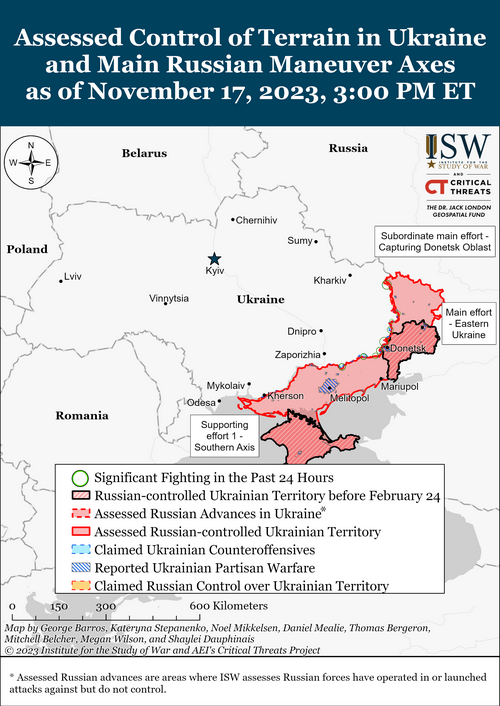
From The Institute For The Study of War:
Russian Offensive Campaign Assessment, November 17, 2023
Riley Bailey, Nicole Wolkov, Christina Harward, Angelica Evans, and Frederick W. Kagan
November 17, 2023, 7:15pm ET
Click here to see ISW’s interactive map of the Russian invasion of Ukraine. This map is updated daily alongside the static maps present in this report.
Click here to see ISW’s 3D control of terrain topographic map of Ukraine. Use of a computer (not a mobile device) is strongly recommended for using this data-heavy tool.
Click here to access ISW’s archive of interactive time-lapse maps of the Russian invasion of Ukraine. These maps complement the static control-of-terrain map that ISW produces daily by showing a dynamic frontline. ISW will update this time-lapse map archive monthly.
Note: The data cut-off for this product was 1:30pm ET on November 17. ISW will cover subsequent reports in the November 18 Russian Offensive Campaign Assessment.
Ukrainian officials stated that Ukrainian forces have established bridgeheads on the east (left) bank of Kherson Oblast and are conducting ground operations aimed at pushing Russian forces out of artillery range of the west (right) bank of the Dnipro River. The Ukrainian Marine Corps Command and the Ukrainian General Staff stated on November 17 that Ukrainian marines have secured several “bridgeheads” on the east bank following successful actions and are conducting actions to expand these positions.[1] US military doctrine defines a bridgehead as “an area on the enemy’s side of the water obstacle that is large enough to accommodate the majority of the crossing force, has adequate terrain to permit defense of the crossing sites, provides security to crossing forces from enemy direct fire, and provides a base for continuing the attack.”[2] The doctrinal definition of a bridgehead does not stipulate a certain size for the crossing force, the extent of the secured positions, or the ability to transfer and operate heavy military equipment from those positions. The necessary size of a bridgehead depends on the operations it is meant to support, and the official Ukrainian acknowledgment of these positions as bridgeheads indicates that the Ukrainian command assesses that these positions are sufficient for continuing ground operations on the east bank.
The Ukrainian General Staff stated that one of the main operational objectives for Ukrainian ground operations on the east bank is to prevent Russian shelling of Ukrainian civilians on the west bank of Kherson Oblast, particularly near Kherson City. The 152mm tube artillery systems that Russian forces widely operate in Ukraine have an approximate range of 25km, although Russian forces are unlikely to deploy these systems to immediate frontline areas due to the threat of Ukrainian counterbattery fire. The Ukrainian General Staff reported that Ukrainian forces on the east bank are conducting diversionary actions, raids, and reconnaissance and are particularly surveilling Russian positions for intelligence on Russian logistics and ammunition concentrations.[3]
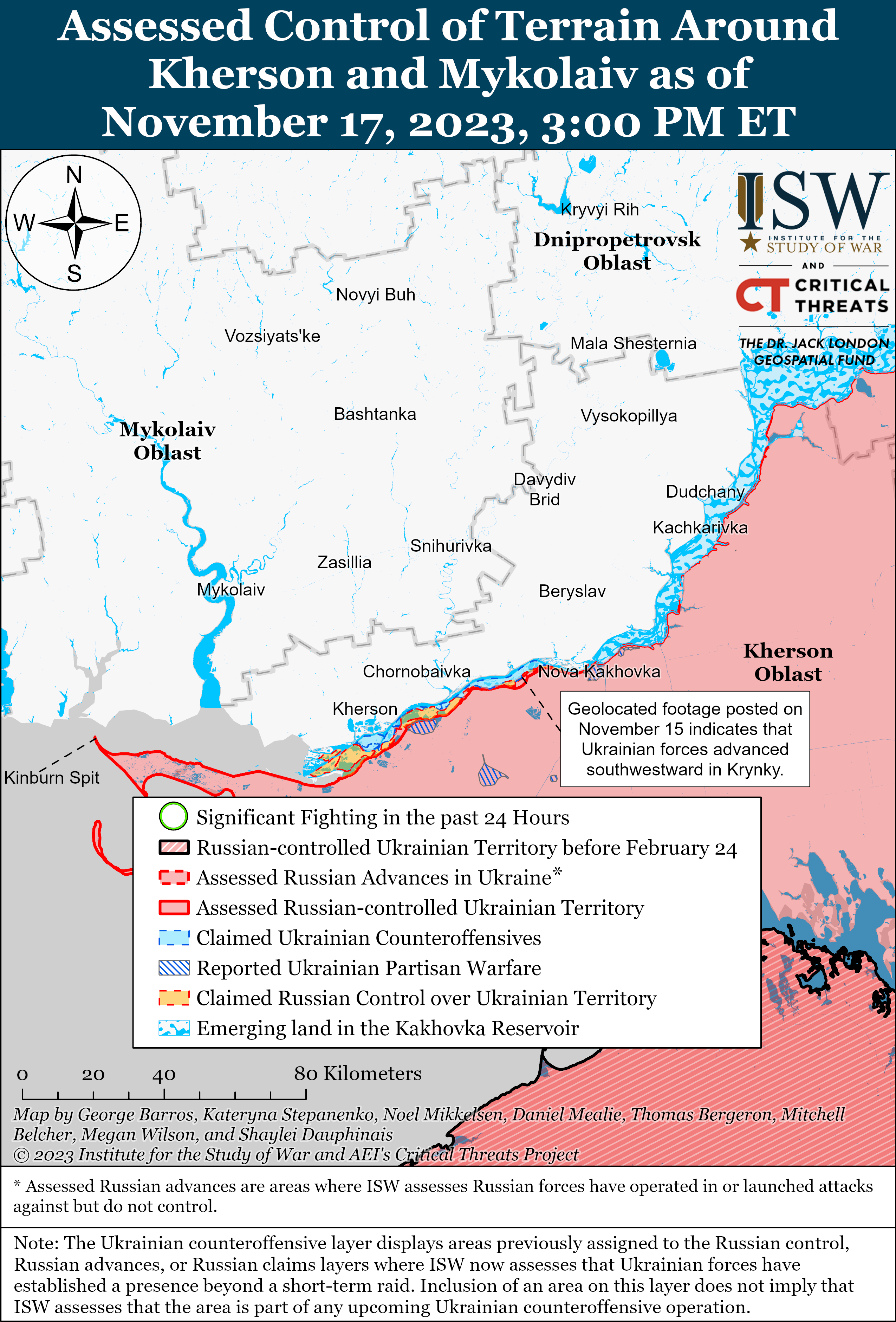
Russian forces appear to be applying lessons learned from attempts to man Russian multilayered defenses in western Zaporizhia Oblast during the Ukrainian counteroffensive to current Russian defensive operations in Kherson Oblast. The Ukrainian General Staff acknowledged that Russian forces have a “fairly serious” line of fortifications in Kherson Oblast.[4] A Ukrainian soldier operating on the left (east) bank of Kherson Oblast characterized Russian defensive positions as “elaborate dugouts that [Russian forces] constructed over months” in an interview with the Wall Street Journal (WSJ) published on November 15.[5] The WSJ also reported that Russian forces heavily mined the area around Krynky (30km northeast of Kherson City and 2km from the Dnipro River), where Ukrainian forces currently maintain positions.[6] Ukrainian military observer Kostyantyn Mashovets noted that Russian forces are not deploying their forces in a “pillar formation” at the immediate frontline on the east bank, likely in an effort to protect concentrations of Russian forces from Ukrainian artillery fire and drone strikes.[7] Mashovets claimed on November 12 that the Russian command in the Kherson direction has refused to commit additional forces of the 70th Motorized Rifle Division (of the newly formed 18th Combined Arms Army) and 7th Air Assault (VDV) Division beyond elements of single regiments and battalions to the frontline, opting instead to maintain the remainder of these formations in near rear areas and secondary echelons of defense.[8]
This tactical deployment of forces in Kherson is reminiscent of changes that Russian forces made to Russian tactical defensive deployments in western Zaporizhia Oblast. ISW observed Russian forces concentrating personnel along the defensive layer closest to Ukrainian offensive operations at the start of the Ukrainian counteroffensive in western Zaporizhia Oblast.[9] ISW observed a shift in Russian defensive operations as Ukrainian forces began penetrating Russian defensive layers in mid-September, wherein Russian forces shifted personnel away from manning immediate frontline defensive positions in order to man defensive layers further from the frontline from which more combat effective forces would counterattack.[10] Russian forces have not constructed extensive visible defensive fortifications similar to those that Russian forces established in western Zaporizhia Oblast prior to the start of the Ukrainian counteroffensive and appear to have opted for more discrete fortifications set further from the frontline. The discrete fortifications located away from the frontline in Kherson Oblast will likely only be fully effective if they remain concealed, however. Fall and winter weather conditions may reveal some concealed positions as foliage and natural ground cover die.
Ukrainian officials reported that Russian forces have suffered roughly a brigade’s worth of casualties since Ukrainian forces started ground operations on the east bank of Kherson Oblast on October 17, reportedly forcing Russian forces to transfer combat power from elsewhere in Ukraine to Kherson Oblast. The Ukrainian General Staff reported that Ukrainian forces have killed 1,216 Russian personnel and wounded 2,217 since starting “measures” on the east bank.[11] These manpower losses are roughly equivalent to a brigade’s worth of personnel, although these losses are likely spread out across the Russian formations and units operating in the Kherson direction. The Ukrainian General Staff also reported that Ukrainian forces have destroyed 24 Russian tanks, 48 armored combat vehicles, 89 artillery systems, 29 ammunition warehouses, and 14 aircraft since starting “measures” on the east bank.[12] The Ukrainian General Staff reported that Russian forces have transferred unspecified units from other unspecified sectors of the front to Kherson Oblast due to these losses.[13] ISW previously assessed that the Russian military command will likely struggle to redeploy combat-effective reinforcements at scale to respond to ongoing Ukrainian operations in Kherson Oblast while conducting defensive operations in western Zaporizhia Oblast and sustaining other offensive efforts in eastern Ukraine.[14] The scale of Russian reinforcements required, however, depends heavily on how much effort Ukrainian forces put into the Kherson direction and how much progress they make.
Russian forces conducted a series of drone and missile strikes against Ukraine on the night of November 16 to 17. Ukrainian military sources reported on November 17 that Russian forces launched 10 Shahed-131/136 drones primarily targeting Khmelnytskyi Oblast and several S-300 missiles in the Donetsk direction.[15] Ukrainian military sources reported that Ukrainian air defenses downed nine Shahed drones over Mykolaiv, Odesa, Zhytomyr, and Khmelnytskyi oblasts.[16] Russian milbloggers claimed that Russian forces struck targets in Khmelnytskyi, Dnipropetrovsk, Odesa, and Kharkiv oblasts.[17]
Ukrainian President Volodymyr Zelensky stated that the Israel-Hamas war has negatively affected Ukraine’s shell supplies. Zelensky stated during an interview with Bloomberg on November 16 that Israel has sought large quantities of the global supply of 155mm artillery shells and that this has slowed deliveries of artillery shells to Ukraine at a critical moment.[18]
Russian President Vladimir Putin and Kremlin Spokesperson Dmitri Peskov attempted to dismiss criticisms of the Russian government and the war in Ukraine as inevitable yet unfounded and urged Russian citizens to self-censor. Putin stated at the International Cultural Forum in St. Petersburg on November 17 that people who are critical of the war have the right to their own point of view.[19] Putin added that “the head is not only a tool for speaking but is also for thinking before you say something.”[20] Putin commented that many educated, knowledgeable, and talented adults do not follow or understand what is happening, presumably in Ukraine, but acknowledged that “the mood in society and the opinion of a country’s people…is an objective factor that no one can escape.”[21] Peskov similarly stated in a video interview published on November 17 that there should be a level of censorship during wartime that would be unacceptable during peacetime.[22] Peskov stated that the line between criticizing the Russian military and discrediting the Russian forces is very thin and advised those who want to “indiscriminately” speculate about and criticize the Russian military to “think ten times” before doing so.[23]
Peskov also stated that he believes Putin will announce his presidential campaign and that he “does not doubt” that Putin will win the 2024 presidential elections.[24] Peskov also responded to a question about Russian leadership after Putin and the characteristics that Putin’s eventual successor should have, stating that Putin’s successor should be someone exactly like Putin.[25]
Russian authorities detained several Federal Security Service (FSB) employees on November 16 for accepting a five-billion-ruble ($55.6 million) bribe in connection with the dismissal of a corruption case. Russian outlet RBC reported that the FSB employees were involved in the dismissed investigation into the Merlion Group of Companies, a Russian IT company and technology distributor that the FSB previously investigated for corruption.[26] Russian authorities also arrested former head of the Russian Investigative Committee for the North-Western District of Moscow Sergei Romodanovsky, current head of the Russian Investigative Committee’s Khoroshevsky Investigative Department Rustam Yusupov, and former investigator Andrei Zhiryutin in connection to the case’s dismissal on November 10.[27] RBC reported that Russian authorities suspect that additional FSB employees, Romodanovsky, Yusupov, and Zhiryutin accepted a five-billion-ruble bribe to dismiss the case against the Merlion Group. A Russian insider source claimed on November 17 that Russian authorities are also investigating former Director of Russia’s Federal Migration Service Konstantin Romodanovsky (father of Sergei Romodanovsky), who has connections to Russian President Vladimir Putin, and suggested that Russian authorities may intend to blame Konstantin Romodanovsky for Russia’s migration issues to appease Putin’s ultranationalist base.[28]
Key Takeaways:
- Ukrainian officials stated that Ukrainian forces have established bridgeheads on the east (left) bank of Kherson Oblast and are conducting ground operations aimed at pushing Russian forces out of artillery range of the west (right) bank of the Dnipro River.
- Russian forces appear to be applying lessons learned from attempts to man Russian multilayered defenses in western Zaporizhia Oblast during the Ukrainian counteroffensive to current Russian defensive operations in Kherson Oblast.
- Ukrainian officials reported that Russian forces have suffered roughly a brigade’s worth of casualties since Ukrainian forces started ground operations on the east bank of Kherson Oblast on October 17, reportedly forcing Russian forces to transfer combat power from elsewhere in Ukraine to Kherson Oblast.
- Russian forces conducted a series of drone and missile strikes against Ukraine on the night of November 16 to 17.
- Ukrainian President Volodymyr Zelensky stated that the Israel-Hamas war has negatively affected Ukraine’s shell supplies.
- Russian President Vladimir Putin and Kremlin Spokesperson Dmitri Peskov attempted to dismiss criticisms of the Russian government and the war in Ukraine as inevitable yet unfounded and urged Russian citizens to self-censor.
- Russian authorities detained several Federal Security Service (FSB) employees on November 16 for accepting a five-billion-ruble ($55.6 million) bribe in connection with the dismissal of a corruption case.
- Russian forces continued offensive operations along the Kupyansk-Svatove-Kreminna line, near Bakhmut, near Avdiivka, west and southwest of Donetsk City, in the Donetsk-Zaporizhia Oblast border area, and in western Zaporizhia Oblast and advanced in several sectors of the front.
- The United Kingdom Ministry of Defense (UK MoD) reported on November 17 that the Russian military is likely using updated surveillance aircraft due to concerns over Ukraine deploying Western-provided combat aircraft.
- Yale School of Public Health’s Humanitarian Research Lab (Yale HRL) reported on November 16 that Russian and Belarusian authorities have forcibly deported at least 2,442 Ukrainian children between the ages of six and 17 to Belarus via Russia since February 24, 2022.
Go here to read the rest. The Ukrainians seem to be focusing their efforts east of the Dnieper. Thus far the Russians seem to be having difficulty massing forces to oppose them.

