
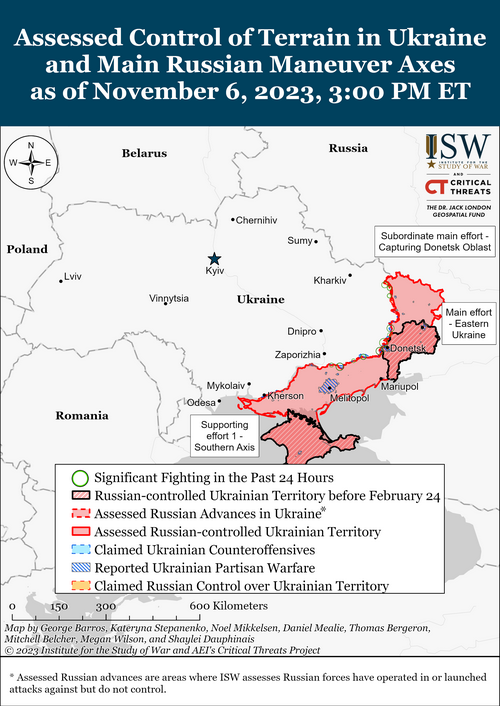
From The Institute For The Study of War:
Russian Offensive Campaign Assessment, November 6, 2023
Kateryna Stepanenko, Karolina Hird, Riley Bailey, Christina Harward, and Frederick W. Kagan
November 6, 2023, 6:50pm ET
Click here to see ISW’s interactive map of the Russian invasion of Ukraine. This map is updated daily alongside the static maps present in this report.
Click here to see ISW’s 3D control of terrain topographic map of Ukraine. Use of a computer (not a mobile device) is strongly recommended for using this data-heavy tool.
Click here to access ISW’s archive of interactive time-lapse maps of the Russian invasion of Ukraine. These maps complement the static control-of-terrain map that ISW produces daily by showing a dynamic frontline. ISW will update this time-lapse map archive monthly.
Note: The data cut-off for this product was 1:00pm ET on November 6. ISW will cover subsequent reports in the November 7 Russian Offensive Campaign Assessment.
Imprisoned ardent nationalist and former Russian officer Igor Girkin argued that Russian forces will be “even less capable of offensive operations than they are now” by spring 2024 given the current nature of Russian offensive operations along the frontline.[1] Girkin’s wife, Miroslava Reginskaya, published a hand-written letter from Girkin dated October 26, in which he summarized the frontline situation in Ukraine for the month of October. Girkin claimed that the situation for Russian forces is “gradually deteriorating” and that Russian forces are showcasing “growing weakness (compared to [Ukraine’s] capabilities,” despite Russia’s “generally successful repulsion” of the Ukrainian offensive over the summer and fall of 2023. Girkin argued that Russian forces were not only unable to start broad offensive operations at the beginning of the fall season but were also unable to complete even limited offensive operations to achieve operationally significant goals – namely around Kupyansk, Lyman, and Avdiivka. Girkin claimed that Russian forces failed to advance in the Kupyansk direction and are now impaled in battles on “the distant approaches to the city,” while also failing to change the situation in the Lyman direction. Girkin added that tactical advances around Avdiivka led to significant losses in Russian manpower and equipment and did not lead to the further development of the Russian offensive. Girkin observed that the Avdiivka offensive demonstrated Russian forces’ inability “to achieve superiority on a very narrow sector of the front” despite Russia’s careful preparations, good coordination of strike forces and means for the initial stage of the offensive, and the abundance of ammunition “unheard of since the assault on Bakhmut.”
Girkin suggested that Russian efforts to repel Ukrainian localized attacks across the frontline and simultaneous fall-winter offensive operations will likely degrade Russian offensive and defensive potential by spring 2024. Girkin noted that Russian forces would need to spend the rest of the fall-winter campaign on the defensive to try to eliminate emerging operational crises – such as the Ukrainian presence in the east (left) bank of Kherson Oblast. Girkin argued that Russian forces will continue to be “incapable of any broad offensive actions” even if Ukrainian forces are unable to “knock out” Russian frontline units, fail to achieve a breakthrough over the fall-winter season, and are exhausted. Girkin, however, added that such a “positional scenario” is not guaranteed and that he fears that Ukrainian forces may be successful in breaking Russian forces that have already been exhausted by months of combat. Girkin’s suggestion that ongoing Russian offensive operations are harming the prospects for future Russian operations is notable because Russian forces still must repel Ukrainian offensive operations while attempting to initiate their own offensives. The timing of current Russian offensives around Avdiivka was also somewhat odd and suboptimal because the rainy and muddy weather has predictably hindered Russian operations.[2] ISW continues to assess that fall and winter weather conditions are unlikely to preclude Russian or Ukrainian offensives.[3]
Girkin implied that additional Western military aid to Ukraine and the lack of mobilization in Russia could allow Ukraine to end positional warfare and conduct successful offensive operations in 2024. Girkin stated that Ukrainian forces are continuing to use Western-provided materiel to target the Russian rear and even destroy the Berdyansk airfield in occupied Zaporizhia Oblast against the backdrop of Russian offensives in Avdiivka. Girkin implied that Ukrainian forces would continue to devastate the Russian rear over the winter as Russian forces continued to push for limited offensive operations. Girkin stated that once Ukraine receives Western-provided F-16 fighter jets, Ukrainian forces could have localized advantages for a short period of time on any section of the frontline. Girkin added that Ukraine could be “seriously strengthened in military-technical terms” with Western military equipment. Girkin also claimed that Ukraine currently has superiority in manpower over Russian forces due to a lack of mobilization in Russia and that the Kremlin is unlikely to call up mobilization before spring 2024 due to upcoming presidential elections. Girkin noted that the Russian Ministry of Defense (MoD) is unlikely to recruit “hundreds of thousands” of new contract servicemen because Russia has exhausted the recruitment potential for new contract servicemen and volunteers. Ukrainian Commander-in-Chief General Valerii Zaluzhnyi’s long essay, “Modern Positional Warfare and How to Win It,” similarly argues that Western-provided military equipment and air superiority among other things will allow Ukraine to overcome positional warfare.[4]
Russian milbloggers appear to be grappling with how Russian forces can overcome wider operational challenges in Ukraine, likely in response to Ukrainian Commander-in-Chief General Valerii Zaluzhnyi’s recent essay on the subject of “positional warfare.” Select milbloggers argued that specific changes in battlefield tactics will allow Russian forces to achieve their desired operational objectives in the current difficult operational environment.[5] Another milblogger argued that Russia should not celebrate Zaluzhnyi’s discussion of Ukrainian difficulties with positional warfare and that Russian forces need to prepare for a long, challenging war.[6] The milblogger argued that Russia is currently no closer to victory in Ukraine and expressed concerns that Russian forces will likely face a renewed Ukrainian counteroffensive in the winter.[7] The milblogger’s discussion of a large Ukrainian counteroffensive effort in the winter suggests that he expects that Russian forces will not completely seize the initiative in the coming months and therefore will not be able to launch a larger offensive effort that would preclude Ukrainian forces from committing resources to counteroffensive operations. The wider Russian information space has offered a relatively muted response to Zaluzhnyi’s essay, and Russian ultranationalists appear to be applying Zaluzhnyi’s discussions about the challenges of the operational environment in Ukraine to Russia’s offensive campaign and not coming to very optimistic conclusions.[8]
Select Russian milbloggers specifically argued that the use of small infantry assault groups will allow both Russian and Ukrainian forces to better achieve operational objectives along the front. Russian milbloggers argued on November 3 and 6 that concentrated attacks with large forces attempting to break through a stable defense to full depth is increasingly ineffective and suggested that small infantry groups with comprehensive support may be more effective at achieving significant operational effects in the current operational environment.[9] One of the milbloggers argued that the initial phases of the ongoing Ukrainian counteroffensive and the ongoing Russian offensive effort near Avdiivka are similar in that both operations made some initial advances at the cost of irretrievable manpower and equipment losses.[10] The milblogger argued that throughout the war in Ukraine, heavy losses during such large, mechanized assaults have prompted Russian and Ukrainian forces to increasingly rely on smaller ad-hoc infantry groups in subsequent operations.[11] The Ukrainian command changed tactics to rely more on infantry assaults following early setbacks in the counteroffensive in June 2023, and Ukrainian forces proceeded to make significant advances in the following months.[12] It remains to be seen if Russian forces will show the same adaptability near Avdiivka, especially since repeated offensive failures suggest that the Russian General Staff has failed to internalize and disseminate lessons learned from previous costly large, mechanized assaults.[13] The milblogger argued that it would be more advantageous to prepare specialized small infantry assault groups with sufficient technological capabilities, specifically in reconnaissance and communication, ahead of offensive operations instead of switching to small infantry assault tactics only after larger, mechanized assaults prove too costly to continue.[14]
Russian sources suggested that some Ukrainian forces may already be fielding the small infantry assault groups that these sources are advocating for. A Russian milblogger noted that Ukrainian forces already appear to be employing this adaptation in ongoing ground operations on the east (left) bank of Kherson Oblast, where the milblogger claimed that small Ukrainian assault groups operating at the operational-tactical level have been able to divert considerable Russian combat resources and attention from elsewhere along the front.[15] The milblogger argued that lower-level Russian commanders have previously made some progress in preparing such small infantry groups south of Bakhmut but that the Russian command’s insistence on manpower-intensive frontal assaults quickly rendered these groups combat ineffective.[16] The milblogger’s observations suggest that Ukrainian forces may be once again successfully adapting to aspects of the battlefield in Ukraine while Russian forces struggle to do so. Select elements of the Russian military have shown the propensity for successful adaptation, particularly in defensive operations during the Ukrainian counteroffensive in western Zaporizhia Oblast, but the Russian command will likely continue to struggle with instituting any successful change in tactics and capabilities writ-large throughout the theater.[17]
The war in Ukraine is likely exacerbating an emerging identity crisis within Russian society resulting from tensions between Russian identity and Russian nationalism. Russian “Vostok” Battalion Commander and Russian Orthodox ideologue Alexander Khodakovsky wrote two long Telegram posts on November 6 about what it means to be “Russian,” acknowledging a schism in Russian national identity that has largely resulted from the ideological arguments advanced to justify and mobilize support for Russia’s war in Ukraine.[18] Khodakovsky shared an anecdote of an unidentified Chechen general who, he claimed, conducted a “genetic study” to identify “the ethnic composition ” of his Russian friends and found out that “Russian genes” were not dominant.[19] Khodakovsky used this anecdote to offer commentary on what it means to be “Russian,” and concluded that it is not “ethnogenetic,” but rather a matter of morals and ideologies, observing that Russian nationalism is “hysteria” resulting from a lack of consolidated Russian identity.[20] Khodakovsky thereby appears to offer the suggestion that when one fixates on a genetic definition of what it means to be Russian, the destructive and toxic ideologies of nationalism appear and erase broader and more socio-cultural and linguistic definitions of identity. Khodakovsky warned that a population that lacks a coherent identity can easily destroy itself from within.[21]
Khodakovsky’s musings offer insight into some socio-cultural implications of Russia’s pursuit of ideological goals in its war in Ukraine. In several ways, the war has narrowed the conception of what it means to be Russian among Russian ideologues, particularly as concepts of identity are increasingly defined by hyper-nationalist and pro-war information space voices who amplify the Kremin’s ideological line on the war and redirect it at domestic audiences.[22] Whereas Russian identity was largely defined before the war linguistically and culturally as enshrined in the Russian concepts of “compatriots abroad” and “Russkyi Mir,” the war has focused Russian identity more narrowly on Russian ethnonationalism that echoes the Kremlin’s ideological justifications for the war.[23] Russia’s deliberate campaign to “Russify” Ukraine through the invasion has generated clear social impacts within Russia itself, particularly aimed at ethnic minority and migrant communities, which have paradoxically been forced by the Russian government to bear the brunt of force generation efforts for the war.[24] Russian nationalist commentators have increasingly fixated on demographic transitions facing Russia particularly relating to the balance between “Russians” and “minorities” within the Russian population, further reinforcing concepts of what it means for Russia to be a fundamentally “Russian” state.[25] Khodakovsky responded to this apparent schism in Russian society by underlining some of the inherent dangers of defining what it means to be Russian as a matter of genetics and notably drew criticism from some more virulently nationalist commentators for being “Russophobic” in his conclusions.[26] Both Khodakovsky’s observations and the immediate response to his conclusions underline a fundamental dilemma facing Russia as it continues its war in Ukraine—the dilemma of how to reconcile the hyper-nationalist ideologies on which the Kremlin increasingly relies to justify the war and demand greater sacrifices from its people with Moscow’s desire to continue to increase the burden of mobilization on disenfranchised minority communities, while also maintaining a sense of Russian identity that society can coalesce behind as the war continues.
Russian forces conducted missile and drone strikes against rear areas in southern Ukraine on the evening of November 5 and on the night of November 5 to 6 as well as the largest series of glide bomb strikes to date against targets in Kherson Oblast on November 5. Ukraine’s Southern Operational Command reported that Russian forces launched a Kh-59 cruise missile at Dnipro City and a Kh-31P anti-radar missile at Odesa City on November 5.[27] Ukraine’s Southern Operational Command stated that Ukrainian air defenses shot down the Kh-59 missile and that the Kh-31P missile struck an infrastructure facility in Odesa City.[28] The Ukrainian Air Force reported that Russian forces also conducted missile and drone strikes on the night of November 5 to 6 with a Kh-31 anti-radar missile and a Kh-59 cruise missile launched from occupied Kherson Oblast, a P-800 Onyx anti-ship missile and an Iskander-M ballistic missile launched from occupied Crimea, and 22 Shahed-131/136 drones launched from Cape Chauda, occupied Crimea.[29] The Ukrainian Air Force reported that Ukrainian forces destroyed the Kh-59 missile and 15 drones.[30] The Ukrainian General Staff reported that the Russian strikes targeted port infrastructure in Odesa Oblast and civilian infrastructure in Kherson City and damaged residential buildings, port infrastructure, transportation infrastructure, and other civil infrastructure.[31] Ukrainian Odesa Oblast Military Administration Head Oleh Kiper reported that a Russian strike partially damaged the Odesa National Art Museum.[32] Ukrainian Minister of Internal Affairs Ihor Klymenko stated that Russian forces launched 87 glide bombs on populated areas in Kherson Oblast on November 5 – the largest number of glide bombs that Russian forces have launched to date since Russia’s full-scale invasion of Ukraine.[33]
The Russian military appears to have increased its stock of high-precision missiles due to reported increases in Russian missile production more rapidly than previous forecasts had suggested. Ukrainian Main Military Intelligence Directorate (GUR) Spokesperson Vadym Skibitskyi stated on November 6 that Russian forces have a total of 870 high-precision operational-strategic and strategic missiles in reserve. Skibitskyi previously stated on August 28 that Russian forces had a total of 585 long-range missiles in reserve, indicating that Russian forces have increased their missile reserves by 285 missiles since August.[34] Skibitskyi added on November 6 that Russian forces produced a total of 115 long-range high-precision missiles in October: 30 Iskander-M cruise missiles, 12 Iskander-K cruise missiles, 20 Kalibr cruise missiles, 40 Kh-101 cruise missiles, 9 Kh-32 cruise missiles, and 4 Kinzhal ballistic missiles.[35] Skibitiskyi stated on August 28 that Russian defense enterprises were struggling to produce several dozens of specific types of missiles a month due to foreign component shortages, and the increase of 285 missiles in Russian reserves since late August — with 115 of that total being produced in October alone — indicates that Russia has increased its domestic production of missiles faster than had been forecasted.[36]
Skibitskyi also commented on Russian domestic drone production on November 6, stating that the GUR has not observed the movement of Shahed drones from Iran to Russia as Iran has fulfilled its first Shahed supply contracts with Russia.[37] Skibitskyi stated that Iran may still send small batches of Shaheds to Russia, however.[38] Skibitskyi also stated that Russia has begun to increase the domestic assembly of Shahed drones with components from Iran including at the factory in Alabuga, Tatarstan Republic.[39] Skibitskyi added that predicted Russian missile and drone strikes against Ukrainian energy infrastructure in the upcoming winter will likely not be as “primitive” as the strike series during the winter of 2022-2023.[40] Ukrainian President Volodymyr Zelensky has recently commented on Ukraine’s urgent need for air defense systems.[41]
Ukrainian forces conducted counteroffensive operations near Bakhmut and in western Zaporizhia Oblast. The Ukrainian General Staff reported that Ukrainian forces continued offensive operations in the Bakhmut and Melitopol (western Zaporizhia Oblast) directions.[42] A prominent Russian milblogger claimed that Ukrainian forces counterattacked near Krasnohorivka (6km northwest of Avdiivka) between November 3 and November 5, thereby forcing Russian troops to withdraw from part of the railway track in the area.[43] The Russian “Russkiy Legion” (BARS-13) irregular armed formation claimed that Ukrainian forces were successfully pressuring Russian forces near Stepove and the “Tsarska Okhota” restaurant south of Avdiivka.[44]
Key Takeaways:
- Imprisoned ardent nationalist and former Russian officer Igor Girkin argued that Russian forces will be “even less capable of offensive operations than they are now” by spring 2024 given the current nature of Russian offensive operations along the frontline.
- Russian milbloggers appear to be grappling with how Russian forces can overcome wider operational challenges in Ukraine, likely in response to Ukrainian Commander-in-Chief General Valerii Zaluzhnyi’s recent essay on the subject of “positional warfare,” and not coming to optimistic conclusions.
- Select Russian milbloggers specifically argued that the use of small infantry assaults groups will allow both Russian and Ukrainian forces to better achieve operational objectives along the front. Russian sources suggested that some Ukrainian forces may already be fielding the small infantry assault groups that these sources are advocating for.
- The war in Ukraine is likely exacerbating an emerging identity crisis within Russian society resulting from tensions between Russian identity and Russian nationalism.
- Russian forces conducted missile and drones strikes against rear areas in southern Ukraine on the evening of November 5 and on the night of November 5 to 6 as well as the largest series of glide bomb strikes to date against targets in Kherson Oblast on November 5.
- The Russian military appears to have increased its stock of high-precision missiles due to reported increases in Russian missile production more rapidly than previous forecasts had suggested.
- Ukrainian forces conducted counteroffensive operations near Bakhmut and in western Zaporizhia Oblast.
- Russian forces conducted offensive operations along the Kupyansk-Svatove-Kreminna line, near Bakhmut, near Avdiivka, west and southwest of Donetsk City, in the Donetsk-Zaporizhia Oblast border area, in eastern Zaporizhia Oblast, and in western Zaporizhia Oblast and advanced in some areas on November 6.
- Russian occupation officials are expanding military recruitment and registration offices in occupied territories, likely in support of coercive mobilization efforts.
- Russian officials continue to weaponize youth engagement programs to consolidate social control of occupied areas of Ukraine.
Go here to read the rest. Small assault groups hearken back to the StormTroop tactics of the Germans in the latter half of World War I to break the trench stalemate. Avoid enemy strongpoints and penetrate through lines not held in force by the enemy. Highly effective initially, the tactic grew less successful as the well trained StormTrooper units took casualties, and the Allies learned how to use similar tactics. I doubt if almost all Ukrainian and Russian units have sufficient training to effectively use such tactics. Additionally with satellites and drones it is much easier to call down artillery on such forces attempting to maneuver their way through fortified areas. Learning from the past is one thing; slavish imitation in very different times is an invitation to defeat.

