
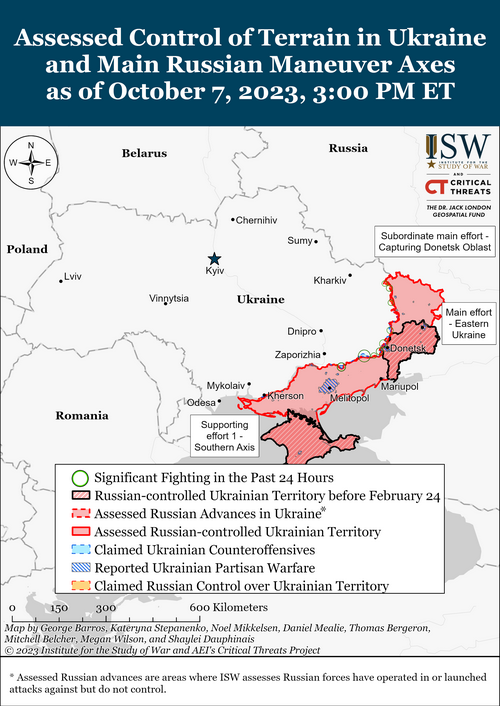
From The Institute For The Study of War:
Russian Offensive Campaign Assessment, October 7, 2023
Kateryna Stepanenko, Karolina Hird, Angelica Evans, Christina Harward, and Mason Clark
October 7, 2023, 5:30pm ET
Click here to see ISW’s interactive map of the Russian invasion of Ukraine. This map is updated daily alongside the static maps present in this report.
Click here to access ISW’s archive of interactive time-lapse maps of the Russian invasion of Ukraine. These maps complement the static control-of-terrain map that ISW produces daily by showing a dynamic frontline. ISW will update this time-lapse map archive monthly.
Note: The data cut-off for this product was 2pm ET on October 7. ISW will cover subsequent reports in the October 8 Russian Offensive Campaign Assessment.
The Kremlin is already and will likely continue to exploit the Hamas attacks in Israel to advance several information operations intended to reduce US and Western support and attention to Ukraine. The Kremlin amplified several information operations following Hamas attacks in Israel on October 7, primarily blaming the West for neglecting conflicts in the Middle East in favor of supporting Ukraine and claiming the international community will cease to pay attention to Ukraine by portraying attention to the Middle East or alternatively Ukraine as a zero-sum comparison. Deputy Chairman of the Russian Security Council Dmitry Medvedev claimed the United States and its allies should have been “busy with” working on “Palestinian-Israeli settlement” rather than “interfering” with Russia and providing Ukraine with military aid.[1] The Russian Ministry of Foreign Affairs (MFA) accused the West of blocking efforts by a necessary “quartet” of Russia, the US, the European Union, and the United Nations, leading to an escalation in violence, implicitly blaming the West for the current fighting.[2] Prominent Russian propagandist Sergei Mardan directly stated that Russia will benefit from the escalation as the world “will take its mind off Ukraine for a while and get busy once again putting out the eternal fire in the Middle East.”[3] These Kremlin narratives target Western audiences to drive a wedge in military support for Ukraine, seek to demoralize Ukrainian society by claiming Ukraine will lose international support, and intend to reassure Russian domestic audiences that the international society will ignore Ukraine’s war effort.
Several key sources within the Russian information space shifted the focus of their daily coverage to the situation in Israel on October 7, which may impact the information environment around the war in Ukraine in the coming days or weeks. Many Russian milbloggers focused largely on the Hamas attacks in Israel on October 7, and some promoted Kremlin information operations by claiming that the West’s attention has shifted away from Ukraine and towards Israel.[4] This focus on Israel even prompted one Russian milblogger to urge others to not “forget” about the war in Ukraine.[5] ISW cannot forecast at this time how the source environment will change as the Hamas attacks in Israel unfold but will provide clear updates on any impact on ISW’s ability to collect from Russian milbloggers and geolocation sources, and subsequent effects on the detail available ISW can provide in these daily assessments.
Ukrainian forces continued offensive operations near Bakhmut and in western Zaporizhia Oblast on October 7 and reportedly advanced in both directions. The Ukrainian General Staff reported that Ukrainian forces were partially successful east of Andriivka (8km southwest of Bakhmut).[6] Ukrainian Eastern Group of Forces Spokesperson Captain Ilya Yevlash noted that Ukrainian forces have advanced from 100 to 300 meters in different directions near Bakhmut over the past day.[7] Ukrainian military sources additionally stated that Ukrainian forces advanced in western Zaporizhia Oblast in the areas north of Kopani (5km northwest of Robotyne) and north of Novoprokopivka (2km south of Robotyne).[8]
Russian forces conducted a series of missile strikes targeting Ukrainian rear areas and port infrastructure on the night of October 6-7. Ukrainian sources, including the Ukrainian Southern Operational Command, reported that Russian forces launched Onyx cruise missiles from occupied Crimea at Chernomorsk, Odesa Oblast; and Poltava Oblast Head Dmytro Lunin stated that Russian forces conducted a missile strike on Myrhorod, Poltava Oblast.[9] The Ukrainian General Staff reported that the Russian strikes damaged a granary, residential buildings, educational buildings, and other civil infrastructure.[10]
The Russian government approved legislation temporarily restricting the border checkpoints that Ukrainian citizens can use to enter Russia from third countries, likely focused on Belarus and the Baltic States, likely in response to continued concern over the security of Russian border regions and possible Ukrainian infiltration efforts. Russian media reported on October 6 that the legislation states that Ukrainian citizens 14 years old and above can only enter Russia from third countries through the Ludonka automotive checkpoint in Pskov Oblast (bordering Latvia) and Sheremetyevo airport in Moscow Oblast beginning on October 16.[11] The legislation does not apply to Ukrainian citizens traveling from occupied Donetsk, Luhansk, Zaporizhia, and Kherson oblasts or Ukrainian citizens under the age of 14 traveling without a legal guardian. This decision is reportedly aimed at “ensuring the safety” of Russian citizens.
Belarusian officials are leveraging international partnerships in an attempt to legitimize Belarus’ role in the illegal deportation of Ukrainian children. Russian and Belarusian media reported on October 4 that a number of diplomats who are accredited in Belarus visited a group of 44 children from Lysychansk and Severodonetsk at an accommodation point in Novopolotsk, Belarus.[12] The group of diplomats included representatives from Zimbabwe, India, Qatar, China, Cuba, Mongolia, the United Arab Emirates, Palestine, Russia, Syria, and the Commonwealth of Independent States (CIS).[13] Russian and Belarusian media reported that Belarusian officials showed the diplomats the dormitory where the children are located and talked about the educational and medical services provided to the children. ISW has previously reported that Belarus has been closely involved in Russia’s efforts to forcibly deport Ukrainian children from their homes, and the European Parliament adopted a resolution reflective of this fact on September 13 that recognizes Belarusian dictator Alexander Lukashenko as complicit in crimes involving the deportation of Ukrainian children to Belarus and the Russian Federation.[14] Belarusian authorities likely hosted the delegation in an effort to portray its actions vis a vis Ukrainian children as somehow legitimate and legal, as many of the diplomats made positive statements about the accommodations and experiences of the children in Belarus.
Russian “Vostok” Battalion Commander Alexander Khodakovsky stated that Russian “patriotic” communities remain vulnerable to division due to Russian officials’ failure to consolidate society, particularly after Wagner Group financier Yevgeny Prigozhin’s June 24 rebellion.[15] Khodakovsky argued that Russia must consolidate its society to achieve a common goal for the war – a goal that he claimed that Russian society does not have a good understanding of. Khodakovsky argued that the fact that Prigozhin remains in people’s heads despite his disappearance from the public eye after his rebellion demonstrates that Russian elites do not care much about the need to consolidate society. Khodakovsky concluded that there are and will be “provocative injections” into the Russian ultranationalist space that aim to break the patriotic environment by stirring up contradictions to slow and complicate the war effort. Khodakovsky added that these provocations also aim to make post-war Russian society unstable. Khodakovsky was likely reacting to discussions in the Russian information space following Russian President Vladimir Putin’s mention of Prigozhin at the Valdai Discussion Club on October 5, and his response likely indicates that Russian society continues to be influenced by Prigozhin despite his death on August 23.[16]
Chechen Republic Head Ramzan Kadyrov awarded his son, Adam Kadyrov, the title of “Hero of the Chechen Republic” on October 7 despite recent controversy after Ramzan Kadyrov posted footage of Adam beating a detainee.[17] Russian State Duma Deputy Adam Delimkhanov, Adam Kadyrov’s godfather, praised Adam for being a “shining example” of competence and education and a purposeful young man.[18] Ramzan Kadyrov also notably appointed his daughter, Aishat Kadyrova, Chechen Deputy Prime Minister for Social Issues on October 2.[19] Both instances came after prominent members of the Russian Human Rights Council called for an investigation into Adam Kadyrov for the beating.[20]
The Russian Ministry of Defense (MoD) highlighted the production of the Sarmat intercontinental ballistic missile (ICBM) on October 7, supporting Russian President Vladimir Putin’s statements about successful tests of the missile on October 5 as part of a continued nuclear brinkmanship information operation. The Russian MoD published footage of Russian Defense Minister Sergei Shoigu visiting the Krasnoyarsk Machine-Building Plant and inspecting the production process of the Sarmat ICBM.[21] Shoigu claimed that the Russian Strategic Missile Force would be re-equipped with the Sarmat missile system. ISW previously assessed that the Kremlin and Russian MoD use nuclear rhetoric to prompt the United States and its allies to pressure Ukraine to negotiate and that Russian nuclear use in Ukraine remains unlikely.[22]
Key Takeaways:
- The Kremlin is already and will likely continue to exploit the Hamas attacks in Israel to advance several information operations intended to reduce US and Western support and attention to Ukraine.
- Several key sources within the Russian information space shifted the focus of their daily coverage to the situation in Israel on October 7, which may impact the information environment around the war in Ukraine in the coming days or weeks.
- Ukrainian forces continued offensive operations near Bakhmut and in western Zaporizhia Oblast on October 7 and reportedly advanced in both directions.
- Russian forces conducted a series of missile strikes targeting Ukrainian rear areas and port infrastructure on the night of October 6-7.
- The Russian government approved legislation temporarily restricting the border checkpoints that Ukrainian citizens can use to enter Russia from third countries, likely focused on Belarus and the Baltic States, likely in response to continued concern over the security of Russian border regions and possible Ukrainian infiltration efforts.
- Belarusian officials are leveraging international partnerships in an attempt to legitimize Belarus’ role in the illegal deportation of Ukrainian children.
- Russian “Vostok” Battalion Commander Alexander Khodakovsky stated that Russian “patriotic” communities remain vulnerable to division due to Russian officials’ failure to consolidate society, particularly after Wagner Group financier Yevgeny Prigozhin’s June 24 rebellion.
- The Russian MoD highlighted the production of the Sarmat intercontinental ballistic missile (ICBM) on October 7, supporting Russian President Vladimir Putin’s statements about successful tests of the missile on October 5 as part of a continued nuclear brinkmanship information operation.
- Russian forces conducted offensive operations along the Kupyansk-Svatove-Kreminna line, near Bakhmut, along the Avdiivka-Donetsk City line, in western Donetsk Oblast, in the western Donetsk-eastern Zaporizhia Oblast border area, and in western Zaporizhia Oblast and reportedly advanced in some areas on October 7.
- Ukrainian partisan activity reportedly killed a United Russia official in occupied Kherson Oblast.
Go here to read the rest. Did the Russians have their Iranian allies provide the funding for the Hamas attack on Israel in order to divert Western attention from Ukraine. I doubt it, but if solid proof comes out, I could imagine Israeli “volunteers” suddenly flying air missions in Ukraine. A greater possibility is open warfare between Israel and Iran. The world is becoming far more dangerous than it was pre-Covid. The Four Horsemen of the Apocalypse are Pestilence, Plague, War and Famine, and the grouping is no accident. Great plagues have often spawned wars in their wake and wars frequently bring about famine. Far better to read a history of an era like ours than to live through it.

