
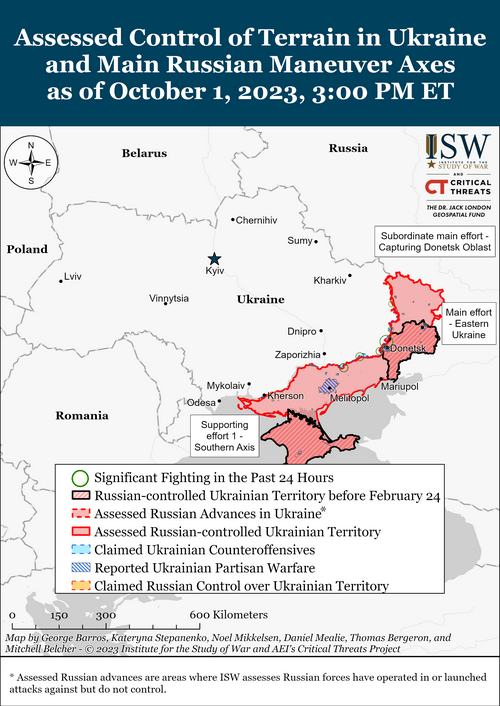
From The Institute For The Study of War:
Russian Offensive Campaign Assessment, October 1, 2023
Angelica Evans, Nicole Wolkov, George Barros, Karolina Hird, and Frederick W. Kagan
October 1, 2023, 5:30pm ET
Click here to see ISW’s interactive map of the Russian invasion of Ukraine. This map is updated daily alongside the static maps present in this report.
Click here to access ISW’s archive of interactive time-lapse maps of the Russian invasion of Ukraine. These maps complement the static control-of-terrain map that ISW produces daily by showing a dynamic frontline. ISW will update this time-lapse map archive monthly.
Note: The data cut-off for this product was 12:15pm ET on September 30. ISW will cover subsequent reports in the October 1 Russian Offensive Campaign Assessment.
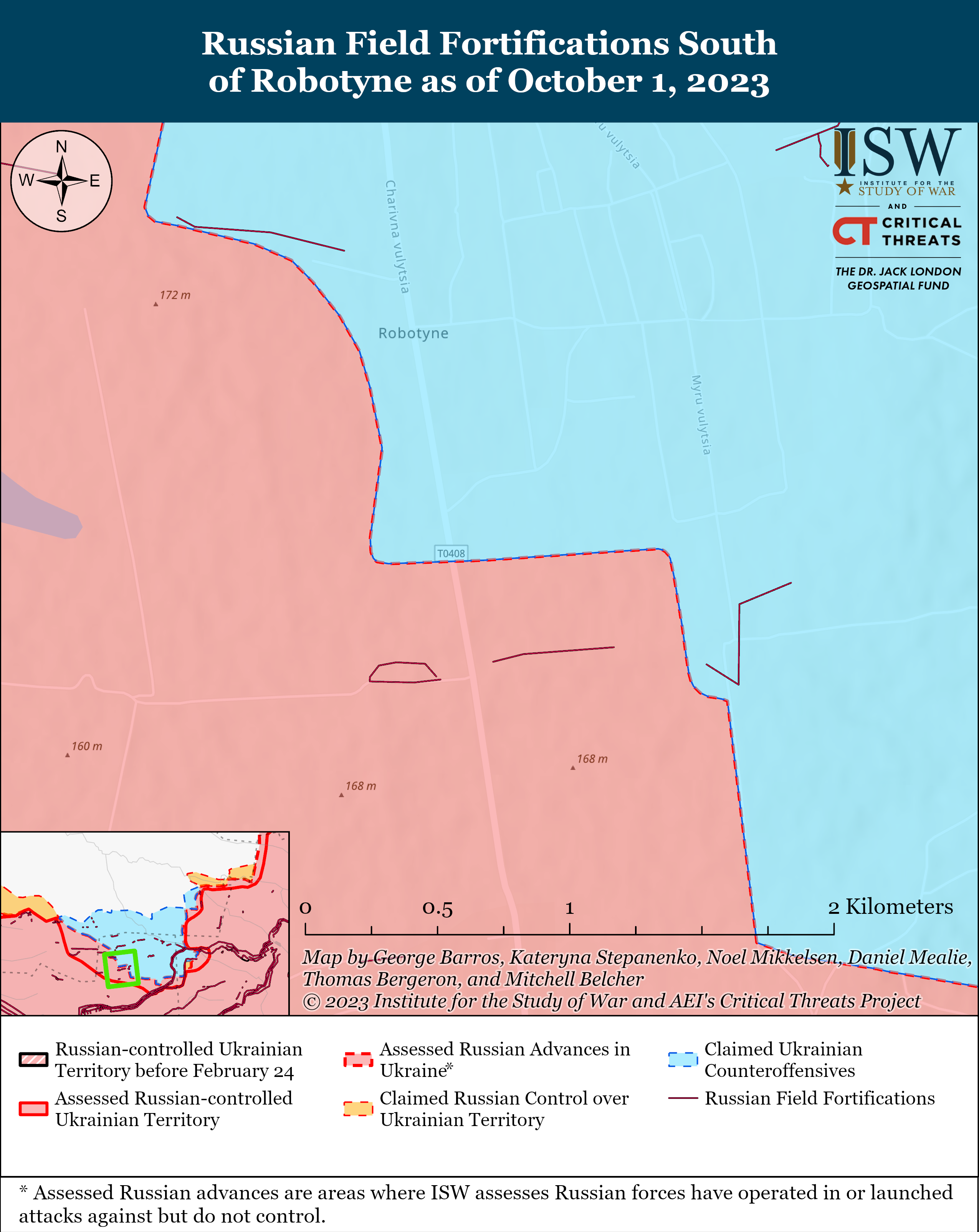
Russian forces are conducting tactical counterattacks in the Robotyne area as part of their elastic defense against ongoing Ukrainian offensive operations in western Zaporizhia Oblast. The situation south of Robotyne is fluid as some tactically significant field fortifications have changed hands several times. Geolocated footage posted on September 30 shows Ukrainian forces striking Russian troops trying to enter a trench system about 1km southwest of Robotyne near the T0408 Robotyne—Tokmak road.[1] Footage posted on September 13 shows that Ukrainian forces had previously occupied segments of this trench and thus appear to have lost it to Russian counterattacks between September 13 and 30.[2] ISW has recoded this area from Ukraine’s counteroffensive to Russian advances.
A Ukrainian soldier analyzed the footage of the area and noted that the aforementioned Russian-controlled trench is a strongpoint in an interconnected system of trenches, firing systems, and dugouts that lie between Robotyne and Novoprokopivka.[3] The Ukrainian soldier noted that the trenches are connected by underground tunnel-like structures and that Russian forces are prioritizing the defense of these positions, which have tactical significance in the area between Robotyne and Novoprokopivka.[4] Geolocated footage posted on October 1 shows Russian forces striking a Ukrainian vehicle just south of the middle of the three trenches and about 1km west of the easternmost trench in the system, suggesting that Ukrainian forces control the easternmost trench and are attempting to push westward to recapture the remaining two trenches and connected dugouts and firing positions.[5] Commercially available satellite imagery indicates that Russian forces destroyed this vehicle between September 25 and 28, indicating that Russian forces repelled a Ukrainian attack and reconsolidated Russian positions near the trench systems in late September. The reported continued presence of Russian forces in the western and central trenches suggests that Russian forces have been conducting successful limited tactical counterattacks south of Robotyne and that the tactical situation in this area is complex and dynamic.
The Russian information space continues to falsely portray Western aid to Ukraine as escalatory in order to discourage continued Western support for Ukraine. Newly appointed United Kingdom Defense Secretary Grant Shapps stated in an interview with the Telegraph published on September 30 that he held talks with unspecified (likely UK) “Army leaders” about moving “more training and production” of military equipment into Ukraine.[6] UK Prime Minister Rishi Sunak walked back Shapps’ statement on October 1 and stated that the UK has no immediate plans to deploy military instructors to Ukraine.[7] Sunak clarified that it may be possible for the UK to conduct some training in the future in Ukraine but stated that the UK would not send British soldiers to fight in the ”current conflict.”[8] Russian Security Council Deputy Chairperson Dmitry Medvedev, a notably nationalistic and extreme voice in the Russian government, called Shapps’ since-clarified statement a “push” toward a ”third world war.”[9] Medvedev regularly voices alarmist rhetoric and continues to portray any Western aid to Ukraine as escalatory in an attempt to undermine Western military aid to Ukraine.[10] His comments are part of a long-running Russian information operation along these lines and do not mark any sort of inflection.
Several Russian milbloggers also expressed baseless paranoia in response to UK officials’ statements by claiming with no evidence at all that the UK intends to help train Ukrainian forces for future operations in Crimea.[11] The milbloggers’ claims are likely also a part of a Russian information operation intended to portray Western military aid and continued support for Ukraine as escalatory. Russian milbloggers have noted broad indicators such as Ukrainian strikes on military targets in Crimea and on Russian Black Sea Fleet (BSF) assets to suggest that western forces are currently aiding Ukrainian forces in preparations to launch military operations in Crimea.[12] Ukrainian strikes against Crimea and BSF assets are more likely part of Ukraine’s interdiction campaign assisting Ukrainian counteroffensive operations in western Zaporizhia Oblast.[13]
The status of the Wagner Group remains unclear amid reported negotiations about the Wagner Group’s future cooperation with the Russian government. The Wagner Group’s main combat elements are split across several countries, including Belarus, the Central African Republic, Libya, and Mali, and there is no clear unified leader for the Wagner Group.[14] Russian President Vladimir Putin publicly embraced former Wagner Group commander and current Ministry of Defense (MoD) employee Andrey Troshev on September 29 and stated that he and Troshev discussed how Troshev would be involved in the formation of new volunteer detachments that perform combat missions primarily in Ukraine.[15] Some Wagner group elements reacted negatively to Putin’s embrace of Troshev and have now put forward an alternative leader. A prominent Wagner-affiliated Telegram channel announced on October 1 that Yevgeny Prigozhin’s 25-year-old son Pavel Prigozhin has taken over “command” of the Wagner Group, and that Pavel Prigozhin is negotiating with Rosgvardia about having the Wagner Group rejoin combat operations in Ukraine.[16] The prominent Wagner-affiliated source reported that Wagner fighters would not have to sign contracts with the Russian MoD and that the Wagner Group would retain its name, symbols, ideology, commanders, management, and existing standard operating principles.[17] A Russian insider source claimed that Pavel Prigozhin is not an independent actor and is under the influence of Wagner Security Service head Mikhail Vatanin, indicating that some Wagner personnel are interested in rallying around a Prigozhin-linked alternative to the Kremlin- and MoD-aligned Troshev, even if that alternative is not an independent entity.[18] A different pro-Wagner source claimed on September 30 that Rosgvardia Head Viktor Zolotov is considering allowing Wagner Group elements to join Rosgvardia as a separate Wagner unit, though the Pavel Prigozhin camp has not commented specifically on how its branch of the Wagner Group may operate with Rosgvardia.[19] It is unclear what the Kremlin thinks the relationship(s) between Wagner elements and the Russian government are. Rosgvardia is directly subordinate to the Russian Presidential Administration, which makes Putin’s public embrace of Troshev and subordinating Wagner elements to the Russian MoD noteworthy. The MoD would have to provide the equipment and supplies for a large, reconstituted force under Rosgvardia in any case, since Rosgvardia does not have the logistical infrastructure to do so on its own.
ISW will revise its assessment about the prospects for the Wagner Group to reemerge an as effective military organization if the Wagner Group successfully reconstitutes as a large, unitary organization under Rosgvardia, the Russian MoD, or a similar organization. ISW previously assessed that disjointed Wagner Group elements were unlikely to pose a serious military threat to Ukraine without bringing the full suite of effectiveness Wagner had as a unitary organization under Yevgeniy Prigozhin’s and Dmitry Utkin’s consolidated leadership. This initial assessment will be invalidated if the Wagner Group reestablishes itself as a coherent and large formation under the Russian government with effective centralized leadership.
Russian forces conducted another series of drone strikes against Ukraine on the night of September 30 to October 1. The Ukrainian General Staff reported on October 1 that Ukrainian air defenses downed 16 of 30 Shahed 131/136 drones that Russian forces launched.[20] Ukrainian Air Force Spokesperson Colonel Yuriy Ihnat stated that Shahed drones have a large power reserve and are highly accurate, which enables them to strike targets far from their launch points.[21] Ihnat stated that unspecified actors, likely Russian authorities and their allies, are working to make Shahed drones and other Russian weapons more resistant to electronic warfare and more difficult to down.[22] A Russian milblogger noted that Ihnat is likely referring to small noise-resistant Comet satellite signal receivers that Russian drone producers have begun installing on domestically produced Shahed drones.[23]
Key Takeaways:
- Russian forces are conducting tactical counterattacks in the Robotyne area as part of their elastic defense against ongoing Ukrainian offensive operations in western Zaporizhia Oblast. The situation south of Robotyne is fluid as some tactically significant field fortifications have changed hands several times.
- The Russian information space continues to falsely portray Western aid to Ukraine as escalatory in order to discourage continued Western support for Ukraine.
- The status of the Wagner Group remains unclear amid reported negotiations about the Wagner Group’s future cooperation with the Russian government.
- ISW will revise its assessment about the prospects for the Wagner Group to reemerge an as effective military organization if the Wagner Group successfully reconstitutes as a large, unitary organization under Rosgvardia, the Russian MoD, or a similar organization.
- Russian forces conducted another series of drone strikes against Ukraine on the night of September 30 to October 1.
- Russian forces continued offensive operations along the Kupyansk-Lyman line, near Bakhmut, along the Avdiivka-Donetsk City line, in the Donetsk-Zaporizhia Oblast border area, and in western Zaporizhia Oblast and marginally advanced in western Zaporizhia Oblast.
- The Russian Ministry of Defense (MoD) officially announced the beginning of its regular fall 2023 conscription cycle on October 1.
Go here to read the rest. The Russians are obviously using their best units to block the land road to the Crimea by the Ukrainians and are having some success.

