Donald R. McClarey
Cradle Catholic. Active in the pro-life movement since 1973. Father of three, one in Heaven, and happily married for 43 years. Small town lawyer and amateur historian. Former president of the board of directors of the local crisis pregnancy center for a decade.
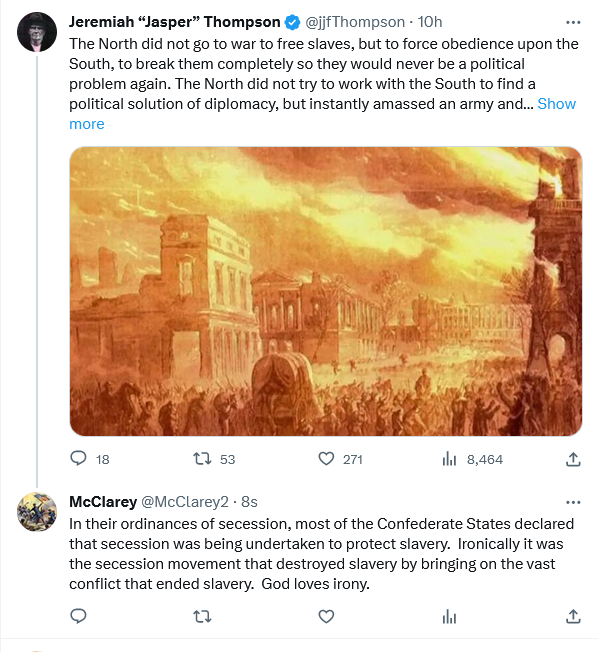



That seems to fall under the template of ‘For the South it was only about slavery because they were racists, for the North it had nothing to do with slavery because they were racists, because America has never been anything but racist.’ A view that was taking hold when I was in college back in the day.
The statement: “The North did not try work with the South to find a political solution” flies in the face of fact. Those facts have “Titles” like “The Missouri Compromise,” “The Compromise of 1850,” and the (thankfully unsuccessful) “Crittenden Compromise of 1860.” Oh, and if one reads the Constitution of the Confederacy, the only thing not to fall under “states rights” but kept at the Confederation level was slavery.
That seems to fall under the template of ‘For the South it was only about slavery because they were racists, for the North it had nothing to do with slavery because they were racists, because America has never been anything but racist.
==
I have a suspicion Mr. Thompson subscribes to the sort of neo-Confederate historiography associated with the von Mises Institute. Whether or not America is ‘racist’ is not a concern of his.
I thought this article had some good points. https://www.theburningplatform.com/2023/09/25/understanding-the-american-civil-war/#more-315503
My father believed that all (modern) wars could be attributed to economics, but then slavery was integral to the South’s economy- so slavery had to be a reason. But also keeping in mind that there were only a limited number of Southerners who directly benefited from slavery yet fought valiantly, and the historical facts concerning the tariff the North wanted to impose that would mainly benefit them to the great detriment of the South – not to mention Lincoln’s documented attitude that ending slavery was beyond his constitutional powers, I believe other reasons had to be at play as well. Interestingly, one commenter on the article above summed up his beliefs on the matter thusly: the Civil War was a disagreement among Freemasons. Oh no! A conspiracy theory! Perhaps they are right, but although I am inclined to investigate further, I do not have the time. But I do know that “qui bono?” Is always an important question and therefore looking at financial players/backers is a must. Banksters rule, and Freemasonry/secret societies is at the heart of bankersterdom. And I have always found it interesting that Albert Pike, Confederate war general and Freemason head honcho in the U. S., had a statue in Washington DC. Further, when it was torn down during Trump’s presidency, Trump commented at the time that it must be put back up. To my, admittedly limited, knowledge, Trump never made a comment like that about any other statue that was torn down.
Whether or not America is ‘racist’ is not a concern of his.
Hard to say. I just know that was more and more emphasized when I was in college, and it definitely came with the attached ‘because Racism’ label.
Banksters rule, and Freemasonry/secret societies is at the heart of bankersterdom
==
Snooze.
Art:
Thanks for the snooze. As a member of the American Numismatic Association I read articles almost monthly about pre-Civil War banks and their colorful notes, most of which proved worthless within one or two decades of their state charters. It’s a laugh to think those financial Keystone Cops could conspire to run anything, much less start a war.
LJM, that article glosses over the real reason the North and the South came to an impasse over slavery. That was the question of its expansion. Lincoln did indeed not think he had the power or intention to do anything about slavery “where it already exists” as he said in his first inaugural speech. But he was clear in that he slavery would not be allowed to expand, and it would die on the vine, whereas southerners knew that it needed to keep expanding to continue being viable. It was the issue that neither side was willing to compromise on, and so it led to the secession.
If the South had achieved independence, I would not have been surprised to see the Confederacy attempt to expand into Mexico, Central American and the Caribbean, as Southern Fire eaters had long called for. No doubt this would have led to another war with the Union.
Confederados – 20,000 Confederates emigrated to Brazil. Emperor Dom Pedro II offered free land to them. He hoped they would help improve cotton farming which they did with importing better farm equiipment and establishing an agricultural school. Pedro’s offer was enticing to Souther families because many had lost their land or did not want to live under the Reconstruction. There were even a few Northeners who emigrated before the War Between the States.
To this day the Confederados have an annual festival to honor their roots.
https://en.wikipedia.org/wiki/Confederados
and it would die on the vine, whereas southerners knew that it needed to keep expanding to continue being viable.
==
‘Viable’ is a frequently misused term. A cotton plantation in Alabama doesn’t need a ranch in Arizona using the same labor system in order to prosper. People who own cotton plantations using slave labor may benefit from having others as political allies, but that’s a different consideration.