
From The Institute For The Study of War:
Russian Offensive Campaign Assessment, August 6, 2023
Riley Bailey, George Barros, Nicole Wolkov, Christina Harward, Kateryna Stepanenko, and Frederick W. Kagan
August 6, 2023, 6:30pm ET
Click here to see ISW’s interactive map of the Russian invasion of Ukraine. This map is updated daily alongside the static maps present in this report.
Click here to access ISW’s archive of interactive time-lapse maps of the Russian invasion of Ukraine. These maps complement the static control-of-terrain map that ISW produces daily by showing a dynamic frontline. ISW will update this time-lapse map archive monthly.
Note: The data cutoff for this product was 12:00pm ET on August 6. ISW will cover subsequent reports in the August 7 Russian Offensive Campaign Assessment.
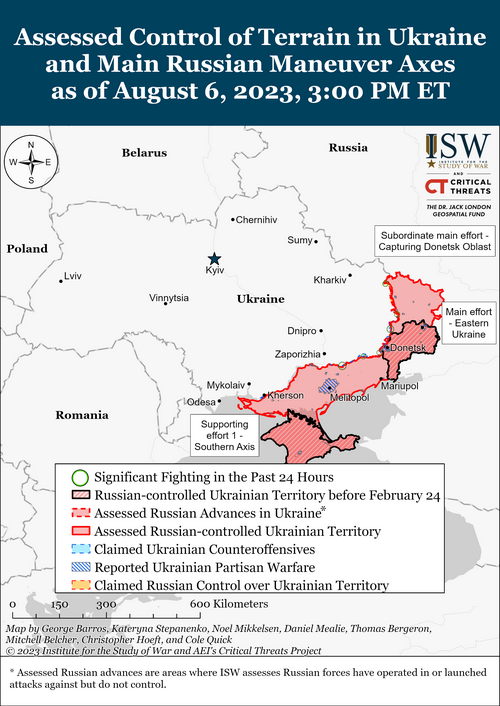
Ukrainian forces struck two key road bridges along critical Russian grounds lines of communication (GLOCs) connecting occupied Crimea and occupied Kherson Oblast on August 6, causing Russian forces to reroute road traffic from shorter eastern routes to longer western routes. Kherson Oblast occupation administration head Vadimir Saldo claimed that Ukrainian forces launched 12 missiles at a road bridge across the Henichesk Strait connecting Henichesk Raion to the Arabat Spit and that Russian air defenses intercepted nine of the missiles.[1] Russian sources amplified images showing significant damage to the bridge and claimed that Ukrainian strikes partially collapsed a section of the bridge.[2] Russian sources amplified footage showing Ukrainian forces striking the Chonhar road bridge along the M-18 (Dzhankoi-Melitopol) highway connecting occupied Crimea with occupied Kherson Oblast and subsequent minor damage to both sides of the bridge.[3] Crimean occupation head Sergei Aksyonov claimed that Ukrainian forces launched two missiles at the bridge and that one missile made it through Russian air defenses and damaged the roadbed of the road bridge.[4] Russian sources claimed that Ukrainian forces used Storm Shadow cruise missiles to conduct both strikes, although ISW has yet to observe confirmation of Russian forces intercepting Storm Shadow cruise missiles.[5]
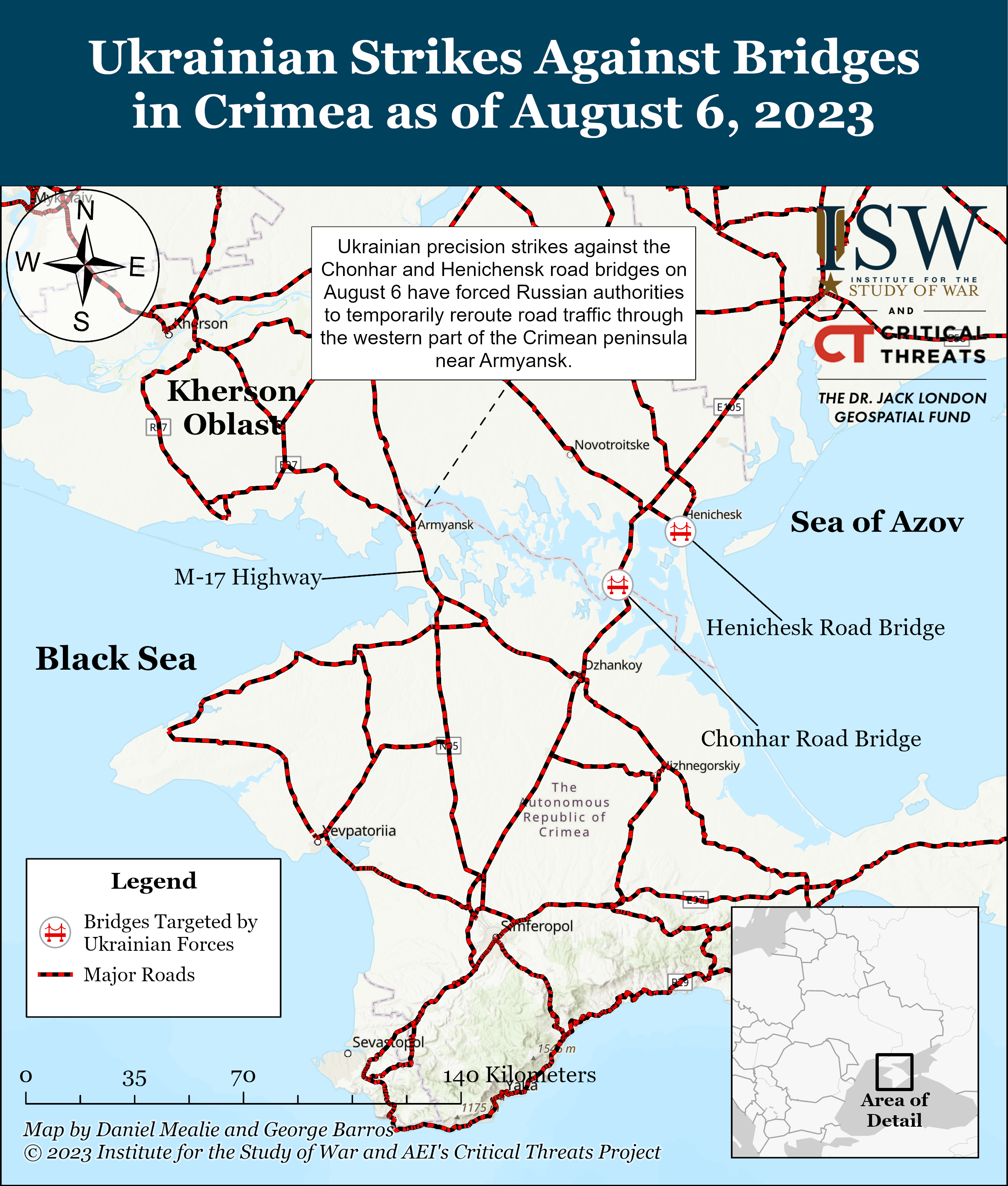
Aksyonov announced that repair work is underway at the Chonhar bridge and that Russian officials will reroute all traffic through the Armyansk and Perekop checkpoints along the M-17 (Armyansk-Oleshky) and T2202 (Armyansk-Nova Kakhovka) highways.[6] The Crimean occupation transport ministry announced that all traffic through the Dzhankoi checkpoint along the M-18 highway is closed but that traffic along the Kerch Strait bridge and the Kerch Strait ferry crossing is operating normally.[7] The Russian Federal Security Service (FSB) suspended civilian entry to the Arabat Spit as of July 31, and Russian officials have not commented on the status of traffic along the Henichesk-Arabat Spit GLOC.[8] The extent of the damage to the bridge across the Henichesk Strait is likely forcing Russian forces to redirect military traffic from the Arabat Spit to longer western routes between occupied Crimea and occupied Kherson Oblast. The M-17 highway passes through Armyansk before branching at a junction with the T2202 highway to the north and continuing to the northwest, meaning that most if not all Russian road traffic between Crimea and Kherson Oblast will have to pass along or very close to one 20km section of the M-17 between Ishun and Armyansk. This major bottleneck in Russian GLOCs will likely pose significant disruptions to logistics and chances for delays and traffic jams. It is unclear how quickly Russian officials will be able to repair the Chonhar bridge and it is equally as unclear if Russian officials have repaired the Chonhar railway bridge that Ukrainian forces struck on July 29.[9] The damage to the Henichesk Strait bridge will likely take Russian officials substantially longer to repair. Russian GLOCs along the T2202 northwest of Crimea – especially routes along primary and trunk roads south of Nova Kakhovka – are closer to Ukrainian positions in upper Kherson Oblast and in many cases within artillery range of the Ukrainian-held western bank of the river. Russian forces likely can reduce risks from Ukrainian indirect fire in this area by taking slower and less efficient village roads northeast of Chaplynka, but at the cost of slower and more complicated logistics support.
Ukrainian strikes on bridges along critical Russian GLOCs are a part of the Ukrainian interdiction campaign focused on setting conditions for future decisive counteroffensive operations. A prominent Wagner-affiliated Russian milblogger argued that the Ukrainian strikes on August 6 show that Ukrainian forces are methodically trying to cut off the Russian grouping in southern Ukraine and disrupt its logistics in a way similar to the Ukrainian interdiction campaign during the Kherson counteroffensive.[10] The milblogger noted that Russian defenses on west (right) bank Kherson Oblast broke down in a matter of days following months of Ukrainian strikes on Russian logistics and expressed concern that the situation could repeat itself.[11] The Ukrainian strikes on the eastern crossing points will likely disrupt the transport of Russian personnel, materiel, and equipment from occupied Crimea to critical Russian defensive operations in western Zaporizhia Oblast and the Zaporizhia-Donetsk Oblast border area for some, undetermined, time. Ukrainian forces appear to be also expanding their interdiction efforts to target Russian naval targets involved in Russian logistics in the Black Sea as ISW has previously observed.[12] Ukrainian officials have routinely stated their commitment to a deliberate interdiction campaign against Russian military targets to degrade Russian logistics and defensive capabilities to set favorable conditions for future Ukrainian counteroffensive activity.[13]
Ukrainian forces continued counteroffensive operations on at least two sectors of the front on August 6. The Ukrainian General Staff reported that Ukrainian forces conducted offensive operations in the Berdyansk (western Donetsk-eastern Zaporizhia Oblast area) and Melitopol (western Zaporizhia Oblast) directions.[14] The Russian Ministry of Defense (MoD) and other Russian sources claimed that Russian forces repelled Ukrainian offensive operations near Bakhmut.[15] Ukrainian Main Military Intelligence Directorate (GUR) Head Major General Kyrylo Budanov stated in an interview published on August 5 that Ukrainian forces are advancing faster around Bakhmut than in southern Ukraine.[16] Budanov also stated that Russian forces have built stationary, fully equipped, concrete-filled defense posts in southern Ukraine, making the Ukrainian offensive there difficult.[17]
Russian forces conducted one of the largest missile and drone strike series on Ukraine in recent months on the night of August 5-6. The Ukrainian General Staff reported that Russian forces launched the first wave of strikes on the night of August 5 consisting of 14 Kalibr cruise missiles and three Kh-47 Kinzhal air-launched ballistic missiles, and that Ukrainian forces shot down 12 Kalibr cruise missiles.[18] The Ukrainian General Staff reported that Russian forces launched a second wave of strikes on August 6 consisting of 27 Shahed-131/136 drones, six Kalibr missiles, and 20 Kh-101/555 air-launched cruise missiles and that Ukrainian forces shot down all 27 Shahed drones, five Kalibr missiles, and 13 Kh-101/555 missiles.[19] Ukrainian Air Force Command Spokesperson Colonel Yuriy Ihnat reported on August 6 that Russian attacks targeted the Starokostyantyniv airfield in Khmelnytskyi Oblast and noted that this is not the first time that Russian forces have attacked the airfield.[20] Some Russian milbloggers claimed that Russians targeted the Starokostyantyniv airfield because Ukrainian forces store foreign-supplied missiles including Storm Shadow cruise missiles at warehouses on the base and because the Ukrainian aviation unit that operates at the base is the only one with Storm Shadow missiles.[21] ISW has not observed any evidence to confirm these claims, however. The milbloggers’ claims that Russian forces specifically targeted an area where Ukrainian forces allegedly store and launch Storm Shadow missiles suggests that Russian forces are increasingly concerned about Ukraine’s interdiction campaign.
Ukrainian officials stated that Ukrainian air defenses have destroyed 3,500 aerial targets since the beginning of Russia’s full-scale invasion of Ukraine on February 24, 2022. Ukrainian Air Force Command Spokesperson Colonel Yuriy Ihnat stated on August 6 that Ukrainian air defenses have intercepted and destroyed 3,500 aerial targets, including 350 Russian fixed and rotary wing aircraft, 1,200 cruise missiles, including 13 hypersonic Russian “Kinzhal” Kh-47M2 missiles, and 24 ballistic missiles.[22] Ukrainian President Volodymyr Zelensky reported on August 6 that Ukrainian air defenses have intercepted and destroyed over 2,000 Russian unmanned aerial vehicles (types unspecified) and that Ukrainian pilots have conducted over 14,000 sorties since February 24, 2022.[23]
International talks aimed at drafting the main principles for a future settlement to the war in Ukraine continued in Jeddah, Saudi Arabia on August 6. Diplomats from 42 countries including the US, Japan, South Korea, South Africa, the United Kingdom, India, and China reportedly agreed that future peace talks between Ukraine and Russia should be based on principles of international law, such as respect for Ukrainian sovereignty and territorial integrity.[24] Ukrainian Presidential Administration Chief of Staff Andriy Yermak reported that the Ukrainian delegation spoke with representatives from each country present at the meeting.[25] Chinese diplomats reportedly reintroduced China’s 12-point peace plan from February 2023, prompting European delegations to respond that an unconditional ceasefire would create a frozen conflict and allow Russia to consolidate its control over occupied Ukrainian territories.[26] The Wall Street Journal reported on August 6 that most countries in attendance in Saudi Arabia, including China, agreed to meet again in the near future in a similar format that again would not include Russia.[27]
Kremlin Spokesperson Dmitry Peskov gave an unclear and contradictory answer to a New York Times reporter who asked whether Russia seeks to conquer more Ukrainian territory beyond the four partially occupied oblasts that Russia illegally annexed in September 2022. The New York Times reported that Peskov said, “No… We just want to control all the land we have now written into our Constitution as ours,” when asked whether Russia seeks to capture more territory in Ukraine.[28] Peskov’s seemingly straightforward answer is contradictory, vague, and does not answer the reporter’s original question. Russian forces do not fully occupy the four oblasts — Kherson, Zaporizhia, Donetsk, and Luhansk oblasts — that the Russian government formally claims. Russian forces would have to conduct significant offensive operations to capture over 16,000 square kilometers of land in these four oblasts to bring de facto Russian-occupied territory in line with the Russian constitution as Peskov described. Russia also occupies territory in northeastern Kharkiv Oblast and in Mykolaiv Oblast (the Kinburn Spit) — territory that the Kremlin has not formally annexed. Peskov’s statement implies that Russian forces should relinquish their territory in Kharkiv and Mykolaiv oblasts, but the Russian government has made no indication that it plans to do so and, in fact, is continuing offensive operations to gain more territory in Kharkiv. The Kremlin likely seeks to continue significant military operations against Ukraine to – at a minimum – capture the remaining parts of Kherson, Zaporizhia, Donetsk, and Luhansk oblasts that Russian forces do not yet occupy. The Kremlin has articulated further maximalist objectives in Ukraine beyond that, including changing the Ukrainian government and constitution.[29]
Peskov also strangely stated that Russia’s presidential election is “not really democracy” but rather a “costly bureaucracy” and that Russian President Vladimir Putin “will be re-elected next year with more than 90 percent of the vote,” but walked back on this statement the same day it was publicized.[30]
Key Takeaways:
- Ukrainian forces struck two key road bridges along critical Russian grounds lines of communication (GLOCs) connecting occupied Crimea and occupied Kherson Oblast on August 6, causing Russian forces to reroute road traffic from shorter eastern routes to longer western routes.
- Ukrainian strikes on bridges along critical Russian GLOCs are a part of the Ukrainian interdiction campaign focused on setting conditions for future decisive counteroffensive operations.
- Russian forces conducted one of the largest missile and drone strike series on Ukraine in recent months on the night of August 5-6.
- Ukrainian officials stated that Ukrainian air defenses have destroyed 3,500 aerial targets since the beginning of Russia’s full-scale invasion of Ukraine on February 24, 2022.
- International talks aimed at drafting the main principles for a future settlement to the war in Ukraine continued in Jeddah, Saudi Arabia on August 6.
- Kremlin Spokesperson Dmitry Peskov gave an unclear and contradictory answer to a New York Times reporter who asked whether Russia seeks to conquer more Ukrainian territory beyond the four partially occupied oblasts that Russia illegally annexed in September 2022.
- Ukrainian forces continued counteroffensive operations on at least two sectors of the front on August 6.
- Russian forces conducted offensive operations along the Kupyansk-Svatove-Kreminna line, near Bakhmut, along the Avdiivka-Donetsk City line, in the Zaporizhia-Donetsk Oblast border area, and in western Zaporizhia Oblast August 6 and made advances in certain areas.
- Russian military command finally allowed personnel of the Russian “Alga” volunteer battalion – which has been involved in the most combat intense frontlines in Donetsk Oblast since Fall 2022 – to return to Russia on leave.
- Russian occupation authorities in Ukraine continue establishing institutional linkages between Russian and Ukrainian governance structures and social services in occupied Ukraine.
Go here to read the rest.
From Strategy Page:
The 2022 invasion of Ukraine has been a disaster for Russia, because Russian troops ran into unexpected and very effective Ukrainian resistance. Russia lost more troops in less than a year of fighting in Ukraine than they did during eight years of fighting in Afghanistan during the 1980s. Russia did have one success because of the Ukraine War, but that occurred in Russia, not Ukraine. Back in Russia, many people opposed the war. While the Russian government portrayed the fighting in Ukraine as an effort to keep NATO from harming Russia, it was obvious that no one was invading or attacking Russia and that it was Russians that invaded Ukraine. Like the Germans who invaded Russia in 1941, where they were on the defensive by 1944. the Russians invading Ukraine were soon on the defensive and could be driven out in another year or so.
Fourteen months after Russia invaded Ukraine, the Ukrainians are attacking and driving the Russian forces out. This was bad news for the Russian government, which was receiving growing criticism from its citizens about not merely the war’s cost, but the need for it at all. The government responded to the internal criticism and did so more effectively than their military efforts in Ukraine. Russia declared criticism of the Russian war effort in Ukraine illegal. Arrested were made and some critics went on trial. This discouraged some Russian critics but emboldened others. Thit sort of thing was uncommon in Russia.
Throughout most of its history, Russia has been a police state. In addition to the secret police, Russia also intercepted and read mail and overheard radio and telephone conversations. Russia mobilized support inside Russia for detecting anonymous critics and threatening them with arrest if they did not curb their criticism.
This criticism made it obvious that the Russian government was losing the support of its own people, including a growing number of senior officers who spoke out, usually via encrypted messages on Telegram, a popular cell phone app in Russia and Ukraine. Early on many of these Russian Telegram based military bloggers (“mil-bloggers”) supported the invasion and were supplied with information by the Russian government, including opportunities to spend some time with the troops inside Ukraine. After a few months the Russian mil-bloggers were no longer reporting the official Russian version of events in Ukraine, but what was being reported by Russian veterans of the fighting.
After Russia announced a pause in offensive military operations in early July, one of these mil-bloggers, a former general who had served in occupied Donbas before the invasion, reported a different reality. He insisted that Russia had suffered higher losses in eastern Ukraine (Luhansk province) than the Ukrainians, who were conducting a classic attrition defense. The Russians had suffered far more losses in men and equipment. Ukrainians were not driven out of Luhansk, but withdrew slowly and deliberately to encourage Russia to keep attacking and losing troops and combat vehicles that could not be replaced. Meanwhile the Ukrainians were receiving more weapons and equipment from NATO and forming new units, including armed resistance groups in occupied Ukraine. This was not the official Russian assessment but it was the reality that Russian troops in Ukraine were experiencing and some Russian mil-bloggers were reporting.
All this was nothing new. When the most modern and effective Russian forces were assembled to invade Ukraine in 2022, they quickly discovered they were not facing an inept, poorly trained and armed foe but one that was far more effective than the Russian invaders. The main offensive in the north, towards the nearby Ukrainian capital Kyiv, suffered heavy losses and within weeks was forced to withdraw back to the border. Russian troops were initially told that they had encountered NATO troops who were in Ukraine preparing to invade Russia. The surviving troops knew better because all they encountered were Ukrainians, usually armed with weapons similar to what Russia used as well as more effective ones they had received from NATO. The Ukrainians used more effective tactics and some new weapons that were based on Western models but Ukrainian- made. The Russian state-controlled media was ordered to ignore reports like this and stick with the official story that this was all a secret NATO operation to attack Russia via Ukraine.
While this information war played on, the Russian ordered everything they had, short of nuclear and chemical weapons, into use in an effort to salvage the situation. Russia was at war with a near-peer opponent and losing. Many Russians, civilian and military, figured out what was happening and openly criticized, or sometimes even physically attacked, their government because of the mess in Ukraine that was killing a lot of Russian troops. These Russian critics were often well-educated professionals in regular contact with Westerners, including more than a million Russians who had left since 2014 because of fears Russia was headed for what actually happened in 2022. Several hundred thousand more departed after the 2022 invasion. Despite this, the majority of Russians accepted the government explanation that Russian was defending itself in Ukraine and that what the government called the “special military operation” must continue. Russia refused to call what they were doing in Ukraine as war.
Russia encountered major problems trying to control information made available to its people. This became a critical problem after the invasion of Ukraine and the government wanted to conceal the extent of their military failures. Passing new laws against disclosing such information and shutting down the last few media operations that were not state-controlled were not enough. The ban on casualty information created a lot of public protest that found ways to get past the censorship.
The Russian government persevered and was eventually successful at organizing effective resistance to internal criticism by Russian officials and civilians. This was done by relying on the growing number of Russian firms that were developing new tools to read encrypted messages and track those who were anonymously news of the Ukraine War that was critical of Russian efforts. The FSB, the Russian secret police that replaced the Cold War era KGB in the 1990s, encouraged the establishment and growth of Russian companies that were developing new tools for the KGB to use for detecting, tracking and eavesdropping on the communications of Russian critics who thought they were safe when using encrypted apps like WhatsApp and Telegram.
These efforts to track the users of encrypted apps and even decrypt some of the messages had some success. Despite that Russians continue criticizing their government, especially the continued fighting in Ukraine. Portions of Ukraine still under Russian control were being pacified by moving Ukrainians to Russia and an uncertain future. The departed Ukrainians were supposed to be replaced, but weren’t, by Russians willing to risk living in a disputed area for a reward of free housing in as the empty homes of the forcibly removed Ukrainians. Somehow no Russian civilians have accepted this offer. Russia has already been condemned for sending the young children of, especially orphans, and sending the kids to Russia for adoption by Russian couples. This sort of thing appalls many Russians because Russian history books describe similar behavior by German invaders during World War II. The Russian government denies any similarities between its activities in Ukraine now and what the German invaders did inside Russia nearly 80 years ago. Russia declared it illegal to spread such ideas. There were a few arrests, but that was also unpopular and the prison system could not handle a large number of Russians convicted of thought crimes.
Successful government tracking and identification of Russians criticizing their government was seen as a victory against the spread of anti-Russian information on the Internet. However, this did little to stop Russians from discussing and criticizing government misbehavior. The government is undeterred and continues to reward Russians and Russian firms that come up with new tools to decrypt encrypted messages and track the extent of this critical information and who was involved.
Coping
Lack of success in Ukraine soon became a problem for the Russian government and the Russian media. Russian leader Vladimir Putin does not tolerate public criticism. After all, he began his career as a Soviet KGB officer. Back then openly criticizing the KGB was against the law and violators were jailed or simply died under mysterious circumstances. Putin revived those practices after the invasion of Ukraine turned out to be a disaster for Russia. Now the Ukrainians are counter-attacking with the goal of driving Russians out of Ukraine entirely. Another embarrassing aspect of the Ukraine fighting was that the Ukrainian received over $80 billion in military and other aid from NATO countries while no one was helping Russia. Several groups in Russia have opinions on why this is so and not all of these opinions agree with each other.
Some Russians see the invasion of Ukraine as necessary if Russia is to negotiate with the West on an equal basis. The invasion triggered an unprecedented degree of Western economic sanctions, which kept Russian leaders busy developing methods to cope with the economic impact, especially on ordinary Russians. Vladimir Putin first established power in Russia two decades ago by paying attention to the standard of living for Russians, especially those surviving on a pension. This made Putin very popular, although that popularity has diminished the longer Russian forces were struggling in Ukraine. This has encouraged the more radical supporters of Putin’s foreign policy, some of it because Russia was losing. An example of this was the “angry Russia” faction that opposes any efforts to negotiate with the West. Demands are preferred but the more Russia struggles in Ukraine the less likely anyone in the West wants to trust or negotiate with Russia. This is because Russia tends to break agreements made with the West and blame the West for forcing Russia to take drastic action.
Despite many failures, Putin remains in power but the growing list of threats is eroding that power. Russians like a strong leader, but there is a limit to how many of the leader’s mistakes they will tolerate. This has created a bad situation for Putin because the most common causes of wars are territorial disputes and overconfidence by the aggressor. The current war in Ukraine is the result of over a decade of bad decisions by Russian leaders, particularly Putin, who has been running Russia for over two decades despite term-limits laws and continued, but futile, popular opposition.
The first actual invasion of Ukraine occurred in 2014 after five days of popular protests in Ukraine forced a pro-Russia Ukrainian president to flee to Russia. Victor Yanukovych had won the 2010 presidential election because of promises to seek greater economic and diplomatic links with the West. At that point Russia had been interfering in Ukrainian affairs for over a decade in an effort to prevent Ukraine from becoming more Western and less subservient to Russia. Yanukovych was bribed by the Russians to renege on his election promises about closer links with the West. In late 2013 Yanukovych was supposed to sign a political association and free trade agreement with the EU (European Union). To the surprise of the Ukrainians who voted for him, Yanukovych refused to sign the EU agreement and announced he was going to seek closer ties with Russia. This triggered a popular uprising demanding he resign. At first Yanukovych tried using violence to suppress what came to be called the Maidan Revolution. Over a hundred protesters were killed but the number of protesters in Kyiv grew and Yanukovych fled to Russia. The Ukrainian parliament then voted to officially remove Yanukovych from office and an interim president was selected to arrange new elections and sign the EU agreement. Petro Poroshenko was elected president in May 2014.
Russia was dismayed by the removal of Yanukovych and turned to more violent solutions to their Ukraine problems. Russia declared that former Ukrainian president Yanukovych was still the legitimate president and had him write a letter requesting Russian military assistance in Crimea, where the new Ukrainian government was threatening to cancel the lease Russia had for their naval base. Russia was providing Yanukovych with sanctuary and protection from prosecution for crimes he was accused of in Ukraine.
Russia was acting on its belief that three Ukrainian provinces, Crimea, Donetsk and Luhansk should be part of Russia because most of the people in those provinces were Russian speakers and could be persuaded to voluntarily join Russia. This turned out to be only partially true. Many of the Russians in Crimea were military personnel and their families, living there because of the continued use of Sevastopol as the Black Sea Fleet headquarters. Russia prepared a surprise operation that involved the 22nd and 45th GRU (Military Intelligence) spetsnaz (special operations) regiments, which were part of the Russian military force but not identified as spetsnaz. There were only a few hundred spetsnaz in Crimea but Ukrainians soon were able to recognize the “little green men” with weapons and lots of attitude wearing uniforms with no insignia. Also identified were recently (after the takeover began) arrived members of the infamous (for brutal but effective special operations in Chechnya) Vostok battalion and an airborne unit (31st Airborne Brigade) that showed up in a lot of tricky situations (Bosnia, Chechnya, Georgia). In other words, what foreign intelligence agencies have come to regard as The Usual Suspects whenever there is an operation requiring special operations forces.
Ukraine appealed to the West for help, not just a trade deal. Putin’s actions in Ukraine had brought Ukraine closer to the west and finally actively sought NATO membership. Putin had invoked grievances with NATO and sought to resolve them by claiming they went into Ukraine to annex it to Russia. This was considered necessary to restore Ukraine to its status as part of Russia. Putin later claimed that he was seeking to restore other areas to Russian control.
Putin eventually named portions of Poland as one of its future targets for absorption into “Greater Russia”, otherwise known as the Russian empire. Belarus, the Baltic States and some former Soviet territories in Central Asia are also on the acquisition list. None of these targets were willing to cooperate. Poland, as the largest and wealthiest East European NATO member, led the way by rearming to confront any future threat. After Russia invaded Ukraine, Poland decided to increase the size of the armed forces to 300,000 personnel and spend at least three percent of GDP on defense. NATO suggests two percent of GDP but few European NATO members spent that much on defense. Now more NATO members are reaching or exceeding two percent and the increases are higher the closer a country is to Russia.
The NATO nations near or bordering Russia insist that, if Russia is allowed to keep any Ukrainian territory, the Russians will attack them too as part of an effort to reconstitute the Greater Russia that the tsars and later communists created and maintained until 1991. Russian leader Vladimir Putin has always insisted that the dissolution of the Soviet Union in 1991 was a big mistake and must be rectified. Many Russians agree with that, but are less willing to pay the economic and military price that Ukraine demonstrated would result if Russia tried.
Kazakhstan, Azerbaijan, and Turkmenistan are nervous because they are, after Ukraine, according to Vladimir Putin, on the list of former Soviet territories that must be absorbed into Greater Russia. That would be difficult because these three states have growing economic ties with China and diplomatic ties with India and the West.
Greater Russia was not just about rebuilding the tsarist or communist empires because Russia does not want the expensive of ruling Central Asian states, but rather more lucrative territories Russian once ruled. This includes portions of Poland, all of the Baltic States and Finland, and parts of Alaska. There are some serious legal and practical problems with these claims. The United States has a larger military and nukes which might come into play to deal with efforts to enforce any Russian claims on Alaska. Russia is making claims on several Eastern European NATO members who are protected by the mutual defense clause of the NATO treaty.
Russia and all the nations involved are members of the United Nations. Article 51 of the UN charter demands that members refrain from the use of force against the territorial integrity or political independence of any state. Russia says this does not apply because Ukraine is a breakaway part of Russia and Russian troops are seeking to liberate Ukraine from foreign (NATO) oppression. Ukraine is also a UN member and protests Russian claims as well as the UN tolerating the Russian use of its Security Council veto to block any serious UN opposition to the Russian aggression.
Ukraine pointed out that the Ukrainian forces will force Russian troops out of Ukraine and then the problem will be what the rest of the world does about Russia. Putin’s decisions have led Western and even some Russian media to describe Putin as out of control. Ukraine was one of many unpopular Putin decisions. Another one was the effort to sever access to the Internet outside of Russia. Only a few government and commercial operations would have access to the Internet beyond Russia’s borders. Putin has had this system tested in early July and there were still major problems that had to be fixed before he could sever international Internet access for most Russians and create Sovereign Internet for Russia and end access to the international Internet. This was not popular with most Russian Internet users.
Putin appears to go out of his way with actions and statements that further diminish his popularity inside Russia. There are still like-minded Russians who agree with Putin, but their number dwindles as each new scheme backfires and makes things worse for Russia.
July 31, 2023: In the Black Sea, an Israeli cargo ship defied the Russian naval blockade and entered Ukrainian waters, followed by four other cargo ships. An American P8 maritime surveillance aircraft flew overhead searching for any Russian naval activity. The Russian threat was not backed up by the presence of any warships, because doing so would make the Russian ships targets for Ukrainian anti-ship missiles or small, fast unmanned bomb boats.
Russia admitted that they had deported 4.8 million Ukrainian civilians to Russia since early 2022. The Geneva Convention considers such forcible deportations illegal while Russia describes it as a military necessity to reduce armed resistance in Russian occupied portions of Ukraine. Russia now considers these territories part of Russia. International law does not recognize such annexations.
Russia increased fines for men who do not report for military service. There are also fines for organizations, commercial or government, that do not accurately report the number and Ids of military age men on the payroll. Western analysts believe that Russia has lost (killed, seriously wounded, captured or missing) 250,000 soldiers since early 2022 and has outlawed the release of information on troop losses and threatens to prosecute anyone who releases that data anyway. It doesn’t make much difference in Russia, where the personal experiences of so many people, as expressed in social media, seems to confirm the Western estimates. To make matters worse the Ukrainian military continues to release transcripts of cell phone calls made by Russian soldiers in Ukraine to wives or other family members in Russia describing the losses and lack of support (supplies, replacements) they suffer from. This lack of support has led to many Russian soldiers not fighting when ordered to attack or defend. The troops will prepare fortifications, operate artillery and plant mines and explosive devices, and this is what causes most Ukrainian casualties. The Ukrainian troops find fewer Russian soldiers actively attacking or even fighting back. The Russian government has declared it a criminal act for soldiers to surrender. Those who do so will be imprisoned if they are eventually released and return to Russia.
Many of these complaints are made by Russian officers, who are reluctant to threaten their troops with punishment for not fighting. There is fear of mutiny by the miserable Russian troops. Officers deal with this problem by avoiding it and not doing anything that will further anger their troops and report to their superiors that everything is fine, except for the lack of supplies and replacements. The government attitude seems to be that they will increase punishments until troop morale improves. The government has also tried to suppress much of the bad news coming from the Ukrainian front. State-controlled media will not report what is really going on and the government tries to convince the Internet-based Russian commentators to limit their reporting of the bad news in Ukraine. Russian leaders, especially Vladimir, fear a rebellion inside Russia against the government for all the problems the Russian invasion of Ukraine has caused for Russia.
Go here to read the rest.
This War will likely end in the morale of the forces of one side collapsing. My money is on Russian morale collapsing first.

