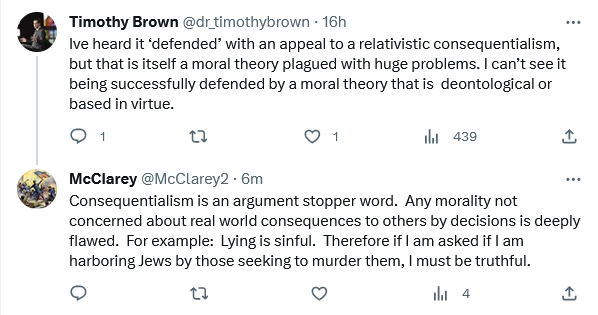
Consequences are never the be all and end all of morality. But denying that consequences have a role in moral calculations, especially when other people will pay the price of a decision, is lunacy.
Donald R. McClarey
Cradle Catholic. Active in the pro-life movement since 1973. Father of three, one in Heaven, and happily married for 43 years. Small town lawyer and amateur historian. Former president of the board of directors of the local crisis pregnancy center for a decade.
What was that old catechism class admonition again? You can never do evil, no matter how small, regardless of how large the good it may bring.
CAG
Tuesday, July 25, AD 2023 5:17am
“Therefore it is not lawful to tell a lie in order to deliver another from any danger whatever. Nevertheless it is lawful to hide the truth prudently, by keeping it back, as Augustine says”
~ St. Thomas Aquinas (Summa Theologiae II:110:3 Reply to Objection 4)
With all respect to the Angelic Doctor, such casuistry often makes a forthright lie seem honest by comparison. As an attorney I am quite familiar with weasel words.
Often said by nuns, God love ’em, who had no greater responsibilities than a catechism class. Better exemplars of what Catholic morality has looked like in practice might be a close history of the actions of the popes over the many centuries when they were secular rulers with secular responsibilities, particularly when it came to war, diplomacy and criminal justice.
Lucius Quinctius Cincinnatus
Tuesday, July 25, AD 2023 6:32am
The Hebrew midwives lied to Pharoah in Exodus 1:15-22, and it was a righteous lie.
Rahab lied to the king of Jericho in Joshua 2:1-7, and it was a righteous lie.
There are many more such examples in Sacred Scripture. These self-righteous, sanctimoniously pious Pharisees need to be put into their place.
CAG
Tuesday, July 25, AD 2023 6:55am
As an attorney I am quite familiar with weasel words.
The suggestion offered is more along the lines of “Even if I were harboring enemies of the state, I wouldn’t tell YOU!”
… It might get you killed (no greater love than this…) but it’s not a lie, nor is it casuistry. 🙂
Oh, he likely would tell on the third day of his torture. His attempt to avoid lying would then cost him and his guests their lives, and likely any family members who lived near him.
Frank
Tuesday, July 25, AD 2023 7:03am
Aquinas was undoubtedly deserving of his status as a Doctor of the Church. But that designation has never been meant or properly understood to signify infallibility. Theological errors or questionable positions can be found in the writings of several beloved Saints and Doctors over the millennia. This in no way detracts from the value of those writings.
As for the above Aquinas quotation, I have never been convinced by the attempt to distinguish between affirmative falsehood and intentionally hiding the truth “prudently.” To me they are almost exactly the same. If one is permissible, then in most cases so is the other. My patron Saint did tend on occasion to overthink some things, a reflection of his thoroughness, but not always profitable, IMO.
CAG
Tuesday, July 25, AD 2023 7:06am
We’re not commanded to save the world, that’s His job. We’re commanded to trust The Lord with all our hearts and do His holy will. I think John chapter 8 tells us what The Lord thinks of lying.
I wonder what the Lord believes about us foolishly throwing lives entrusted to us away because we refuse to lie to murderous agents of a totalitarian regime?
G. Poulin
Tuesday, July 25, AD 2023 7:39am
The commandment doesn’t forbid lying. I forbids making false accusations against someone. Jesus in John 8 isn’t making a general statement about lying; he is specifically taking his opponents to task for making false accusations against him. So I think I have to side with Donald on this one. Honesty may be the best policy as a general rule, but there are going to be exceptions.
CAG
Tuesday, July 25, AD 2023 9:19am
Jesus in John 8 isn’t making a general statement about lying
“You belong to your father the devil and you willingly carry out your father’s desires. He was a murderer from the beginning and does not stand in truth, because there is no truth in him. When he tells a lie, he speaks in character, because he is a liar and the father of lies.”
~ John 8:44
Strong words … I’m thinking Jesus wasn’t a fan of lying.
CAG
Tuesday, July 25, AD 2023 9:28am
I wonder what the Lord believes about us foolishly throwing lives entrusted to us away because we refuse to lie to murderous agents of a totalitarian regime?
Throw them away? I wonder what he thinks of those who endure torture and sinlessly give their lives to protect them?
“Precious in the sight of the Lord are the deaths of his faithful ones”
~ Psalm 116:15
Don, I respect you, and I get where you’re coming from. 900 years separated Augustine and Aquinas, and the Church was still debating the subject. Obviously, it’s not a clear-cut slam dunk issue. But I’m siding with Augustine and the idealists on this one. A lot of Christians could’ve lied to avoid the lion’s den but didn’t.
[…] For Life Act’ would Extend Child Tax Credit to Cover Unborn Children – CNA/The Reg Morality on Auto Pilot – Donald R. McClarey, J.D., at The American Catholic Saint James the Greater – Noel […]
Rudolph Harrier
Tuesday, July 25, AD 2023 2:23pm
Saying that lying is sinful in all circumstances is consistent.
It is also consistent to say that lying per se is not sinful, but that some special species of lies are sinful (ex. those that misinform people of information that they have a right to.) Then it would follow that some lies are not sins, and could be justified.
But if you say that lying is sinful (generally) but it’s okay if the consequences are desirable enough, then that really is consequentialism (i.e. saying that evil acts can be justified by good consequences.)
Rudolph Harrier
Tuesday, July 25, AD 2023 2:30pm
In the Sakoku period Japanese history, Christianity was banned and the government took great efforts to root out “hidden Christians.” One policy was to stop people and have them commit various blasphemies against Christ to prove their lack of faith. Those who refused would be tortured to death.
Now in some cases when the government believed that they had found a community of Christians they would offer the leader a different deal. They knew that many Christians would gladly accept martyrdom, so instead they would make the leader the following offer: blaspheme Christ, or we will torture your followers.
Would such a leader be justified in blaspheming Christ?
Lucius Quinctius Cincinnatus
Tuesday, July 25, AD 2023 3:04pm
From Dennis Prager’s Rational Bible Series, Exodus:
And yes, I know he is an Orthodox Jew, and many here will immediately discount anything he has to say simply because of that fact. Sadly, those people will miss out on a lot of wisdom. And no, I don’t agree with everything Mr. Prager writes or says. But he always makes me think and that’s a GOOD thing. So let us think instead of becoming mired in Medieval sanctimonious self-righteous piety or impossible theoretical scenarios as Rudolph postulates above.
WHEN LYING IS MORAL
1.19 The midwives said to Pharaoh, “Because the Hebrew women are not like the Egyptian women: they are vigorous. Before the midwife can come to them, they have given birth.”
The midwives lie to Pharaoh, offering as an excuse the supposedly rapid nature of Hebrew women’s manner of giving birth. This passage offers guidance to all people confronting criminals or evil political regimes. The midwives want to save the infants, but they don’t want to die; so they don’t tell Pharaoh what they are really thinking: We fear God more than you and therefore have disobeyed you and your evil decree.
We can infer from this episode that one is not obligated to speak truthfully to murderers and die—or have other innocents die—as a result. Rather, we are not only permitted, but morally obligated, to lie to the evil in order to save ourselves or other innocents. The notion that it is always immoral to lie is itself immoral.
To explain why this is so—why lying is sometimes moral and telling the truth is sometimes immoral—it is necessary to explain the concept of moral absolutes.
ESSAY: MORAL ABSOLUTES, MORAL RELATIVISM, AND SITUATIONAL ETHICS
Many religious people think that if you believe in moral absolutes, you cannot believe in situational ethics; they think situational ethics and moral relativism are synonymous.
This is a serious mistake. Moral relativism and situational ethics are not at all the same. In fact, if you believe in moral absolutes, you must also believe in situational ethics.
The doctrine of moral absolutes—or “objective morality” or “moral truth”—means there is an objective moral standard that transcends personal or societal opinion. To cite three examples, murder, the sexual abuse of a child, and lying are morally wrong not because many people or even an entire society believe they are wrong but because they are wrong—in the same way two plus two equals four, not because many (or even all) people think they equal four, but because they do equal four. There are moral truths just as there are mathematical, scientific, and historical truths. (However, there is one big difference: unlike scientific and historical truths, moral truths require God—because while scientific and historical truths can be proven, moral truths cannot be proven. You can argue murder is wrong, but you cannot prove it is wrong the way you can prove, for example, the earth is round. Moral truths depend entirely upon the existence of a Moral Source higher than mankind. Murder is wrong because God says so. If there is no God, all notions of right and wrong are subjective opinion.)
One more way to describe the existence of moral absolutes is “universal morality.” This means that just as two-plus-two-equals-four is universally true, so, too, moral truths are universal. If it is a truth that murder is wrong, it is wrong for all people. Moral relativism holds the opposite. It holds that morality is not universal but determined by each individual or each society: “what you think is wrong is wrong—for you; and what I think is wrong is wrong—for me.”
“Situational ethics” is not at all the same as moral relativism. Situational ethics does not mean every individual determines what is moral; it means only by knowing the situation can we know whether an act is moral or immoral.
This should be clear to anyone who gives it a moment’s thought. Take, for example, killing a person. Is that morally wrong? It depends entirely on the situation. If it is done in self-defense or to defend other innocents, or in a moral war, it is a moral act. Otherwise it is not “killing,” but “murder.” And murder,
by definition, is immoral killing.
Or, take sexual intercourse. That act can be the most beautiful form of physical human bonding, but the same exact act can be the evil act known as rape. What determines whether sexual intercourse is beautiful and even holy or evil? The answer is—the situation.
The situation is what makes it possible for us to determine what the moral absolute is. Very few acts are in and of themselves morally wrong. It is the situation that enables us to determine what is right and wrong.
Lying is another example. The situation enables us to determine whether lying is wrong. If a murderer asks you where his intended victim is hiding, and you know the answer, it is not only alright to lie to the murderer, it is morally imperative to do so—because saving an innocent person’s life is a greater moral good than refraining from lying.
That is why the midwives’ lie was moral. And the biblical proof that this is what God wanted is two verses later when God rewards their behavior. God approved of both their conduct and their lie.
Oh, and I almost forgot. Here is Dennis Prager’s video about the Ninth Commandment (Eighth in Roman Catholic numbering). At the end of the video, he briefly mentions lying to save a life as an exception to the Commandment.
Is forced blasphemy, blasphemy? Christ said that if we deny him before men, He would deny us, but in the example you raise, it would seem the intent to blaspheme is missing.
I believe that some lies are sinful and some lies are virtuous. This has been a hot topic in the Church for centuries, but I doubt if most of us are truthful when the truth is cruel or would have cruel consequences.
Rudolph Harrier
Tuesday, July 25, AD 2023 3:38pm
Is forced blasphemy, blasphemy? Christ said that if we deny him before men, He would deny us, but in the example you raise, it would seem the intent to blaspheme is missing.
Most people do not blaspheme Christ with the intent to deny Christ primarily. If someone blasphemes Christ to save his own skin, isn’t his primary desire to save his own skin? He may even tell himself “I say this but I do not mean it.” What about people who tell a blasphemous joke at work to get in good with their bosses and make a promotion more likely? They may tell themselves “this is just shop talk, I don’t really mean it.”
In fact, if we allow that such acts of “fake” blasphemy are licit, then many martyrs in fact become in the wrong. Many of them would have been able to do more good acts had they lived. Should we view them as cowards for not making an act of blasphemy “without intent” to save their lives?
Greg Mockeridge
Tuesday, July 25, AD 2023 3:58pm
“Honey, does this dress make me look fat?“
Plead the fifth on that one. Because she’s gonna accuse you of lying if you say no anyway.
Most people do not blaspheme Christ with the intent to deny Christ primarily
Then it may not be blasphemy.
If someone blasphemes Christ to save his own skin,
Cowardice in a man is deplorable. By a frightened woman or a kid, not so much. Blaspheme Christ or we will torture to death your kids before your eyes would probably be the threat. Whatever anyone says under such a threat, I doubt if it is blasphemy.
“What about people who tell a blasphemous joke at work to get in good with their bosses and make a promotion more likely? They may tell themselves “this is just shop talk, I don’t really mean it.”
No force involved and denying Christ for a promotion is Judas territory.
“then many martyrs in fact become in the wrong.”
Not at all. They are heroes and go straight to Heaven. I doubt failing to follow their example, depending upon the circumstances, is necessarily sinful.
CAG
Tuesday, July 25, AD 2023 5:29pm
Would such a leader be justified in blaspheming Christ?
Sure. You have a friend who is fighting a losing battle with cancer. (Been there too many times.) They look like death warmed over. You lie and tell them they look stronger to you. They smile and tell you they think they are a bit stronger.
Your kid proudly gives you a picture that he has drawn. It looks like a drunken monkey was the artist. You praise it to the skies.
You wink at a homely girl you know. She titters and you have made her day.
I am an undercover operative in 1944 and know the invasion is coming ashore in Normandy. I stage an elaborate deception to convince the Nazis that the Allies will be invading at the Pas de Calais.
You tell a dying child that soon he will be coming home.
Pinky
Tuesday, July 25, AD 2023 6:12pm
Sengoku period – I don’t see how blasphemy could be justified. We hold the early Church martyrs up as examples. How many people in those persecutions, or any such throughout the ages, also had families? A martyr isn’t responsible for the actions of his captors. If an official is threatening to torture me and my family or my flock, I personally don’t see me holding up under it for more than a minute, but that’s what we’re called to do. If I’m wrong on this, someone will have to demonstrate it to me.
Martyrs are always right Pinky, but their example often is rare, hence our veneration of them. Consider the Donatist heresy. The early Church had plenty of clergy and laity who caved and were craven in the face of persecution. They were readmitted to the Church after a period of penance because the Church wisely knows that all of us are not born brave. Donatus wanted a Church without clergy who had compromised with Rome. He ended up founding a pernicious heresy that endured for several centuries in North Africa.
Nate Winchester
Tuesday, July 25, AD 2023 6:57pm
I always find a bit of wry amusement in these as people argue so intently over it when 99.999% of us will never drop a bomb or have to lie to gestapo. Maybe instead of wondering how we should treat people we will never meet, we should take a moment to reflect on how we treat the real, actual neighbors we are interacting with in the process. (Even more so those whose faces you actually see.)
Considering the sad shape that the Church Hierarchy is in, isn’t the Donatist teaching about the worthiness of the clergy and the sacraments pegging the meter? A teaching for our times.
CAG
Tuesday, July 25, AD 2023 7:43pm
Sure. You have a friend who is fighting a losing battle with cancer. (Been there too many times.) They look like death warmed over. You lie and tell them they look stronger to you
1) These aren’t scripture, Doctors of the Church or even Denzinger.
2) Most of us don’t know the day or the hour, and the opportunity to know what’s coming and get right with God is a great gift! Instead of lying to them and telling them everything is great, wouldn’t helping them gain the strength to approach the end, in the sacraments with hope, be a better idea?
Asking for a cancer survivor who has held the hands of friends who’ve passed.
CAG
Tuesday, July 25, AD 2023 7:54pm
Don, let me add … Augustine, Aquinas and The Church has always held that lying is an action with a deliberate desire to deceive. None of your emotion-eliciting examples are that. For example, telling your wife she doesn’t look fat is more of an attempt to preserve your happy marriage … you wouldn’t be trying to trick your wife into wearing clothing that was unflattering.
… Kind, but not *virtuous! Your claim was that lying can be virtuous. The noun “virtue” has a defined meaning in the Church. Please explain how a lie can fall into that category.
Intent defines sin. I’m not talking the “end justifies the means” type. Intent is what separates the act from it being something evil, and contrary to God, from something which is good (of God). Then there is prudence (is it wise for me to admit or answer something if it will make a situation worse or put someone’s life in jeopardy). These are all factors, including a well-formed conscience and personal reflection with God, on whether not being forthright was out outright lie and therefore sinful. There’s many factors. Maybe my explanation is not sophisticated, but not everyone has been Blessed by God with the ability to articulate and comprehend on a theological level.
1) These aren’t scripture, Doctors of the Church or even Denzinger.
Read the Old Testament closer CAG, it is filled with such deceptions. Jacob got his blessing from Isaac through pretending to be Esau. The mother of Moses pretended not to be his mother in order to nurse him. Jael granted hospitality to Sisera before slaying him. etc. The Jesuits down the centuries gave instruction on how to lie without lying through weasel words and mental reservations.
It is widely recognized that Pius XII authorized the issuing of false baptismal certificates to Jews during WWII, although people William Doino Jr. dispute this. False and forged documents saved countless Jewish lives in Rome and throughout Europe throughout Europe during the war. That such went on without at the pope’s implicit approval at the very least seems absurd on its face.
Undercover and sting operations, which are deceptive in nature, have been carried out by law enforcement for time immemorial and I’m not aware of any hint from the Church such are morally illicit.
I think it’s silly to say it is wrong to use deceit to thwart evil.
CAG
Wednesday, July 26, AD 2023 5:32am
Your examples, Don, are more along the lines of God writing straight with crooked lines. Again, there’s a big difference between deception being permissible and deception being virtuous. God using the deception of people (BTW, God never deceives) for good doesn’t mean deception is hunky dory … He used the murder of His Son for good, but it was still a crime.
Your examples, Don, are more along the lines of God writing straight with crooked lines.
Naw, they are examples of human deception being used by God for His purposes. The Israelites certainly thought Jael’s deception was virtuous:
“Most blessed of women be Jael,
the wife of Heber the Kenite,
most blessed of tent-dwelling women.
25
He asked for water, and she gave him milk;
in a bowl fit for nobles she brought him curdled milk.
26
Her hand reached for the tent peg,
her right hand for the workman’s hammer.
She struck Sisera, she crushed his head,
she shattered and pierced his temple.
27
At her feet he sank,
he fell; there he lay.
At her feet he sank, he fell;
where he sank, there he fell—dead.
28
“Through the window peered Sisera’s mother;
behind the lattice she cried out,
‘Why is his chariot so long in coming?
Why is the clatter of his chariots delayed?’
29
The wisest of her ladies answer her;
indeed, she keeps saying to herself,
30
‘Are they not finding and dividing the spoils:
a woman or two for each man,
colorful garments as plunder for Sisera,
colorful garments embroidered,
highly embroidered garments for my neck—
all this as plunder?’
31
“So may all your enemies perish, Lord!
But may all who love you be like the sun
when it rises in its strength.”
Then the land had peace forty years.
Saint Jerome put it well in his commentary on Galatians 2:11:“The example of Jehu, king of Israel, who slew the priests of Baal, pretending that he desired to worship idols, should teach us that dissimulation is useful and sometimes to be employed”.



What was that old catechism class admonition again? You can never do evil, no matter how small, regardless of how large the good it may bring.
“Therefore it is not lawful to tell a lie in order to deliver another from any danger whatever. Nevertheless it is lawful to hide the truth prudently, by keeping it back, as Augustine says”
~ St. Thomas Aquinas (Summa Theologiae II:110:3 Reply to Objection 4)
https://www.newadvent.org/summa/3110.htm
With all respect to the Angelic Doctor, such casuistry often makes a forthright lie seem honest by comparison. As an attorney I am quite familiar with weasel words.
Often said by nuns, God love ’em, who had no greater responsibilities than a catechism class. Better exemplars of what Catholic morality has looked like in practice might be a close history of the actions of the popes over the many centuries when they were secular rulers with secular responsibilities, particularly when it came to war, diplomacy and criminal justice.
The Hebrew midwives lied to Pharoah in Exodus 1:15-22, and it was a righteous lie.
Rahab lied to the king of Jericho in Joshua 2:1-7, and it was a righteous lie.
There are many more such examples in Sacred Scripture. These self-righteous, sanctimoniously pious Pharisees need to be put into their place.
As an attorney I am quite familiar with weasel words.
The suggestion offered is more along the lines of “Even if I were harboring enemies of the state, I wouldn’t tell YOU!”
… It might get you killed (no greater love than this…) but it’s not a lie, nor is it casuistry. 🙂
Oh, he likely would tell on the third day of his torture. His attempt to avoid lying would then cost him and his guests their lives, and likely any family members who lived near him.
Aquinas was undoubtedly deserving of his status as a Doctor of the Church. But that designation has never been meant or properly understood to signify infallibility. Theological errors or questionable positions can be found in the writings of several beloved Saints and Doctors over the millennia. This in no way detracts from the value of those writings.
As for the above Aquinas quotation, I have never been convinced by the attempt to distinguish between affirmative falsehood and intentionally hiding the truth “prudently.” To me they are almost exactly the same. If one is permissible, then in most cases so is the other. My patron Saint did tend on occasion to overthink some things, a reflection of his thoroughness, but not always profitable, IMO.
We’re not commanded to save the world, that’s His job. We’re commanded to trust The Lord with all our hearts and do His holy will. I think John chapter 8 tells us what The Lord thinks of lying.
I wonder what the Lord believes about us foolishly throwing lives entrusted to us away because we refuse to lie to murderous agents of a totalitarian regime?
The commandment doesn’t forbid lying. I forbids making false accusations against someone. Jesus in John 8 isn’t making a general statement about lying; he is specifically taking his opponents to task for making false accusations against him. So I think I have to side with Donald on this one. Honesty may be the best policy as a general rule, but there are going to be exceptions.
Jesus in John 8 isn’t making a general statement about lying
“You belong to your father the devil and you willingly carry out your father’s desires. He was a murderer from the beginning and does not stand in truth, because there is no truth in him. When he tells a lie, he speaks in character, because he is a liar and the father of lies.”
~ John 8:44
Strong words … I’m thinking Jesus wasn’t a fan of lying.
I wonder what the Lord believes about us foolishly throwing lives entrusted to us away because we refuse to lie to murderous agents of a totalitarian regime?
Throw them away? I wonder what he thinks of those who endure torture and sinlessly give their lives to protect them?
“Precious in the sight of the Lord are the deaths of his faithful ones”
~ Psalm 116:15
Don, I respect you, and I get where you’re coming from. 900 years separated Augustine and Aquinas, and the Church was still debating the subject. Obviously, it’s not a clear-cut slam dunk issue. But I’m siding with Augustine and the idealists on this one. A lot of Christians could’ve lied to avoid the lion’s den but didn’t.
Honesty is the best policy, but insanity is the best defense
[…] For Life Act’ would Extend Child Tax Credit to Cover Unborn Children – CNA/The Reg Morality on Auto Pilot – Donald R. McClarey, J.D., at The American Catholic Saint James the Greater – Noel […]
Saying that lying is sinful in all circumstances is consistent.
It is also consistent to say that lying per se is not sinful, but that some special species of lies are sinful (ex. those that misinform people of information that they have a right to.) Then it would follow that some lies are not sins, and could be justified.
But if you say that lying is sinful (generally) but it’s okay if the consequences are desirable enough, then that really is consequentialism (i.e. saying that evil acts can be justified by good consequences.)
In the Sakoku period Japanese history, Christianity was banned and the government took great efforts to root out “hidden Christians.” One policy was to stop people and have them commit various blasphemies against Christ to prove their lack of faith. Those who refused would be tortured to death.
Now in some cases when the government believed that they had found a community of Christians they would offer the leader a different deal. They knew that many Christians would gladly accept martyrdom, so instead they would make the leader the following offer: blaspheme Christ, or we will torture your followers.
Would such a leader be justified in blaspheming Christ?
From Dennis Prager’s Rational Bible Series, Exodus:
https://therationalbible.com/wp-content/uploads/sites/8/2021/12/Rational-Bible-Exodus-Excerpt.pdf
And yes, I know he is an Orthodox Jew, and many here will immediately discount anything he has to say simply because of that fact. Sadly, those people will miss out on a lot of wisdom. And no, I don’t agree with everything Mr. Prager writes or says. But he always makes me think and that’s a GOOD thing. So let us think instead of becoming mired in Medieval sanctimonious self-righteous piety or impossible theoretical scenarios as Rudolph postulates above.
WHEN LYING IS MORAL
1.19 The midwives said to Pharaoh, “Because the Hebrew women are not like the Egyptian women: they are vigorous. Before the midwife can come to them, they have given birth.”
The midwives lie to Pharaoh, offering as an excuse the supposedly rapid nature of Hebrew women’s manner of giving birth. This passage offers guidance to all people confronting criminals or evil political regimes. The midwives want to save the infants, but they don’t want to die; so they don’t tell Pharaoh what they are really thinking: We fear God more than you and therefore have disobeyed you and your evil decree.
We can infer from this episode that one is not obligated to speak truthfully to murderers and die—or have other innocents die—as a result. Rather, we are not only permitted, but morally obligated, to lie to the evil in order to save ourselves or other innocents. The notion that it is always immoral to lie is itself immoral.
To explain why this is so—why lying is sometimes moral and telling the truth is sometimes immoral—it is necessary to explain the concept of moral absolutes.
ESSAY: MORAL ABSOLUTES, MORAL RELATIVISM, AND SITUATIONAL ETHICS
Many religious people think that if you believe in moral absolutes, you cannot believe in situational ethics; they think situational ethics and moral relativism are synonymous.
This is a serious mistake. Moral relativism and situational ethics are not at all the same. In fact, if you believe in moral absolutes, you must also believe in situational ethics.
The doctrine of moral absolutes—or “objective morality” or “moral truth”—means there is an objective moral standard that transcends personal or societal opinion. To cite three examples, murder, the sexual abuse of a child, and lying are morally wrong not because many people or even an entire society believe they are wrong but because they are wrong—in the same way two plus two equals four, not because many (or even all) people think they equal four, but because they do equal four. There are moral truths just as there are mathematical, scientific, and historical truths. (However, there is one big difference: unlike scientific and historical truths, moral truths require God—because while scientific and historical truths can be proven, moral truths cannot be proven. You can argue murder is wrong, but you cannot prove it is wrong the way you can prove, for example, the earth is round. Moral truths depend entirely upon the existence of a Moral Source higher than mankind. Murder is wrong because God says so. If there is no God, all notions of right and wrong are subjective opinion.)
One more way to describe the existence of moral absolutes is “universal morality.” This means that just as two-plus-two-equals-four is universally true, so, too, moral truths are universal. If it is a truth that murder is wrong, it is wrong for all people. Moral relativism holds the opposite. It holds that morality is not universal but determined by each individual or each society: “what you think is wrong is wrong—for you; and what I think is wrong is wrong—for me.”
“Situational ethics” is not at all the same as moral relativism. Situational ethics does not mean every individual determines what is moral; it means only by knowing the situation can we know whether an act is moral or immoral.
This should be clear to anyone who gives it a moment’s thought. Take, for example, killing a person. Is that morally wrong? It depends entirely on the situation. If it is done in self-defense or to defend other innocents, or in a moral war, it is a moral act. Otherwise it is not “killing,” but “murder.” And murder,
by definition, is immoral killing.
Or, take sexual intercourse. That act can be the most beautiful form of physical human bonding, but the same exact act can be the evil act known as rape. What determines whether sexual intercourse is beautiful and even holy or evil? The answer is—the situation.
The situation is what makes it possible for us to determine what the moral absolute is. Very few acts are in and of themselves morally wrong. It is the situation that enables us to determine what is right and wrong.
Lying is another example. The situation enables us to determine whether lying is wrong. If a murderer asks you where his intended victim is hiding, and you know the answer, it is not only alright to lie to the murderer, it is morally imperative to do so—because saving an innocent person’s life is a greater moral good than refraining from lying.
That is why the midwives’ lie was moral. And the biblical proof that this is what God wanted is two verses later when God rewards their behavior. God approved of both their conduct and their lie.
Oh, and I almost forgot. Here is Dennis Prager’s video about the Ninth Commandment (Eighth in Roman Catholic numbering). At the end of the video, he briefly mentions lying to save a life as an exception to the Commandment.
https://www.youtube.com/watch?v=Dd0LpVe3Lkk
Is forced blasphemy, blasphemy? Christ said that if we deny him before men, He would deny us, but in the example you raise, it would seem the intent to blaspheme is missing.
But if you say that lying is sinful (generally)
Honey, does this dress make me look fat?
Is the chemo destroying my looks?
I believe that some lies are sinful and some lies are virtuous. This has been a hot topic in the Church for centuries, but I doubt if most of us are truthful when the truth is cruel or would have cruel consequences.
Is forced blasphemy, blasphemy? Christ said that if we deny him before men, He would deny us, but in the example you raise, it would seem the intent to blaspheme is missing.
Most people do not blaspheme Christ with the intent to deny Christ primarily. If someone blasphemes Christ to save his own skin, isn’t his primary desire to save his own skin? He may even tell himself “I say this but I do not mean it.” What about people who tell a blasphemous joke at work to get in good with their bosses and make a promotion more likely? They may tell themselves “this is just shop talk, I don’t really mean it.”
In fact, if we allow that such acts of “fake” blasphemy are licit, then many martyrs in fact become in the wrong. Many of them would have been able to do more good acts had they lived. Should we view them as cowards for not making an act of blasphemy “without intent” to save their lives?
“Honey, does this dress make me look fat?“
Plead the fifth on that one. Because she’s gonna accuse you of lying if you say no anyway.
Most people do not blaspheme Christ with the intent to deny Christ primarily
Then it may not be blasphemy.
If someone blasphemes Christ to save his own skin,
Cowardice in a man is deplorable. By a frightened woman or a kid, not so much. Blaspheme Christ or we will torture to death your kids before your eyes would probably be the threat. Whatever anyone says under such a threat, I doubt if it is blasphemy.
“What about people who tell a blasphemous joke at work to get in good with their bosses and make a promotion more likely? They may tell themselves “this is just shop talk, I don’t really mean it.”
No force involved and denying Christ for a promotion is Judas territory.
“then many martyrs in fact become in the wrong.”
Not at all. They are heroes and go straight to Heaven. I doubt failing to follow their example, depending upon the circumstances, is necessarily sinful.
Would such a leader be justified in blaspheming Christ?
Is he a Dominican or a Jesuit?
I believe … some lies are virtuous
I’m gonna need a chapter and verse on this one.
Sure. You have a friend who is fighting a losing battle with cancer. (Been there too many times.) They look like death warmed over. You lie and tell them they look stronger to you. They smile and tell you they think they are a bit stronger.
Your kid proudly gives you a picture that he has drawn. It looks like a drunken monkey was the artist. You praise it to the skies.
You wink at a homely girl you know. She titters and you have made her day.
I am an undercover operative in 1944 and know the invasion is coming ashore in Normandy. I stage an elaborate deception to convince the Nazis that the Allies will be invading at the Pas de Calais.
You tell a dying child that soon he will be coming home.
Sengoku period – I don’t see how blasphemy could be justified. We hold the early Church martyrs up as examples. How many people in those persecutions, or any such throughout the ages, also had families? A martyr isn’t responsible for the actions of his captors. If an official is threatening to torture me and my family or my flock, I personally don’t see me holding up under it for more than a minute, but that’s what we’re called to do. If I’m wrong on this, someone will have to demonstrate it to me.
Martyrs are always right Pinky, but their example often is rare, hence our veneration of them. Consider the Donatist heresy. The early Church had plenty of clergy and laity who caved and were craven in the face of persecution. They were readmitted to the Church after a period of penance because the Church wisely knows that all of us are not born brave. Donatus wanted a Church without clergy who had compromised with Rome. He ended up founding a pernicious heresy that endured for several centuries in North Africa.
I always find a bit of wry amusement in these as people argue so intently over it when 99.999% of us will never drop a bomb or have to lie to gestapo. Maybe instead of wondering how we should treat people we will never meet, we should take a moment to reflect on how we treat the real, actual neighbors we are interacting with in the process. (Even more so those whose faces you actually see.)
Considering the sad shape that the Church Hierarchy is in, isn’t the Donatist teaching about the worthiness of the clergy and the sacraments pegging the meter? A teaching for our times.
Sure. You have a friend who is fighting a losing battle with cancer. (Been there too many times.) They look like death warmed over. You lie and tell them they look stronger to you
1) These aren’t scripture, Doctors of the Church or even Denzinger.
2) Most of us don’t know the day or the hour, and the opportunity to know what’s coming and get right with God is a great gift! Instead of lying to them and telling them everything is great, wouldn’t helping them gain the strength to approach the end, in the sacraments with hope, be a better idea?
Asking for a cancer survivor who has held the hands of friends who’ve passed.
Don, let me add … Augustine, Aquinas and The Church has always held that lying is an action with a deliberate desire to deceive. None of your emotion-eliciting examples are that. For example, telling your wife she doesn’t look fat is more of an attempt to preserve your happy marriage … you wouldn’t be trying to trick your wife into wearing clothing that was unflattering.
… Kind, but not *virtuous! Your claim was that lying can be virtuous. The noun “virtue” has a defined meaning in the Church. Please explain how a lie can fall into that category.
Withholding the truth from evildoers is virtue
Intent defines sin. I’m not talking the “end justifies the means” type. Intent is what separates the act from it being something evil, and contrary to God, from something which is good (of God). Then there is prudence (is it wise for me to admit or answer something if it will make a situation worse or put someone’s life in jeopardy). These are all factors, including a well-formed conscience and personal reflection with God, on whether not being forthright was out outright lie and therefore sinful. There’s many factors. Maybe my explanation is not sophisticated, but not everyone has been Blessed by God with the ability to articulate and comprehend on a theological level.
Withholding the truth from evildoers is virtue
But is deceiving them?
1) These aren’t scripture, Doctors of the Church or even Denzinger.
Read the Old Testament closer CAG, it is filled with such deceptions. Jacob got his blessing from Isaac through pretending to be Esau. The mother of Moses pretended not to be his mother in order to nurse him. Jael granted hospitality to Sisera before slaying him. etc. The Jesuits down the centuries gave instruction on how to lie without lying through weasel words and mental reservations.
https://www.newadvent.org/cathen/10195b.htm
Cardinal Newman gives a good history of the tangled Church teaching on when a lie, or something very much like a lie, is permissible:
https://the-american-catholic.com/2011/02/27/cardinal-newman-on-lying-and-equivation/
It is widely recognized that Pius XII authorized the issuing of false baptismal certificates to Jews during WWII, although people William Doino Jr. dispute this. False and forged documents saved countless Jewish lives in Rome and throughout Europe throughout Europe during the war. That such went on without at the pope’s implicit approval at the very least seems absurd on its face.
Undercover and sting operations, which are deceptive in nature, have been carried out by law enforcement for time immemorial and I’m not aware of any hint from the Church such are morally illicit.
I think it’s silly to say it is wrong to use deceit to thwart evil.
Your examples, Don, are more along the lines of God writing straight with crooked lines. Again, there’s a big difference between deception being permissible and deception being virtuous. God using the deception of people (BTW, God never deceives) for good doesn’t mean deception is hunky dory … He used the murder of His Son for good, but it was still a crime.
Your examples, Don, are more along the lines of God writing straight with crooked lines.
Naw, they are examples of human deception being used by God for His purposes. The Israelites certainly thought Jael’s deception was virtuous:
“Most blessed of women be Jael,
the wife of Heber the Kenite,
most blessed of tent-dwelling women.
25
He asked for water, and she gave him milk;
in a bowl fit for nobles she brought him curdled milk.
26
Her hand reached for the tent peg,
her right hand for the workman’s hammer.
She struck Sisera, she crushed his head,
she shattered and pierced his temple.
27
At her feet he sank,
he fell; there he lay.
At her feet he sank, he fell;
where he sank, there he fell—dead.
28
“Through the window peered Sisera’s mother;
behind the lattice she cried out,
‘Why is his chariot so long in coming?
Why is the clatter of his chariots delayed?’
29
The wisest of her ladies answer her;
indeed, she keeps saying to herself,
30
‘Are they not finding and dividing the spoils:
a woman or two for each man,
colorful garments as plunder for Sisera,
colorful garments embroidered,
highly embroidered garments for my neck—
all this as plunder?’
31
“So may all your enemies perish, Lord!
But may all who love you be like the sun
when it rises in its strength.”
Then the land had peace forty years.
Saint Jerome put it well in his commentary on Galatians 2:11:“The example of Jehu, king of Israel, who slew the priests of Baal, pretending that he desired to worship idols, should teach us that dissimulation is useful and sometimes to be employed”.