
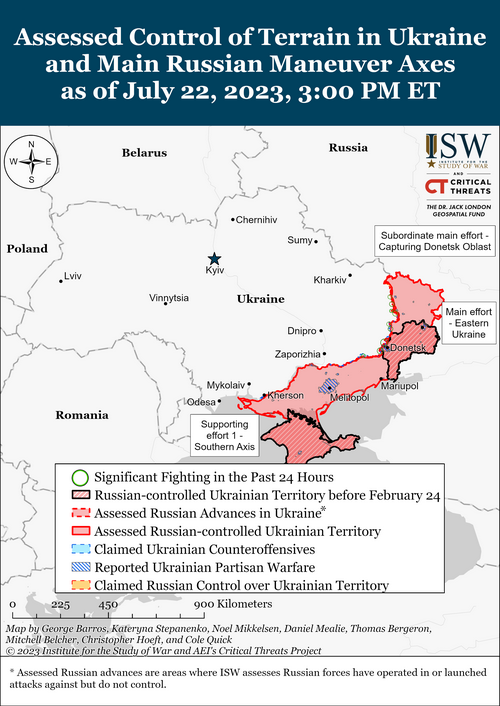
From The Institute For The Study of War:
Russian Offensive Campaign Assessment, July 23, 2023
George Barros, Nicole Wolkov, Grace Mappes, Riley Bailey, Thomas Bergeron, and Frederick W. Kagan
July 23, 2023, 7:15pm ET
Click here to see ISW’s interactive map of the Russian invasion of Ukraine. This map is updated daily alongside the static maps present in this report.
Click here to access ISW’s archive of interactive time-lapse maps of the Russian invasion of Ukraine. These maps complement the static control-of-terrain map that ISW produces daily by showing a dynamic frontline. ISW will update this time-lapse map archive monthly.
Note: The data cutoff for this product was 12:30pm ET on July 23. ISW will cover subsequent reports in the July 24 Russian Offensive Campaign Assessment.
Russian President Vladimir Putin revealed his continuing concern over the potential threats that the Wagner Group and Yevgeny Prigozhin may pose to him through symbolism and posturing during a meeting with Belarusian President Alexander Lukashenko in St. Petersburg, Russia. Putin made several significant symbolic gestures during his July 23 meeting with Lukashenko, suggesting that Putin sought to project power and confidence in his own supremacy over the Prigozhin-aligned St. Petersburg-based faction. Putin took Lukashenko to visit Kronstadt in St. Petersburg – the historically significant island fortress where Russian soldiers and sailors conducted a famous unsuccessful anti-Bolshevik insurrection in early 1921 that the Soviet government ultimately suppressed.[1] Putin and Lukashenko toured Kronstadt with St. Petersburg Governor Alexander Beglov and Russian Defense Minister Sergei Shoigu’s younger daughter Ksenia Shoigu.[2] Both Beglov and Shoigu are personal enemies of Prigozhin, and Putin‘s public meeting with Beglov, Shoigu‘s daughter, and Lukashenko on the historic grounds of the failed Kronstadt rebellion was almost certainly intended to signal Putin’s and his loyalist cadre‘s defeat of Prigozhin‘s armed rebellion and Prigozhin’s St. Petersburg-based supporters.[3] Putin also made an unusual effort to take photographs with crowds of local Russian citizens, including children, while at Kronstadt, likely to present himself as a popular and beloved leader among the Russian people.[4] These symbolic gestures indicate that Putin is concerned about his perceived popularity, the security of his regime, and the array of factions competing for power within the high echelons of Russian governance.
Lukashenko told Putin that the Wagner Group in Belarus will remain in central Belarus likely subtly reminding Putin of the threat the Wagner military organization still poses to him and underlining Lukashenko’s control over that power.[5] Lukashenko’s statements were likely meant to make Putin reflect on the uncomfortable (for Putin) fact that Wagner’s new garrison in Belarus puts its forces half as far from Moscow as Wagner’s previous base in southern Russia. The Wagner Group’s previous base in Krasnodar Krai was about 1,370 km from Moscow, whereas its new base in Belarus is about 720 km along an excellent military highway.
Putin and Lukashenko also amplified information operations targeting the West. The leaders amplified their false claims that Ukraine’s counteroffensive has failed.[6] Senior Western and Ukrainian leaders–and ISW–continue to assess that it is too early to evaluate Ukraine’s counteroffensive since Ukraine still has significant uncommitted prepared forces and retains the ability to launch decisive operations at times and places of its choosing.[7] Lukashenko and Putin also reiterated an information operation that the Wagner Group poses a threat to Poland.[8] There is no indication that Wagner fighters in Belarus have the heavy weaponry necessary to mount a serious offensive against Ukraine or Poland without significant rearmament, as it was a condition of the Putin-Lukashenko-Prigozhin deal ending the armed rebellion that Wagner surrender such weapons to the Russian Ministry of Defense (MoD). Maxar imagery of the main Wagner base in Tsel, Asipovichy, collected at an oblique angle on July 23 indicates that the vehicles currently parked in and around the vehicle storage area are primarily hundreds of cars, small trucks, and approximately 35 semi-trailers.[9] Wagner forces in Belarus pose no military threat to Poland or Ukraine, for that matter, until and unless they are re-equipped with mechanized equipment. They pose no meaningful threat to NATO even then.

Caption: Wagner Group Field camp in Tsel, Asipovichy, Belarus. Collected on July 23, 2023.
Credit: Satellite image ©2023 Maxar Technologies.

Caption: Wagner Group Field camp in Tsel, Asipovichy, Belarus. Collected on July 23, 2023.
Credit: Satellite image ©2023 Maxar Technologies.
US Secretary of State Antony Blinken told CNN on July 23 that Ukrainian forces have liberated approximately 50 percent of the territory that Russian forces captured since the start of Russia’s full-scale invasion in February 2022.[10] This figure is largely consistent with ISW’s current assessment of control of terrain. Analysts can employ several methods to calculate control of terrain with varying results depending on the cartographical projection used and other factors. An estimate using ISW’s control of terrain data and the Mercator projection indicates that Ukrainian forces liberated about 53 percent of the land that Russian forces captured since February 2022. Estimates made using different data sources, measurement methods, or projections will generate different numbers. Factors, such as higher confidence about unconfirmed Russian claimed territorial gains, can impact such estimations as well. ISW appreciates and closely studies government officials’ statements about control of terrain geometry to cross-reference, confirm, and where necessary correct assessments.
Ukrainian forces continued counteroffensive operations on at least three sectors of the front line and advanced on July 23. Geolocated footage published on July 22 shows that Ukrainian forces made some advances in the western Donetsk-eastern Zaporizhia Oblast border area near Staromayorske (9km south of Velyka Novosilka), and some Russian sources claimed that Ukrainian forces also advanced near Pryyutne (14km southwest of Velyka Novosilka).[11] Geolocated footage published on July 22 also shows that Ukrainian forces made marginal advances in western Zaporizhia Oblast near Kamianske, and Russian sources claimed that Ukrainian forces conducted additional ground attacks south of Orikhiv near Robotyne (12km south).[12] The Ukrainian General Staff reported continued Ukrainian counteroffensive operations in both areas of the front.[13] Some Russian and Ukrainian sources claimed that Ukrainian forces continued attacking on Bakhmut’s northern and southern flanks and reportedly made advances near Khromove (immediately west of Bakhmut).[14]
Russian forces conducted another series of missile strikes against port infrastructure and the city center in Odesa City overnight on July 22 to 23, severely damaging civilian areas. The Ukrainian General Staff reported that Russian forces launched 19 missiles, including five Onyx, five Iskander-K, four Kalibr, two Kh-22, and two Iskander-M missiles, and that Ukrainian forces shot down four Kalibr and five Iskander-K missiles.[15] Ukraine’s Southern Operational Command reported that Russian strikes hit the Odesa Transfiguration Cathedral, and Southern Operational Command Spokesperson Captain First Rank Nataliya Humenyuk stated that the city center strikes injured 19 civilians.[16] Ukrainian National Security and Defense Council Secretary Oleksiy Danilov stated that Russian strikes against Odesa City and Oblast intend to disrupt Ukraine’s access to the Black Sea and intimidate international partners working to restore the Black Sea Grain Initiative deal.[17] Ukrainian Main Military Intelligence Directorate (GUR) Spokesperson Vadym Skibitskyi warned that Russian forces are also evaluating Ukrainian energy infrastructure to identify critical infrastructure objects, presumably to target in future strikes.[18]
Further speculation about former Russian officer and ardent nationalist Igor Girkin’s arrest and the public posturing of Girkin’s affiliates suggests that a limited section of the pro-war community may have been contemplating political action in opposition to the Kremlin. Angry Patriots Club member and leader of the “Civil Solidarity” movement Georgy Fedorov claimed on July 22 that the Club developed a strategy and specific action plan for a campaign to defend Girkin and will be reaching out to grassroots supporters for help.[19] Fedorov also announced that the Angry Patriots Club will release a political statement sometime next week.[20] A Russian insider source claimed that Girkin planned to start formal legal procedures to create a political party in the spring of 2024.[21] The insider source claimed that Girkin had discussed with Angry Patriots members the possibility of holding a founding party congress in fall 2023 and plans to form regional branches for the Angry Patriots Club.[22] The Angry Patriots Club has opened a St Petersburg regional chapter and published a 17-point political resolution on June 26 that signaled its interest in participating in Russian politics.[23] The Angry Patriots Club’s political resolution explicitly states that it will use legal means to compel Russian leadership to ”end the policy of appeasement and behind-the-scenes agreement with the West” and declares its ”intention to claim political power.”[24] The Angry Patriots Club’s resolution indicates that this section of the pro-war community may have attempted to set conditions for future political actions opposing figures in the Kremlin whom the Angry Patriots Club believes seek to end the war. Girkin previously claimed that there is a faction within the Kremlin arguing in favor of freezing the front line in Ukraine and negotiating with the West, and the Angry Patriots appeared to be preparing to explicitly challenge this faction through a political project.[25] Factions within the Kremlin are likely aiming to maneuver for more influence against the backdrop of Russia’s 2024 presidential elections, and Girkin’s alleged plans to explicitly cast himself and his affiliates as political actors ahead of the elections likely threatened some of these factions.
Angry Patriots members likely view Girkin’s arrest as an existential threat to the segment of the ultranationalist community he represents and will likely intensify their campaign to cast Girkin as an opposition figure. Angry Patriots Club member Yevgeny Mikhailov continued to criticize the Kremlin, calling Girkin’s arrest a ”gross mistake” and highlighting the double standards that Russian authorities use for prominent Russian officials who have criticized Russian forces’ conduct in the war in Ukraine.[26] Mikhailov noted the hypocrisy of arresting a ”Russian patriot” who he claimed ”led the Donetsk and Luhansk People’s Republics to victory in 2014” while allowing Russian State Duma Deputy Sergei Morozov to go unpunished for saying that officers who sent mobilized personnel into combat without preparation “should be shot themselves.”[27] Another Angry Patriots member, Vladimir Grubnik, expressed his loyalty to Girkin claiming that he joined at Girkin’s invitation and would leave the organization if Girkin chose to leave.[28] Grubnik claimed that 95 percent of the people joined the Angry Patriots Club because of Girkin’s personality and reputation.[29] The continued support for Girkin despite his arrest suggests that Girkin established a strong personal loyalty among his affiliates reminiscent of other ultranationalist figures, particularly Prigozhin’s support among Wagner personnel and affiliated milbloggers.[30]
The Kremlin may be attempting to censor an isolated segment of the Russian ultranationalist community that is consistently vocally hostile to the Kremlin. Russian news outlet Kommersant reported on July 21 that Russian law enforcement is investigating Angry Patriots Club Chair Pavel Gubarev for extremism because of his Telegram posts.[31] Milbloggers outside of Girkin’s relatively isolated Angry Patriots Club have notably not commented on Girkin’s arrest, suggesting a fragmentation in the Russian ultranationalist community along factional affiliations and ideological differences on Russia’s approach to the war in Ukraine. Continued Russian law enforcement censorship of Angry Patriots members likely indicates that the Kremlin does not intend to censor the wider ultranationalist community at this time and is likely isolating this round of censorship primarily to the Angry Patriots movement and their affiliates.
The head of one of the largest suppliers of surveillance equipment to Russian special services died on July 22. Russian law enforcement found “IKS Holding” Head Anton Cherepennikov dead in his office on July 22 and later claimed that Cherepennikov suffocated during a xenon gas therapy session.[32] IKS Holding owns the developer of the YADRO data storage system, which Russian authorities reportedly use in efforts to monitor Russian internet users, and the Citadel Group, which produces operational-search measures that Russian special services use to listen to phone calls and monitor internet activities.[33]
Key Takeaways:
- Russian President Vladimir Putin revealed his continuing concern over the potential threats that the Wagner Group and Yevgeny Prigozhin may pose to him through symbolism and posturing during a meeting with Belarusian President Alexander Lukashenko in St. Petersburg, Russia.
- Lukashenko told Putin that the Wagner Group in Belarus will remain in central Belarus likely subtly reminding Putin of the threat the Wagner military organization still poses to him and underlining Lukashenko’s control over that power.
- Putin and Lukashenko also amplified information operations targeting the West.
- US Secretary of State Antony Blinken told CNN on July 23 that Ukrainian forces have liberated approximately 50 percent of the territory that Russian forces captured since the start of Russia’s full-scale invasion in February 2022.
- Ukrainian forces continued counteroffensive operations on at least three sectors of the front line and advanced on July 23.
- Russian forces conducted another series of missile strikes against port infrastructure and the city center in Odesa City overnight on July 22 to 23, severely damaging civilian areas.
- Further speculation about former Russian officer and ardent nationalist Igor Girkin’s arrest and the public posturing of Girkin’s affiliates suggests that a limited section of the pro-war community may have been contemplating political action in opposition to the Kremlin.
- Angry Patriots members likely view Girkin’s arrest as an existential threat to the segment of the ultranationalist community he represents and will likely intensify their campaign to cast Girkin as an opposition figure.
- The Kremlin may be attempting to censor an isolated segment of the Russian ultranationalist community that is consistently vocally hostile to the Kremlin.
- The head of one of the largest suppliers of surveillance equipment to Russian special services died on July 22.
- Russian forces continued offensive operations along the Svatove-Kreminna line and reportedly made tactically significant gains.
- Ukrainian forces continued counteroffensive operations along the Svatove-Kreminna line and in the Bakhmut area, and reportedly made gains near Bakhmut.
- Russian forces continued offensive operations in the Bakhmut and Avdiivka-Donetsk City areas but did not advance.
- Ukrainian forces continued offensive operations in the western Donetsk-eastern Zaporizhia oblasts border area and in western Zaporizhia Oblast and advanced.
- Russian forces conducted limited ground attacks in the western Donetsk-eastern Zaporizhia oblasts border area.
- The Russian Ministry of Defense (MoD) continues to recruit prisoners to fight in Ukraine.
- Russian occupation authorities are bringing foreign citizens to occupied Ukraine to artificially alter demographics.
Go here to read the rest. Interesting game of chess going on between Putin and the strong man of Belarus, President Alexander Lukashenko, with the Wagner forces being Lukashenko’s Knights. Wheels with wheels is always an accurate phrase for anything involving Russia.

