
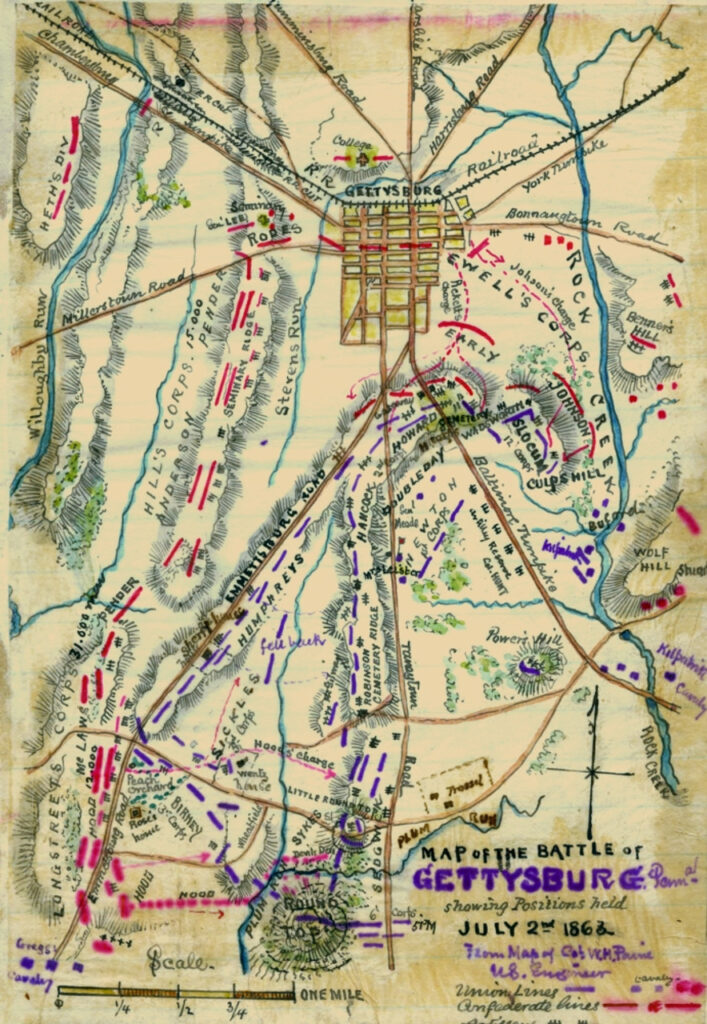
On the second day of Gettysburg, July 2, 1863 the battle became unstuck for General Lee. If all the attacks had been properly coordinated and launched at the same time, it is quite possible that Lee’s plan of attack would have succeeded. Instead the attacks went in piecemeal, giving the wavering Union forces opportunities throughout the day to shift troops to threatened areas and to rest troops that had been engaged. It was the worst performance by the Army of Northern Virginia since its early days during the Seven Days battles in 1862. Here is Lee’s report of the second day:
It was ascertained from the prisoners that we had been engaged with two corps of the army formerly commanded by General Hooker, and that the remainder of that army, under General Meade, was approaching Gettysburg. Without information as to its proximity, the strong position which the enemy had assumed could not be attacked without danger of exposing the four divisions present, already weakened and exhausted by a long and bloody struggle, to overwhelming numbers of fresh troops. General Ewell was, therefore, instructed to carry the hill occupied by the enemy, if he found it practicable, but to avoid a general engagement until the arrival of the other divisions of the army, which were ordered to hasten forward. He decided to await Johnson’s division, which had marched from Carlisle by the road west of the mountains to guard the trains of his corps, and consequently did not reach Gettysburg until a late hour.
In the meantime the enemy occupied the point which General Ewell designed to seize, but in what force could not be ascertained, owing to the darkness. An intercepted dispatch showed that another corps had halted that afternoon 4 miles form Gettysburg. Under these circumstances, it was decided not to attack until the arrival of Longstreet, two of whose divisions (those of Hood and McLaws) encamped about 4 miles in the rear during the night. Anderson’s division of Hill’s corps came up after the engagement.
It had not been intended to deliver a general battle so far from our base unless attacked, but coming unexpectedly upon the whole Federal Army, to withdraw through the mountains with our extensive trains would have been difficult and dangerous. At the same time we were unable to await an attack, as the country was unfavorable for collecting supplies in the presence of the enemy, who could restrain our foraging parties by holding the mountain passes with local and other troops. A battle had, therefore, become in a measure unavoidable, and the success already gained gave hope of a favorable issue.
The enemy occupied a strong position, with his right upon two commanding elevations adjacent to each other, one southeast and the other, known as Cemetery Hill, immediately south of the town, which lay at its base. His line extended thence upon the high g round along the Emmitsburg road with a steep ridge in rear, which was also occupied. This ridge was difficult of ascent, particularly the two hills above mentioned as forming its northern extremity, and a third at the other end, on which the enemy’s left rested. Numerous stone and rail fences along the slope served to afford protection to his troops and impede our advance. In his front, the ground was undulating and generally open for about three-quarters of a mile.
General Ewell’s corps constituted our left. Johnson’s division being opposite the height adjoining Cemetery Hill, Early’s in the center, in front of the north face of the latter, and Rodes upon his right. Hill’s corps faced the west side of Cemetery Hill, and extended nearly parallel to the Emmitsburg road, making an angle with Ewell’s Pender’s division formed his left, Ander’s his right. Heth’s, under Brigadier-General Pettigrew, being in reserve. His artillery, under Colonel [R. L.] Walker, was posted in eligible positions along his line.
It was determined to make the principal attack on the enemy’s left, and endeavor to gain a position from which it was thought that our artillery could be brought to bear with effect. Longstreet was directed to place the divisions of McLaws and Hood on the right of Hill, partially enveloping the enemy’s left, which he was to drive in.
General Hill was ordered to threaten the enemy’s center, to prevent re-enforcements being drawn to either wing, and co-operate with his right division in Longstreet’s attack.
General Ewell was instructed to make a simultaneous demonstration upon the enemy’s right, to be converted into a real attack should opportunity offer.
About 4 p.m. Longstreet’s batteries opened, and soon afterward Hood’s division, on the extreme right, moved to the attack. McLaws followed somewhat later, four of Anderson’s brigades, those of Wilcox, Perry, [A.R.] Wright, and Posey supporting him on the left in the order named. The enemy was soon driven from his position on the Emmitsburg road to the cover of a ravine and a line of stone fences at the foot of the ridge in his rear. he was dislodged from those after a severe struggle, and retired up the ridge, leaving a number of his batteries in our possession. Wilcox’s and Wright’s brigades advanced with great gallantry, breaking successive lines of the enemy’s infantry, and compelling him to abandon much of his artillery. Wilcox reached the foot and Wright gained the crest of the ridge itself, driving the enemy down the opposite side: but having become separated from McLaws and gone beyond the other two brigades of the division, they were attacked in front and on both flanks, and compelled to retire being unable to bring off any of the captured artillery. McLaws’ left also fell back and, it being now nearly dark, General Longstreet determined to await the arrival of General Pickett. He disposed his command to hold the ground gained on the right, withdrawing his left to the first position from which the enemy had been driven.
Four pieces of artillery, several hundred prisoners, and two regimental flags were taken. As soon as the engagement began on our right, General Johnson opened with his artillery, and about two hours later advanced up the hill next to Cemetery Hill with three brigades, the fourth being detained by a demonstration on his left. Soon afterward, General Early attacked Cemetery Hill with two brigades, supported by a third, the fourth having been previously detached. The enemy had greatly increased by earthworks the strength of the positions assailed by Johnson and Early.
The troops of the former moved steadily up the steep and rugged ascent, under a heavy fire, driving the enemy into his entrenchment’s, part of which was carried by Stuart’s brigade, and a number of prisoners taken. The contest was continued to a late hour, but without further advantage. On Cemetery Hill, the attack by Early’s leading brigades — those of Hays and Hoke under Colonel [I.E.] Avery — was made with vigor. Two lines of the enemy’s infantry were dislodged from the cover of some stone and board fences on the side of the ascent, and driven back into the works on the crest, into which our troops forced their way, and seized several pieces of artillery.
A heavy force advanced against their right which was without support, and they were compelled to retire bringing with them about 100 prisoners and four stand of colors. General Ewell had directed General Rodes to attack in concert with Early, covering his right and had requested Brigadier-General Lane, then commanding Pender’s division, to co-operate on the right of Rodes. When the time to attack arrived, General Rodes, not having his troops in position, was unprepared to co-operate with General Early, and before he could get in readiness the latter had been obliged to retire for want of the expected support on his right. General Lane was prepared to give the assistance required of him, and so informed General Rodes, but the latter deemed it useless to advance afte the failure of Early’s attack.
In this engagement our loss in men and officers was large. Major-Generals Hood, and Pender, Brigadier-Generals [J.M.] Jones, Semmes, G.T. Anderson, and Barksdale, and Colonel Avery, commanding Hoke’s brigade, were wounded, the last two mortally. Generals Pender and Semmes died after their removal to Virginia.
The result of this day’s operations induced the belief that, with proper concert of action, and with the increased support that the positions gained on the right would enable the artillery to render the assaulting columns, we should ultimately succeed, and it was accordingly determined to continue the attack. The general plan was unchanged. Longstreet, re-enforced by Pickett’s three brigades, which arrived near the battle-field during the afternoon of the 2d, was ordered to attack the next morning, and General Ewell was directed to assail the enemy’s right at the same time. The latter, during the night, re- enforced General Johnson with two brigades from Rodes’ and one from Early ‘s division.


Ah, those interior lines….Something even Sickles couldn’t screw up.
Slight afterthought. In my opinion this day was the pivotal one, Lee was the general of maneuver. When the maneuvers failed on this day he then made the questionable decision to send his army into Fredericksburg like meat grinder. But that’s lost to history since everyone talks about Pickett’s charge. Something like the fact that the colonies actually declared independence by vote on July 2, not July 4. With New York abstaining incidentally. Some things never change. Happy Birthday Dad who is the guy that pointed this out to me because he was happy to be born on the real Independence Day.
Mr. McClarey, have you been to Gettysburg or Antietam? Just curious.
No. I hope to do so in my retirement.
Don- the annual reenactment that occurs on or about July 4 is like history-nerd Woodstock (with better sanitation). I recommend it highly. The fun of watching competing reenactor mortar batteries is just so cool.
The feds don’t let them do these things in the park itself, but it is still entirely worthwhile.
Sounds like a hoot BO!
Also Grant’s victory at Vicksburg. Split the South and had a different but equally negative effect as Gettysburg.