
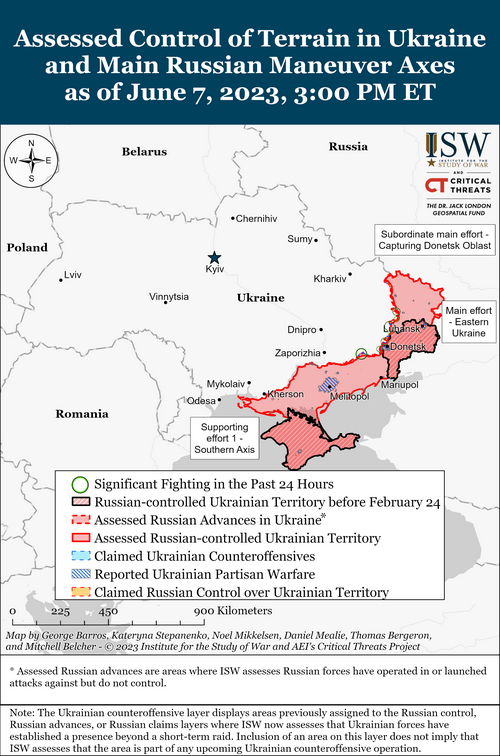
From The Institute For The Study of War:
Russian Offensive Campaign Assessment, June 7, 2023
Kateryna Stepanenko, Karolina Hird, Grace Mappes, Nicole Wolkov, George Barros, and Fredrick W. Kagan
June 7, 2023, 8:45 pm ET
Click here to see ISW’s interactive map of the Russian invasion of Ukraine. This map is updated daily alongside the static maps present in this report.
Click here to access ISW’s archive of interactive time-lapse maps of the Russian invasion of Ukraine. These maps complement the static control-of-terrain map that ISW produces daily by showing a dynamic frontline. ISW will update this time-lapse map archive monthly.
Note: The data cutoff for this product was 3pm ET on June 7. ISW will cover subsequent reports in the June 8 Russian Offensive Campaign Assessment.
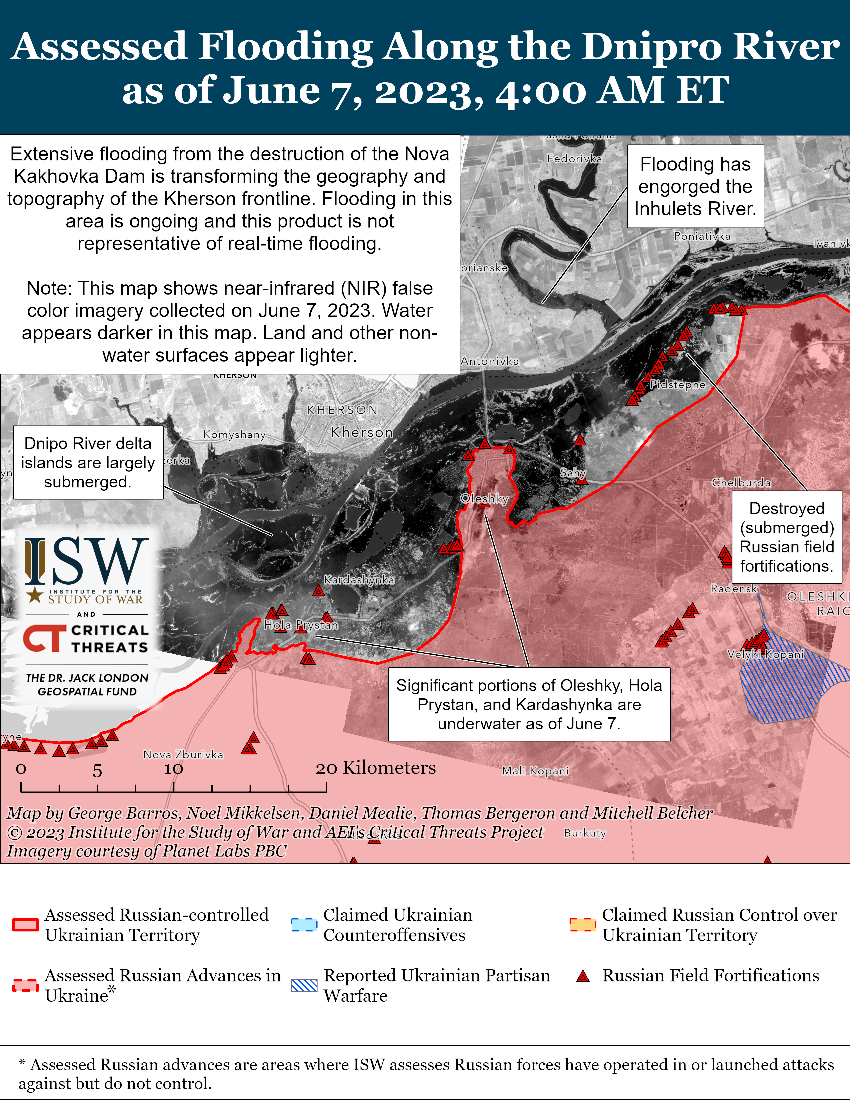
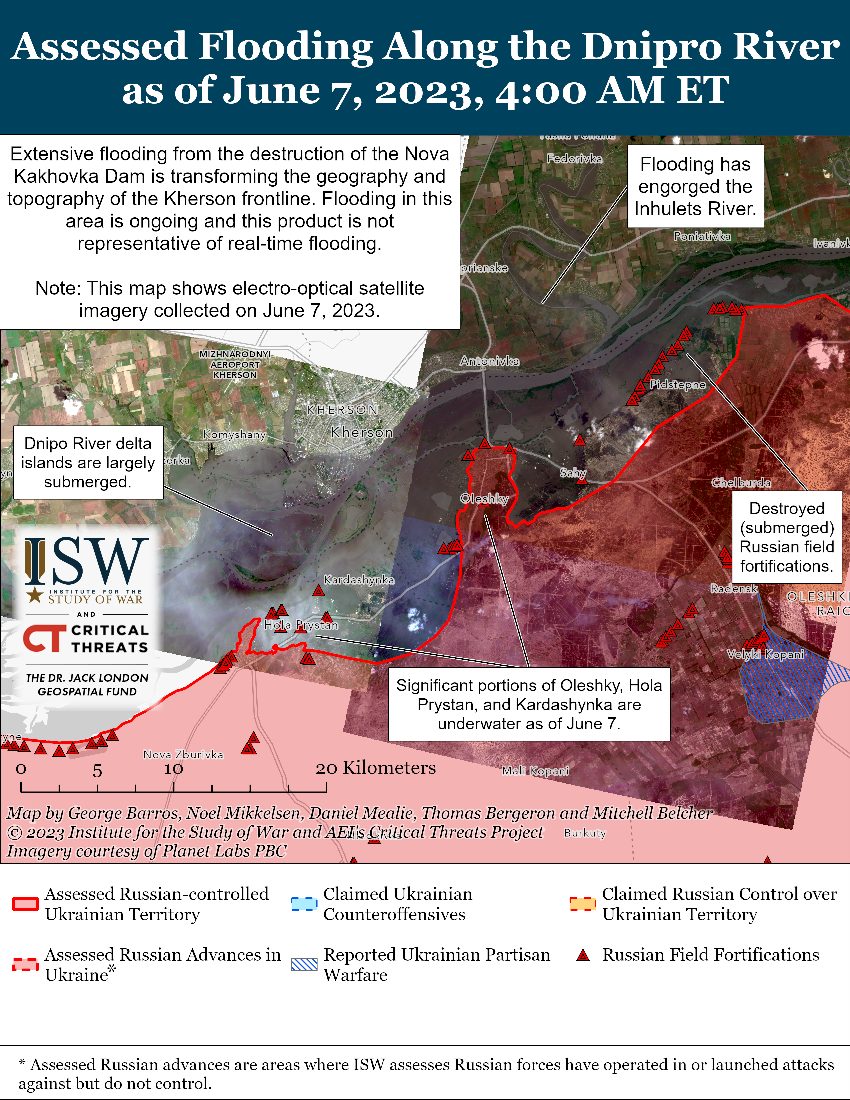
The destruction of the Kakhovka Hydroelectric Power Plant (KHPP) dam is significantly changing the geography and topography of the Kherson frontline sector in southern Ukraine. Near-infrared (NIR) imagery captured at 0400 am ET on June 7 indicates that the flooding is heavily disrupting Russian prepared defensive positions on the east (left) bank of the Dnipro River – especially affecting Russian first-line positions in Hola Prystan and Oleshky. Various sources reported that Oleshky, Hola Prystan, Kozacha Laheri, and Dnipryany are almost entirely flooded with water levels rising to the height of a one-story buildings in some areas.[1] The Ukrainian headquarters established to remediate the consequences of the dam’s destruction reported that as of June 7 29 settlements are partially or fully flooded, 19 of which are located on the Ukrainian-controlled territory and 10 on Russian occupied territories.[2] Russian sources published footage indicating that water had begun receding in Nova Kakhovka and had dropped by 30cm.[3] Russian sources also claimed that water levels decreased by three to four meters in some areas from a high of 10 meters.[4] Water levels in nearby Mykolaiv City reportedly increased by 70cm as of June 7.[5] Flooding will likely worsen and further change the geography in Kherson Oblast over the next 72 hours.
The destruction of the KHPP dam is affecting Russian military positions on the eastern bank of the Dnipro River. The flooding has destroyed many Russian first line field fortifications that the Russian military intended to use to defend against Ukrainian attacks. Rapid flooding has likely forced Russian personnel and military equipment in Russian main concentration points in Oleshky and Hola Prystan to withdraw. Russian forces had previously used these positions to shell Kherson City and other settlements on the west (right bank) of Kherson. Ukrainian Southern Operational Command Spokesperson Nataliya Humenyuk stated that Russian forces relocated their personnel and military equipment from five to 15 kilometers from the flood zone, which places Russian forces out of artillery range of some settlements on the west (right bank) of the Dnipro River they had been attacking.[6] The flood also destroyed Russian minefields along the coast, with footage showing mines exploding in the flood water.[7] Kherson Oblast Occupation Head Vladimir Saldo, however, claimed that the destruction of the KHPP is beneficial to the Russian defenses because it will complicate Ukrainian advances across the river.[8] Saldo’s assessment of the situation ignores the loss of Russia’s first line of prepared fortifications. The amount of Russian heavy equipment lost in the first 24 hours of flooding is also unclear.
Ukrainian officials continued to accuse Russian forces of destroying the KHPP dam out of fear that Ukrainian forces would land on the east (left) bank Kherson Oblast. Representative of the Ukrainian Main Military Intelligence Directorate (GUR) Andriy Yusov stated that only Russian forces could have detonated the dam given its structural and engineering features and noted that Russians are “very happy that the islands, on which [Ukrainian forces] were allegedly based, were flooded.”[9] Humenyuk states that Russian forces did not consider the consequences before destroying the dam and were too concerned over a Ukrainian counteroffensive.[10] The Ukrainian General Staff similarly claimed that Russian forces detonated internal structures of the KHPP to damage the dam and thereby prevent the advance of Ukrainian forces.[11] Russian milbloggers had expressed concern about claimed Ukrainian river crossings onto the east bank the day before the destruction of the KHPP dam and on numerous occasions in the past. A Kremlin-affiliated milblogger claimed that there were active engagements between Ukrainian and Russian forces in the Dachi area on the east bank of the Dnipro River (11km southwest of Kherson City) and on the contested islands near Kherson City as of June 5.[12] The milblogger claimed that the number of Ukrainian speedboats also increased in the Dnipro Delta as of June 5. Another milblogger speculated that Ukrainian forces were attempting to establish a bridgehead by seizing the KHPP dam.[13] ISW offers no assessment of whether the Ukrainians were attempting to cross the river or for what purpose they might have sought to do so. The clear concern in the Russian military information space, however, shows that the fear of such a crossing and belief that it was either underway or imminent was present in the minds of Russians closely following the war shortly before the dam was destroyed.
The New York Times (NYT) reported that engineering and munitions experts believe that a deliberate explosion was the likely cause of KHPP dam’s collapse on June 6.[14] NYT reported that a blast within an enclosed space would cause the most damage, whereas external detonations – such as by targeted missile or artillery strikes – would only exert a fraction of the force necessary to breach the dam. The NYT quoted the experts as acknowledging that the KHPP sustained damage from military operations prior to the collapse but questioning whether this prior damage alone was sufficient to collapse the dam. NYT reported that the dam was first breached in its middle, close to the KHPP on the Russian-held east (left) riverbank, and that more of the dam collapsed throughout the day, a pattern that one expert characterized as inconsistent with the dam failing due to prior damage.
Russian forces and occupation authorities are responding to the flooding in Kherson Oblast with a great degree of disorganization and thereby exacerbating harm to the civilian population of occupied areas. Kherson Oblast Occupation Head Vladimir Saldo claimed that Russian authorities have evacuated about 1,500 people from flooded areas and established 48 temporary accommodations in occupied Zaporizhia Oblast to house them.[15] Saldo also claimed that the Kherson Occupation Administration is “almost mandatorily” sending children living in flooded areas to “recreation camps” located deeper in Russian-occupied Kherson Oblast and in occupied Crimea.[16] Saldo‘s reports of proactive efforts on the part of occupation authorities do not cohere with reports by Ukrainian officials and anecdotal evidence from the occupied east (left) bank of Kherson Oblast, however. The Ukrainian General Staff reported that Russian military personnel near Kozachi Laheri (30km southwest of the KHPP on the Russian-occupied east bank of the Dnipro River) purposefully prevented civilian populations from fleeing the area despite flooding.[17] Ukrainian Kherson Oblast Administration Advisor Serhiy Khlan stated that residents of east bank settlements are waiting on their roofs with no food or water for the occupation administration to provide aid and evacuate them, while Russian soldiers abandoned their positions and fled.[18] Russian opposition outlet Verstka reported that civilians in Russian-occupied Oleshky (53km southwest of KHPP) have waited for almost two days on roofs for volunteers and Russian Ministry of Emergency Situations employees to arrive after which they helped civilians evacuate to dry areas of Oleshky, but that Russian forces did not permit civilians to evacuate outside of Oleshky.[19] Russian forces’ and occupation authorities’ varied responses and slow reaction time indicate that they were unprepared to deal with civilian evacuations.
Civilian accounts about the lack of evacuations in Belgorod Oblast in response to the pro-Ukrainian all-Russian Russian Volunteer Corps (RDK) and Freedom of Russian Legion‘s (LSR) raids suggest a similar pattern of Russian authorities struggling to coordinate evacuations even on their own territory.[20]
Select Wagner Group-affiliated Russian senior military officers continue to posture as effective commanders to appeal to Russian President Vladimir Putin by capitalizing on high-profile military events. A Russian milblogger published a long interview with Russian Colonel “K. Zalessky” in which Zalessky claimed that Russian Airborne Forces (VDV) Commander Colonel General Mikhail Teplinsky played a decisive role in Russian forces’ ability to defend against the ongoing Ukrainian localized counterattacks near Velyka Novosilka, Donetsk Oblast.[21] Zalessky confirmed prior claims that Teplinsky became an overall theater deputy commander responsible for southern Ukraine as of April 1 and praised Teplinsky for being intimately involved in Russian defensive preparations west of Vuhledar and throughout the south.[22] The interview notably portrays the Russian defense against these localized Ukrainian attacks as a significant undertaking, contrasting with some Russian milblogger claims that these Ukrainian operations constitute a reconnaissance-in-force and were not part of a main counteroffensive effort.[23]
The pro-Teplinsky interview is likely part of an information operation aimed at undermining the Russian Ministry of Defense (MoD). Zalessky claimed that Teplinsky praised the commanders of the 5th Combined Arms Army and 36th Combined Arms Army (both of the Eastern Military District) for their defensive efforts in the Velyka Novosilka area but claimed that not all of the Russian military command displayed similar bravery.[24] Zalessky claimed that Teplinsky personally arrayed Russian formations across their defensive lines, inspected battalions, and trained personnel, echoing Wagner Group financier Yevgeny Prigozhin’s June 6 criticisms that MoD officials need to visit the front lines.[25] The interview was published almost immediately after the MoD claimed that Chief of the Russian General Staff Army General Valery Gerasimov took command of Russian operations in the south on June 5, and after Russian Defense Minister Sergei Shoigu characterized the defense as an MoD success on June 6.[26] Shoigu notably also praised elements of the 5th and 36th Combined Arms armies but failed to visit them on the frontlines as Teplinsky reportedly did.[27] Teplinsky notably had to use a Russian milblogger to claim credit for repelling claimed Ukrainian attacks in eastern Zaporizhia and western Donetsk oblasts. The MoD has previously blocked Wagner-affiliated commanders from being featured on official platforms.[28] It is noteworthy that Russian commanders and senior military leaders appear to prioritize public posing in the midst of ongoing significant military operations and major catastrophes.
Wagner-affiliated commanders’ reactive public relations campaigns may not be sufficient to deflect from battlefield realities. Though some large milbloggers amplified the Teplinsky interview on June 7, the broader Russian information space remained saturated with tactical claims of Ukrainian counterattacks near Velyka Novosilka and with the Kakhovka Hydroelectric Power Plant (KHPP) dam disaster.[29]
Key Takeaways
- The destruction of the Kakhovka Hydroelectric Power Plant (KHPP) dam is significantly changing the geography and topography of the Kherson frontline sector in southern Ukraine.
- Ukrainian officials continued to accuse Russian forces of destroying the KHPP dam out of fear that Ukrainian forces would land on the east (left) bank Kherson Oblast.
- The New York Times (NYT) reported that engineering and munitions experts believe that a deliberate explosion was the likely cause of KHPP dam’s collapse on June 6.
- Russian forces and occupation authorities are responding to the flooding in Kherson Oblast with a great degree of disorganization and thereby exacerbating harm to the civilian population of occupied areas.
- Select Wagner Group-affiliated Russian senior military officers continue to posture as effective commanders to appeal to Russian President Vladimir Putin by capitalizing on high-profile military events.
- The pro-Teplinsky interview is likely part of an information operation aimed at undermining the Russian Ministry of Defense (MoD).
- Wagner-affiliated commanders’ reactive public relations campaigns may not be sufficient to deflect from battlefield realities.
- Russian and Ukrainian officials each accused the other state of damaging an ammonia pipeline that runs through Kharkiv Oblast and causing an ammonia leak.
- Russian forces continued to conduct ground attacks around Kreminna.
- Ukrainian officials indicated that Ukrainian forces are conducting offensive operations in the Bakhmut direction as of June 7.
- Russian forces continued limited ground attacks along the Avdiivka-Donetsk City line.
- Russian sources continued to claim that Ukrainian forces conducted ground attacks on the administrative border between Donetsk and Zaporizhia oblasts on June 7.
- Russian and Ukrainian forces reportedly engaged in skirmishes in western Zaporizhia Oblast.
- Russian authorities continue to restrict international travel for those eligible for military service.
- Russian officials and occupation authorities continue to establish patronage programs between Russian regions and occupied territories in order to integrate occupied territories into Russia.
Go here to read the rest. The destruction of the dam has entered a powerful black swan event into the war. We will see how this plays out.


For what it’s worth, Yevgeni Prigozhin reported on the Russian Telegram app that the Ukrainian counteroffensive has begun, and Ukrainian forces are pushing along a 600-mile front from north of Izium to the Crimea, with advances to the north and south of Bakhmut and also in the area of Zaporizhia. He says the Russian army is breaking unless he receives “200,000 troops” under his Wagner command, a disaster will soon befall the Russian Army, which he says is beset by incompetent leadership, and a disconnect of communication between the Russian high command and the front.
Most interesting, Steve P. Thanks.