
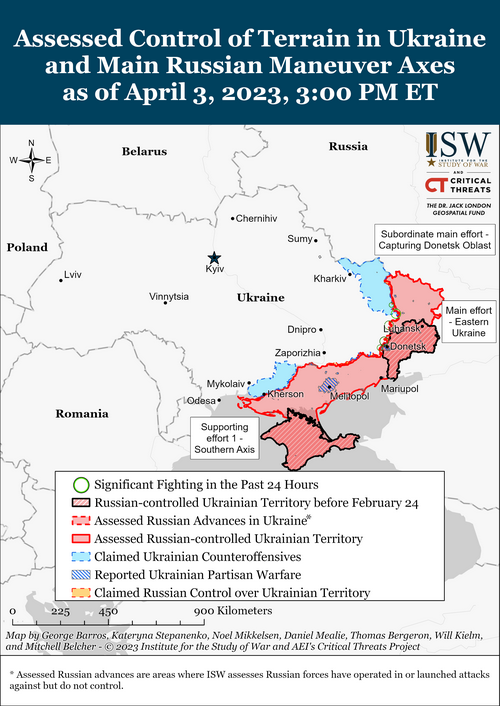
From The Institute For The Study of War:
Russian Offensive Campaign Assessment, April 3, 2023
Karolina Hird, Grace Mappes, Nicole Wolkov, Layne Philipson, and Mason Clark
April 3, 8:30pm ET
Click here to see ISW’s interactive map of the Russian invasion of Ukraine. This map is updated daily alongside the static maps present in this report.
Click here to access ISW’s archive of interactive time-lapse maps of the Russian invasion of Ukraine. These maps complement the static control-of-terrain maps that ISW produces daily by showing a dynamic frontline. ISW will update this time-lapse map archive monthly.
Wagner Group fighters made further advances in central Bakhmut and seized the Bakhmut City Administration Building on the night of April 2. Wagner Group financier Yevgeny Prigozhin raised a Russian flag with an inscription in memory of assassinated milblogger Maksim Fomin across from the Bakhmut City Administration building the night of April 2 and claimed that Wagner “legally controls” Bakhmut, though Ukrainian troops remain in the western part of the city.[1] Russian forces made further advances on April 3, with drone footage posted on April 3 depicting Wagner Group and Russian flags planted over the rubble of the destroyed administration building.[2] Several Russian milbloggers additionally circulated an image of a Wagner fighter standing in front of the Bakhmut City Administration building before its destruction.[3] The Wagner Group likely will continue attempts to consolidate control of central Bakhmut and attempt to push westward through dense urban areas toward Khromove.
Russian authorities are blaming Ukrainian government entities and Russian opposition figure Alexei Navalny for the April 2 assassination of Russian milblogger Maksim Fomin, also known as Vladlen Tartarsky. The Russian National Anti-Terrorism Committee claimed that Ukrainian special services collaborated with the Anti-Corruption Fund, which Navalny founded in 2011, to plan the attack against Fomin.[4] Kremlin Spokesperson Dmitry Peskov claimed that the Ukrainian government may be behind Fomin’s death and claimed that Ukraine has killed others since 2014, such as Daria Dugina, which Peskov spuriously used as justification for the “special military operation.”[5] The Russian Investigative Committee reclassified the case as a terrorist attack and claimed that it was planned in Ukrainian territory.[6] The Russian Ministry of Internal Affairs (MVD) confirmed that the sculpture handed to Fomin prior to his death contained hidden explosives.[7] The Russian Investigative Committee confirmed on April 3 that Russian authorities detained Daria Trepova in a St. Petersburg apartment on suspicion of the attack.[8] Authorities released an excerpt of their interrogation of Trepova, in which Trepova stated that authorities questioned her about giving a sculpture to Fomin, but she did not answer on camera whether she knew the sculpture contained explosives.[9] The range of various official responses is notably disjointed, with a lack of consensus among official Russian sources regarding Trepova’s involvement or association with either Ukrainian special services or Navalny’s Anti-Corruption Fund.
Official Russian responses to Fomin’s death failed to generate a single narrative in the information space and led to disjointed responses from prominent pro-war voices. Several prominent milbloggers and news aggregators fixated on the reported investigation into Daria Trepova and analyzing footage of the lead-up to and aftermath of the explosion.[10] Other milbloggers claimed that the attack was carried out by Ukrainian special services and amplified news of the investigation without offering additional commentary into the situation.[11] The Donetsk People’s Republic (DNR) People’s Militia posted a simple message mourning Fomin without engaging with the Kremlin’s informational response.[12] Zaporizhia Oblast occupation deputy Vladimir Rogov claimed that unspecified attackers targeted Fomin because he listened to both the Russian and Ukrainian perspectives, had over 500,000 Telegram subscribers, and effectively organized donation drives for Russian forces.[13] Russian Orthodox Church head Patriarch Kirill connected Fomin’s murder to the ongoing conflict over the Kyiv Pechersk Lavra, despite no obvious connection between the two incidents.[14]
As Russian officials try to galvanize an official narrative around the National Anti-Terrorism Committee’s investigation, Russian milbloggers will likely increasingly criticize the results and conclusions of the investigation, and Fomin’s death is likely to become a major point of information space neuralgia. One Russian milblogger and political analyst overtly criticized the official Russian response to Fomin’s death and noted that Russian officials have likely predetermined the final findings of the investigation.[15] The absence of a coherent narrative in the pro-Russian information space is reminiscent of responses to Ukraine’s successful Kharkiv Oblast counteroffensive in fall 2022, when the Kremlin’s propaganda machine initially failed to define a rhetorical line to respond to massive Ukrainian gains and caused an information space breakdown that manifested in disjointed responses across the entire pro-war community.[16]
Russian security services reportedly continue to confiscate the passports of senior officials and state company executives to limit flight from Russia. Financial Times reported on April 2 that the Russian security services seek to prevent senior officials, ex-officials, and state company executives from traveling abroad, indicating that the Kremlin continues to fear elites will flee Russia.[17] Current Time TV and Radio Free Europe/Radio Liberty-associated investigative project “Sistema” reported on March 10 that Russian security officials told government officials and employees of state-owned companies to hand over their passports on threat of forcibly revoking an individual’s passports or forced resignation.[18]
Key Takeaways
- Wagner Group fighters made further advances in central Bakhmut and seized the Bakhmut City Administration Building on the night of April 2.
- Russian authorities are blaming Ukrainian government entities and Russian opposition figure Alexey Navalny for the assassination of Russian milblogger Maksim Fomin (also known as Vladlen Tartarsky).
- Official Russian responses to Fomin’s death failed to generate a single narrative in the information space and led to disjointed responses from prominent pro-war voices.
- Russian security services reportedly continue to confiscate passports of senior officials and state company executives in an effort to limit flight from Russia.
- Russian forces conducted limited ground attacks along the Svatove-Kreminna line.
- Russian sources reported on April 3 that Russian Airborne Forces (VDV) units received TOS-1A thermobaric artillery systems for the first time.
- Russian forces continued ground attacks in and around Bakhmut, Avdiivka, Donetsk City, and in western Donetsk Oblast.
- Russian officials likely remain concerned about a potential Ukrainian threat to Crimea amid continued fortification and logistical efforts.
- Russian President Vladimir Putin signed a decree establishing a state fund to support military personnel who participate in the war in Ukraine and their families.
- Likely Ukrainian partisans used an improvised explosive device (IED) to target a former Russian occupation official in Melitopol, Zaporizhia Oblast.
Go here to read the rest. With the admission of Finland to NATO, the Russians have another NATO member on their border. The further expansion of NATO may be the main result of Putin’s Ukrainian adventure.

